Articles

  • Article 1 in this issue

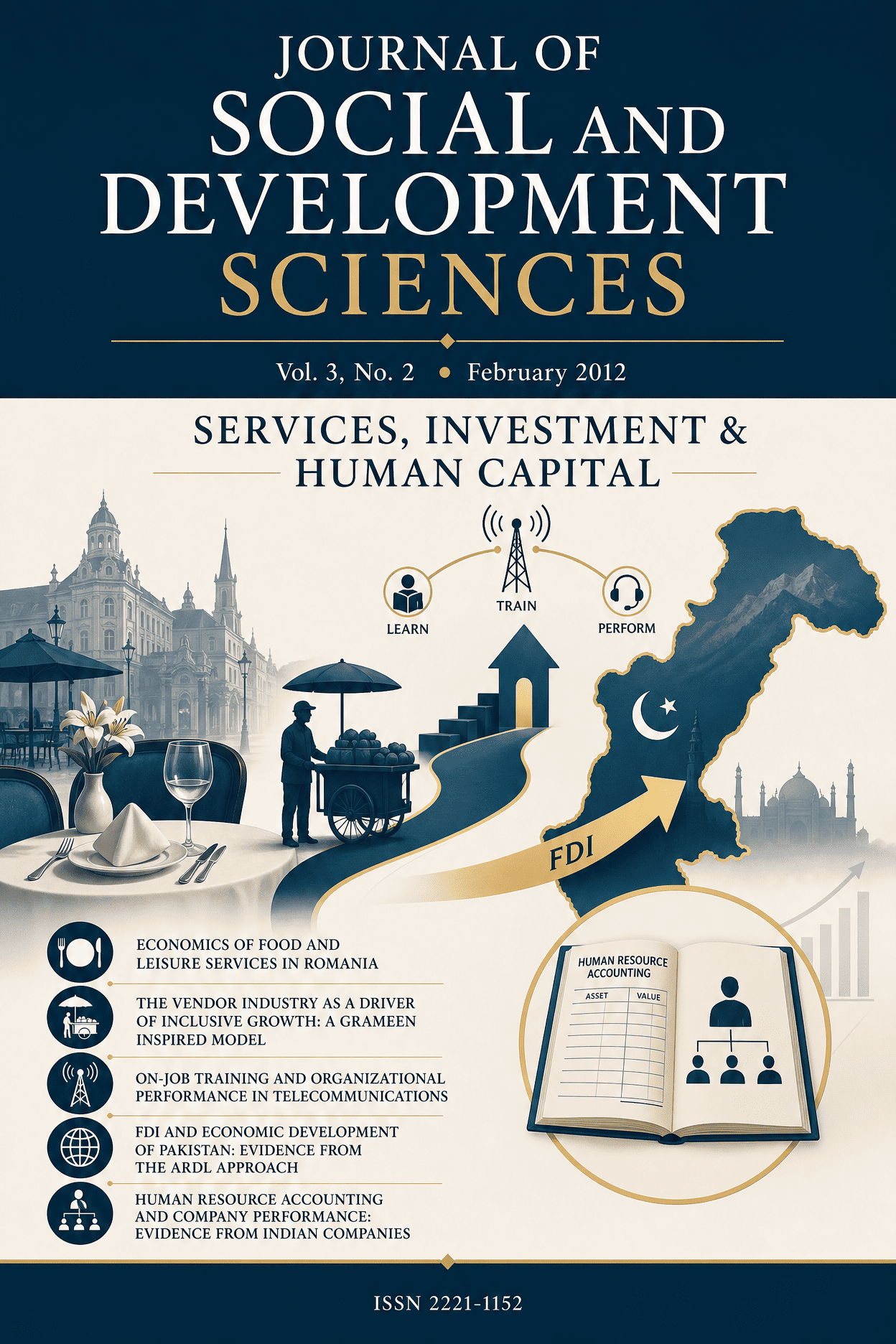
    Economics Of Food And Leisure Services

    • Author: Alexandru Trifu, Moise Cîndea

    Important in this paperwork is to underline the significance and the role of one of the economic niche domain, that is food and leisure . We think that this name, evoqued in the title, is more appropriate, than catering, to design the economic process of providing, transformation (even production) and consumption of food, especially within firms, corporations, in the benefit of theirs employees. Therefore, we’ve analyzed some theoretical and practical aspects of this kind of Economics. Because, it’s indeed an aspect of Economics, regarding the factors of production (on a larger scale, the resources), the production and preparation of different meals and, finally, meet the demand required by the people who intend to mix the food pleasure with work activities.The practical example is from Romania’s services, which domain is not enough developed and there are many things, especially of qualitative order, in order to improve catering or food services within the entire Romanian economic system.

    Pages 33-38

    PDF - Economics Of Food And Leisure Services (opens in a new tab)
  • Article 2 in this issue

    Vendor Industry: Revolution in Economic Growth

    • Author: Nisar Ahmad

    The developing countries with ample human resources can be the major benefactors of vendor industry. Such countries have high potential of using people, who otherwise may be fully or partially unemployed most of the time. Poor countries are not benefiting because of financial/material foreign assistance from rich countries. In fact, many of these countries are accumulating huge foreign debts without any trickledown effect to improve the economic welfare of the common person. Poor people because of lack of education and opportunities to earn income are forced to live with minimum of food intake and poor health facilities. Empowering the common person should be the ultimate aim where national resources are to be employed. This will necessarily mean reversing national priorities, which presently seem to have painfully neglected the welfare of the majority of people living in the poor countries. The suggested model in this Paper presents an approach similar to the one adopted by the Grameen Bank. The idea was to extend interest free small loans to the eligible families (having required skill and basic education) to do business on their own. However, all this is to be handled through the private sector, and monitored by the banking authorities for repayment of all those loans within a feasible period. This Paper provides strong justification for expanding vendor industry in developing countries on terms and conditions, which can motivate and provide incentives for the poor families to earn and live an honorable life of comfort and respect in the society. The Paper analysis the effectiveness of the western advocated theories of economic growth and suggests a complete turnaround in the philosophy of national resource use. The economic growth concept advocated in this Paper is built on the ground that the developing countries cannot benefit from the foreign assistance, rather the people (a valuable resource for the poor countries) in these countries need to be focused, educated, trained and provided with the opportunities to work and to do business in their specialized domain so that they can add value to the national product (GDP).

    Pages 39-46

    PDF - Vendor Industry: Revolution in Economic Growth (opens in a new tab)
  • Article 3 in this issue

    Impact of On-Job Training on Performance of Telecommunication Industry

    • Author: Nadir Khan, Sayed Fayaz Ahmed, Muhammad Ibrahim, Muhammad Khalil Shahid

    This research is about On-Job training and Performance of organization. It discusses the importance of training and its output, which is very necessary for individual performance and over all organizational performance. In this research study, various variables, which are the outcome of Training, have been taken into account. Further, more the relationship of all those variables with the over all organizational performance has been studied. A structural model has been developed according to the results and relationship of these variables. The research will add a significant figure to the performance of organization and will raise the importance and value of training in organizations. The results are applicable to all type of organizations and will help managers to make their firms more productive and stable.

    Pages 47-58

    PDF - Impact of On-Job Training on Performance of Telecommunication Industry (opens in a new tab)
  • Article 4 in this issue

    The Impact of FDI on Economic Development of Pakistan

    • Author: Muhammad Tahir Mahmood, Kashif-ur-Rehman

    The foreign direct investment has made its position better as a bundle of benefits during the last three decades at the global level. The ultimate result of its benefits for the recipient countries is often sought in term of economic development. Such results do not appear in the same fashion in all recipient economies and so provide the space to investigate this nexus at country level. This study is an endeavor to examine empirically the impact of FDI on economic development of Pakistan. For this purpose, the time series data covering the period (1971-2009) were used. For data analysis, the bound testing approach to co integration within the framework of the Autoregressive Distributed Lag (ARDL) was utilized. The findings of the study supported the hypothesis of positive impact of FDI on economic development of Pakistan. The results also endorsed the views that the FDI is more effective than that of domestic investment.

    Pages 59-68

    PDF - The Impact of FDI on Economic Development of Pakistan (opens in a new tab)
  • Article 5 in this issue

    Human Resource Accounting System in Selected Indian Companies

    • Author: Upasna Joshi, Reeta Mahei

    The human resource may be seen as the most fundamental of all available resources to an economy or an organization. Human resources are energies, skills, talents and knowledge of people that are or can be potentially applied to the production of goods and services. Corporations cannot run by machines or systems alone, however smart those may be. The human element in it is inevitable, even for knowledge based lean organizations of the 21st century. It is an irony that valuation of this important asset is not reflected in the books of accounts. However to enhance goodwill and attract investors, need is being felt for human resource accounting . In our present paper, an attempt has been made to do the comparative study of the human resource accounting practices of CCI, HPCL, Infosys and Rolta India Limited. The variables that are important for the purpose of human resource accounting are identified and by analyzing, the annual reports of these selected companies scores are assigned to the organizations and mean scores for these organizations were calculated. Ranks to the organizations are also given based upon the extent of the HRA information reported in their annual reports.

    Pages 69-76

    PDF - Human Resource Accounting System in Selected Indian Companies (opens in a new tab)