Abstract
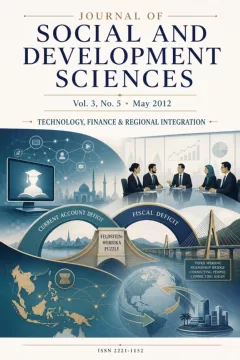
The main purpose of this study is to examine the relationship between budget deficit and current account deficit in Iran's economy through twin deficits and Feldstein-Horioka puzzle. To achieve this goal, Engel-Granger and seemingly unrelated regressions are used during "1971-2007". The results indicate that there exists a long run equilibrium link between budget deficit and current account deficit. There is a one–way causality relationship from the budget deficit toward the current account deficit .Testing the validity of the Feldstein-Horioka puzzle indicates a low level of international capital mobility for Iran.
Keywords
- Twin Deficits Search this journal for Twin Deficits (opens in a new tab)
- Budget Deficit Search this journal for Budget Deficit (opens in a new tab)
- Current Account Deficit Search this journal for Current Account Deficit (opens in a new tab)
- Feldstein-Horioka Puzzle Search this journal for Feldstein-Horioka Puzzle (opens in a new tab)
References
- Alkswani, M. (2000).The Twin Deficits Phenomenon in Petroleum Economy: Evidence from Saudi Arabia. In Paper presented at the seventh annual conference, economic research forum (ERF).
- Baharumshah, A. Z., Ismail, H. & Lau, E. (2005). Twin Deficits Hypothesis and Capital Mobility: The ASEAN-5 Perspective. Journal Pengurusan , 29, 15-32.
- Barro, R. (1974). Are Government Bonds Net Wealth? Journal of Political Economy , 82(6), 1095–1117.
- Barro, R. (1989). The Ricardian Approach to Budget Deficits. Journal of Economic Perspectives , 3(2), 37-52.
- Bernheim, B. (1987). Ricardian Equivalence an Evaluation of Theory and Evidence with Three Comments. NBER Macroeconomics Annual, 263-315.
- Branson, W. (1993). World Interest Rate and the DM with Germany Unification. Paper Prepared for a Symposium in Honor of Heinz Konig, Manheim.
- Feldstein, M. & Horioka, C. (1980). Domestic saving and international capital flows. The Economic Journal , 90, 314–329.
- Fidrmuc, J. (2003). The Feldstein-Horioka Puzzle and Twin Deficits in Selected Countries. Economics of Planning , 36, 135-152.
- Islam, F. (1998). Brazil’s Twin Deficits: An Empirical Examination. Atlantic Economic Journal , 26(2), 121-28.
- Kim, K. (1995). On the Long-run Determinants of the US Trade Balance: A Comment. Journal of Post Keynesian Economics , 17, 447-55.
- Kouassi, E., Mougou´e, M. & Kymn, K. (2004). Causality Tests of the Relationship between the Twin Deficits. Empirical Economics , 29, 503-525.
- Marinheiro, C. F. (2008). Ricardian Equivalence, Twin Deficits and the Feldestein-Horioka Puzzle in Egypt. Journal of Policy Modeling , 30, 1041-1056.
- Perron, P. (1989). The great crash, the oil price shock, and the unit root hypothesis. Econometrica , 99, 1361-1401.
- Siddiqui, M. (2010). Twin Deficits: An Empirical Analysis in the Case Pakistan. World Applied Sciences Journal , 8(11), 1398-1400.
- Summers, L. (1988). Tax policy and international competitiveness. In Frenkel, J. A. (Ed.), International aspects of fiscal policies (NBER Conference Report), 349–375.
Downloads
No downloads have been recorded for this article yet. Figures appear here once readers begin downloading the full text.
How to Cite
Share this article
License
Copyright (c) 2012 Farzane Bagheri, Salma Keshtkaran, Fatemeh Daroghe Hazrati (Author)

This work is licensed under a Creative Commons Attribution 4.0 International License.
Author (s) should affirm that the material has not been published previously. It has not been submitted and it is not under consideration by any other journal. At the same time author (s) need to execute a publication permission agreement to assume the responsibility of the submitted content and any omissions and errors therein. After submission of revised paper in the light of suggestions of the reviewers, the editorial team edits and formats manuscripts to bring uniformity and standardization in published material.
This work will be licensed under Creative Commons Attribution 4.0 International (CC BY 4.0) and under condition of the license, users are free to read, copy, remix, transform, redistribute, download, print, search or link to the full texts of articles and even build upon their work as long as they credit the author for the original work. Moreover, as per journal policy author (s) hold and retain copyrights without any restrictions.
Keywords
- Twin Deficits Search this journal for Twin Deficits (opens in a new tab)
- Budget Deficit Search this journal for Budget Deficit (opens in a new tab)
- Current Account Deficit Search this journal for Current Account Deficit (opens in a new tab)
- Feldstein-Horioka Puzzle Search this journal for Feldstein-Horioka Puzzle (opens in a new tab)
Section
Published
Submissions
Have research to publish? Journal of Social and Development Sciences welcomes submissions.
Make a Submission