Abstract
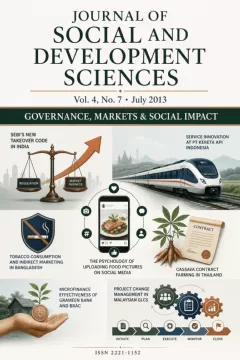
Innovation is an important key for an organization to win the market competition, both in aspects of organization, culture, and business to produce an excellence service and product. Service innovation has been developed to respond quickly the demand of society that increasingly aware of the importance of quality service. PT. Kereta Api Indonesia (KAI) as one of the Indonesian state-owned companies engaged in public transportation made a breakthrough by launching a service product innovation, purchasing system of train tickets and new trains. This paper analyzes the types of service product innovation, success factors of innovation, and explore the barriers of innovation. This study used qualitative methods based on review of the innovation management literature and semi-structured interviews. The role of leadership has an important influence in shaping the behavior of the organization. These organizational learning concepts are used to gain a dynamic of service innovation, it suggests that the company should still perform improvement processes in developing service innovation to meet the challenges faced.
Keywords
- Innovation Search this journal for Innovation (opens in a new tab)
- Public Service Innovation Search this journal for Public Service Innovation (opens in a new tab)
- PT. KAI Search this journal for PT. KAI (opens in a new tab)
- Qualitative Method Search this journal for Qualitative Method (opens in a new tab)
- Leadership Search this journal for Leadership (opens in a new tab)
References
- Atuahene-Gima, K. (1996). Differential potency of factors affecting innovation performance in manufacturing and services firms in Australia. Journal of Product Innovation Management , 13, 3552.
- Avlonitis, G. J., Papastathopoulou, P. G. & Gounaris, S. P. (2001). An empirically-based typology of product innovativeness for new financial services: success and failure scenarios. Journal of Product Innovation Management , 18(5), 324-42.
- Central Bureau of Statistics. (2012). Trends of Selected Socio-Economic Indicators of Indonesia. Jakarta, Indonesia.
- Cook, G., Matthews, M. & Irwin, S. (2009). Innovation in the Public Sector : Enabling Better Performance, Driving New Directions, Australia National Audit Office.
- Cooper, R. J. (1998). A Multidimensional Approach to the Adoption of Innovation. Management Decision, 36(8), 493 – 502.
- De-Brentani, U. (2001). Innovative versus incremental new business services: different keys for achieving success. Journal of Product Innovation Management , 18, 169-87.
- Denis, J. L., Hebert, Y., Langley, A., Lozeau, D. & Trottier, L. (2002). Explaining diffusion patterns for complex health care innovations. Health Care Management Review , 27, 60-73.
- Drew, S. (1995). Strategic benchmarking: innovation practices in financial institutions. International Journal of Bank Marketing , 13(1), 4-16.
- Edvardsson, B., Haglund, L. & Mattsson, J. (1995). Analysis, planning, improvisation and control in the development of new services. International Journal of Service Industry Management , 6(2), 24-35.
- Garden-Ellson, N., Huss, R. A., Levine, J. & Pierce, W. E. (1986). Key factors in new product success: three case studies. Journal of Retail Banking , 8(1/2), 25-33.
- Haaroff, K. (1983). An exercise in product development for the 1980s: international cash management service. International Journal of Bank Marketing , 1(3), 56-68.
- Johne, A. (1993). Insurance product development: managing the changes. International Journal of Bank Marketing , 11(3), 5-14.
- Johne, A. & Storey, C. (1997). New service development: a review of the literature and annotated bibliography. Management Working Paper B97/2, City University Business School, London.
- Johnston, R. (1999). Service operations management: return to roots. International Journal of Operations & Production Management , 19(2), 104-24.
- Lewis, M. & Hartley, J. (2001). Evolving forms of quality management in local government: lessons from the Best Value pilot programme . Policy and Politics , 29, 477-496.
- Lekhi, R. (2007). Public Service Innovation, This research report was prepared by Research Republic LLP for The Work Foundation’s Knowledge Economy Programme.
- March, J. G. & Olsen, J. P. (1989). Rediscovering Institutions: The Organizational Basis of Politics. New York: The Free Press
- Mulgan, G. & Albury, D. (2003). Innovation in the Public Sector, Strategy Unit, Cabinet Office.
- Oke, A. (2004). Innovation types and innovation management practices in service companies. International Journal of Operations & Production Management , 27(6), 564-587.
- PT. Kereta Api Indonesia (Persero). (2012). The State Owned Enterprise Award 2012 Presentation Materials, Bandung, Indonesia. http://www.kereta-api.co.id.
- Suwarno, Y. (2008). Inovasi di Sektor Publik, STIA-LAN Press, Jakarta, Indonesia.
- Wong, P. & Cha, V. (2008). Service Innovation in Public Sector – A Case Study on The National Library Board, National University of Singapore.
Downloads
No downloads have been recorded for this article yet. Figures appear here once readers begin downloading the full text.
How to Cite
Share this article
License
Copyright (c) 2013 Grisna Anggadwita, Wawan Dhewanto (Author)

This work is licensed under a Creative Commons Attribution 4.0 International License.
Author (s) should affirm that the material has not been published previously. It has not been submitted and it is not under consideration by any other journal. At the same time author (s) need to execute a publication permission agreement to assume the responsibility of the submitted content and any omissions and errors therein. After submission of revised paper in the light of suggestions of the reviewers, the editorial team edits and formats manuscripts to bring uniformity and standardization in published material.
This work will be licensed under Creative Commons Attribution 4.0 International (CC BY 4.0) and under condition of the license, users are free to read, copy, remix, transform, redistribute, download, print, search or link to the full texts of articles and even build upon their work as long as they credit the author for the original work. Moreover, as per journal policy author (s) hold and retain copyrights without any restrictions.
Keywords
- Innovation Search this journal for Innovation (opens in a new tab)
- Public Service Innovation Search this journal for Public Service Innovation (opens in a new tab)
- PT. KAI Search this journal for PT. KAI (opens in a new tab)
- Qualitative Method Search this journal for Qualitative Method (opens in a new tab)
- Leadership Search this journal for Leadership (opens in a new tab)
Section
Published
Submissions
Have research to publish? Journal of Social and Development Sciences welcomes submissions.
Make a Submission