Abstract
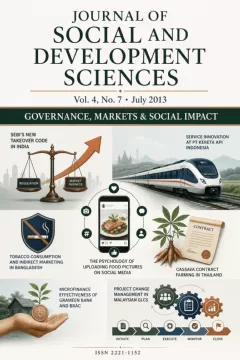
Lately, people like to capture food picture and post to social media. They share, recommend and critic the food and restaurant to other social media users. Based on exploratory research findings, this phenomenon is assumed having a relation with personality traits, self-concepts and perception of social media users. This paper aims to investigate the effect of restaurant attractiveness, personality, selfconcepts, self-control, and perception to willingness to dine out. Qualitative studies are carried out to get the indicators for designing questionnaires and afterward the questionnaires are distributed by survey. Sample size for qualitative research is 12 respondents who like to post food picture on social media and 102 social media users in Indonesia as respondents for survey. Collected data are analyzed using multivariate analysis. The finding shows that restautant attractiveness, self-concepts, and consumer perception have positive effect to consumer’s willingness to dine out after looking at the posted food picture on social media. Implication of this research can help manager of restaurant or cafe to plan marketing program based on consumer personality and other psychological concepts.
Keywords
References
- Aaker, D. (1996). Building Strong Brands: The Free Press, New York, NY.
- Ahuvia, A. (2005). Beyond the Extended Self: Love Objects and Consumer’s Identity Narratives.
- Andreassen, T. W. & Lervik, L. (1999). Perceived relative attractiveness today and tomorrow as predictors of future repurchase intention. Journal of Service Research , 2(2), 164-72.
- Anreassen, T. & Olsen, L. (2008). The Impact Of Consumer’s Perception of Varying Degree of Consumer Service On Commitment and Perceived Relative Attractiveness . Managing Service Quality, 18 (4), 309-328.
- Boyd, D. & Ellison, N. (2007).Social network sites: definition, history, and scholarship. Journal of Computer – Mediated Communication , 13(1), 210-30.
- Carman, J. M. (1990). Consumer perception of service quality: an assessment of the SERVQUAL dimensions. Journal of Retailing , 66(1), 33-45.
- DeVellis, R. F. (2003). Scale development: Theory and applications (2nd edn). Thousand Oaks, California: Sage.
- Dube, L., Renaghan, L. M. & Miller, J. M. (1994). Measuring consumer satisfaction for strategic management. The Cornell Hotel and Restaurant Administration Quarterly , 35(1), 39-47.
- Dulen, J. (1999). Quality control. Restaurant & Institutions, 109(5), 38-52.
- Fu, Y. Y. & Parks, S. C. (2001). The relationship between restaurant service quality and consumer loyalty among the elderly. Journal of Hospitality and Tourism Research , 25(3), 320-336.
- Gosling, S. D., Rentfrow, P. J. & Swann, W. B. Jr. (2003). A Very Brief Measure of the Big Five Personality Domains. Journal of Research in Personality, 37, 504-528.
- Greenwald, A. G. (1989). Why Attitude Are Important: defining attitude and attitude theory twenty years later, in Pratkanis, A.R, Brecker and Greenwald, Attitude Structure and Function, Erlbaum, Hillsdale, NJ, 429-440.
- Hair, J. & Black, W. (2006). Multivariate Data Analysis: Pearson Prentice Hall
- Johnson, M. D., Gustafson, A., Andreassen, T. W., Lervik, L. & Cha, J. (2001). The evolution and future of national consumer satisfaction indices . Journal of Economic Psychology , 22(2), 217-45.
- Kaufman, C. S. (2002).E-shopping image multiple channel environment. Journal of Consumer Marketing , 19(4), 333-350.
- Kivela, J., Reece, J. & Robert, I. (1999). Consumer research in the restaurant environment. Part 2: Research design and analytical methods. International Journal of Contemporary Hospitality Management , 11(6), 269-286
- Lee, J. & Allaway, A. (2002). Effects of personal control on adoption of self- service technology innovations. Journal of Services Marketing, 16(6), 553-72.
- McShane, S. L. & von Glinow, M. A. (2010). Organizational Behavior (5th Edition). McGraw-Hill.
- Namkung, Y. & Jang, S. (2007). Are highly satisfied restaurant consumers really different? A quality perception perspective. International Journal of Contemporary Hospitality Management , 20(2), 142-155.
- Olson, J. C. (1977). Price as an informational cue: effects in product evaluation, in Woodside, A., Sheth, J. and Bennet, P. (Eds), Consumer and Industrial Buying Behavior, North Holland .Publishing Company, New York, NY.
- Olson, J. C. & Jacoby, J. (1972). Cue utilization in the quality perception process.paper presented at Third Annual Conference of the Association for Consumer Research Association for Consumer Research, Iowa City.
- Pallant, J. (2011). Survival Manual A step by Step Guide to Data Analysis Using SPSS (4th ed). Allen & Uwin: Crows Nest.
- Palmer, A. & Lewis, N. (2009). An experiential, social network-based approach to direct marketing. Direct Marketing: An International Journal , 3(3), 162-176.
- Pappu, R. & Quester, P. (2006). A consumer based method for the retailer equity measurement: results of an empirical study. Journal of Retailing and Consumer Services , 13(5), 317-29.
- Parasuraman, A., Zeithaml, V. & Berry, L. (1988). SERVQUAL: a multiple-item scale for measuring consumer perceptions of service quality. Journal of Retailing , 64(1), 12-40.
- Porter, L. W., Steers, R. M., Mowday, R. T. & Boulian, P. V. (1974).Organizational commitment, job satisfaction, and turnover among psychiatric technicians. Journal of Applied Psychology, 56(5), 603-9.
- Rahman, M. (2012). Dynamics of consumer’s perception, demographic characteristics and consumers’ behavior towards selection of a restaurant: an exploratory study on Dhaka city consumers. Business Strategy Series , 13(2).
- Rajagopal, G. (2006). Brand excellence: measuring the impact of advertising and brand personality on buying decisions. Measuring Business Excellence , 10(3), 56-66.
- Robbins, S. P. (2005). Organizational Behavior, (11th Edition), Pearson Prentice Hall
- Rosenberg, M. (1979). Conceiving the Self, Basic Books, New York, NY.
- Schiffman, G. L. & Kanuk, L. L. (2000). Consumer Behavior (7th ed). Prentice Hall, Upper Saddle River, NJ
- Shwu-Ing, W. (2003).The relationship between consumer characteristics and attitudes toward online shopping. Marketing Intelligence & Planning , 21(10), 37-44.
- Sirgy, M. J. (1982). Self – Concept in Customer Behavior: a critical review. Journal of Consumer Research , 9, 287-299.
- Solomon, M. R. (2011). Consumer Behavior (9th global edition) Prentice Hall, Englewood Cliffs, NJ.
- Susskind, A. M. & Chan, E. K. (2000). How restaurant features affect check averages: a study of the Toronto restaurant market. The Cornell Hotel and Restaurant Administration Quarterly , 41(6), 56-63.
- Tam, J. L. M. (2004).Consumer satisfaction, service quality and perceived value: an integrative model . Journal of Marketing Management , 20(7), 897-917.
- Yoo, B. H., Donthu, N. & Leee, S. H. (2000).An examination of selected marketing mix elements and brand equity. Journal of the Academy of Marketing Science , 28(2), 195-211.
Downloads
No downloads have been recorded for this article yet. Figures appear here once readers begin downloading the full text.
How to Cite
Share this article
License
Copyright (c) 2013 Novia Dwi Resti, Mustika Sufiati Purwanegara (Author)

This work is licensed under a Creative Commons Attribution 4.0 International License.
Author (s) should affirm that the material has not been published previously. It has not been submitted and it is not under consideration by any other journal. At the same time author (s) need to execute a publication permission agreement to assume the responsibility of the submitted content and any omissions and errors therein. After submission of revised paper in the light of suggestions of the reviewers, the editorial team edits and formats manuscripts to bring uniformity and standardization in published material.
This work will be licensed under Creative Commons Attribution 4.0 International (CC BY 4.0) and under condition of the license, users are free to read, copy, remix, transform, redistribute, download, print, search or link to the full texts of articles and even build upon their work as long as they credit the author for the original work. Moreover, as per journal policy author (s) hold and retain copyrights without any restrictions.
Keywords
Section
Published
Submissions
Have research to publish? Journal of Social and Development Sciences welcomes submissions.
Make a Submission