Abstract
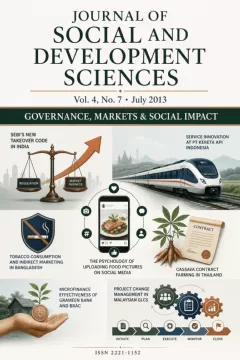
The most important raw materials for bio-ethanol in Thailand are cassava, sugar cane and molasses. However, cassava has been promoted as a feed stock for ethanol due to the minimal inputs for planting, high productivity and all-year planting and harvesting. The most important factor influencing ethanol using cassava production is the price of cassava feedstock. Contract farming could decrease production costs, increase efficiency in markets, provide lower interest rates, decrease risk management and create symmetric information for cassava smallholders. The scope of this study includes cassava cultivation and factors influencing contract participation using logit analysis. Results from a survey consisting of 130 non-contractors and 127 contractors showed there was a verbal communication between farmers and agricultural cooperatives and written contractual agreement between agricultural cooperatives and processors. In addition, contract participation is significantly influenced by gender of household head, education of household members, number of agricultural groups, input costs, machinery costs, incomes and credit access.
Keywords
- Contract Farming Search this journal for Contract Farming (opens in a new tab)
- Smallholders' Participation Search this journal for Smallholders' Participation (opens in a new tab)
- Cassava Production Search this journal for Cassava Production (opens in a new tab)
- Nakhon Ratchasrima Province Search this journal for Nakhon Ratchasrima Province (opens in a new tab)
- Thailand Search this journal for Thailand (opens in a new tab)
References
- Baumann, P. (2000). Equity and Efficiency in Contract Farming Schemes: The Experience of Agricultural Tree Crops, London: Overseas Development Institute.
- Bell, D. R. & Silalertruksa, T. (2010). The Net Cost of Biofuels in Thailand-An economic analysis. Energy Policy , 39, 834-843.
- Bloyd, C. N. (2009). An Update on Ethanol Production and Utilization in Thailand. U.S. Department of Energy, Washington: Pacific Northwest National Laboratory.
- Cooperative Promotion Department. (2012). Agricultural Groups in Nakhon Ratchasima Province 2012, Bangkok: Ministry of Agriculture and Cooperatives.
- Crown, W. H. (1998). Statistical Models for the Social and Behavioral Sciences: Multiple Regression and Limited-Dependent Variable Models, Connecticut: Praeger Publishers.
- Department of Agriculture Extension. (2011). The Registeration of Cassava Farmers in Nakorn Ratchasima District in 2011. Nakorn Ratchasima, Thailand, Department of Agriculture Extension, Bangkok: Ministry of Agricultre and Cooporatives.
- Department of Export Promotion. (2010). Cassava and the Future of Thailand's Biofuel Industry, Bangkok: Ministry of Commerce.
- Ellis, F. & Biggs, S. (2002). Evolving Themes in Rural Development 1950s‐2000s. Development policy review , 19(4), 437-448.
- Fabra, U. P. & Schmidheiny, K. (2010). Binary Response Models: Short Guides to Micro econometrics, Basel: Unversity of Basel.
- George, J. & Mohankumar, C. (2000). Cassava Agronomy Research and Adoption of Improved Practices in India Major. Achievements During the Past 30 Years, 258-276.
- Glover, D. (1990). Contract Farming and Commercialization of Agriculture in Developing Countries, 166175.
- Guo, H. & Jolly, R. W. (2009). Contract Farming in China: Perspectives of Smallholders.
- 2009 Conference, August 16-22, 2009, Beijing, China, International Association of Agricultural Economists, 3-12.
- Hazell, P. & Poulton, C. (2006). The Future of Small Farms: Synthesis Paper, World Bank, London: Imperial College London.
- Howeler, R. & Oates, C. (2000). Strategic Environmental Assessment: Assessment of the Impact of Cassava Production and Processing on the Environment. Draft Report Prepared for the International Fund for Agricultural Development, 4-8.
- Howeler, R. H. (2000). Cassava Agronomy Research in Asia: Has It Benefited Cassava Farmers, 345-382.
- Howeler, R. H. (2007). Production Techniques for Sustainable Cassava Production in Asia, 1-13.
- Kuiper, L. & Ekmekci, B. (2007). Bio-Ethanol from Cassava. Ecofys Netherlands BV, 1-29.
- Kureh, I. & Menkir, A. (2006). Participatory On-farm Evaluation of the Performance of Drought-Tolerant Maize Varieties in the Guinea Savannas of Nigeria. International Journal of Food, Agriculture and Environment , 4(1), 192-196.
- Martinez, S. W. & Reed, A. (1996). From Farmers to Consumers: Vertical Coordination in the Food Industry, US Department of Agriculture, 2-18.
- Masakure, O. & Henson, S. (2005). Why Do Small-Scale Producers Choose to Produce Under Contract? Lessons From Nontraditional Vegetable Exports From Zimbabwe. World Development 33(10), 1721-1733.
- Morrison, P. S. & Murray, W. E. (2006). Promoting Indigenous Entrepreneurship Through Small‐Scale Contract Farming: The Poultry Sector in Sarawak, Malaysia. Singapore Journal of Tropical Geography , 27(2), 191-206.
- Nguyen, T. L. T. & Gheewala, S. H. (2008). Life Cycle Cost Analysis of Fuel Ethanol Produced From Cassava in Thailand. The International Journal of Life Cycle Assessment , 13(7), 564-573.
- Nishimura, H. (2003). Agribusiness Development in Asia and the Pacific with Emphasis on Indonesia, Malaysia, The Philippines and Thailand. Development of Agribusiness Enterprises (Japan), 17-30.
- Nualvatna, K. (2003). Development of Agribusiness Enterprises: Thailand. Development of Agribusiness Enterprises (Japan), 166-174.
- Office of Agricultural Economics. (2007). An Agricultural Farmers' Situation in Thailand 2006-2007, Bangkok: Ministry of Agriculture and Cooperatives.
- Office of Agricultural Economics. (2008). Industrial Cassava: Area, Production and Yield by Region and Province, 2006-2008. Office of Agricultural Economics, Bangkok: Ministry of Agriculture and Cooperatives.
- Office of Agricultural Economics. (2011). Industrial Cassava: Area, Production and Yield by Region and Province 2009-2010, Bangkok: Ministry of Agriculture and Cooperatives.
- Office of the National Economic and Social Development Board. (2009). National Report Thailand: Global Sttudy on Child Poverty and Disparities, Office of the National Economic and Social Development Board, Bangkok: United Nations Children's Fund (UNICEF).
- Office of Women's Affairs and Family Development. (2007). General Situation of Women in Thailand, Bangkok: Ministry of Social Development and Human Security.
- Preechajarn, S. & Prasertsri, P. (2010). Thailand Biofuels Annual Annual 2010, Bangkok: U.S. Department of Agriculture.
- Prowse, M. & Thirion, M. C. (2012). Contract Farming in Developing Countries. A Review. Agence Française de Développement, Paris: Imprimerie de Montligeon.
- Senadee, W. & Aksornneum, K. (2008). Cassava: Valuable Products. House Agricultural Magazine. Thailand, House Agricultural Magazine, 7-44.
- Seumpakdee, S. (2009). The Thai Industries of Ethanol: Problems, Treat and the Development and Extention. Thai Tapioca Starch Association (TTSA) 2009, 12-38.
- Singh, S. (2011). Role of the State in Contract Farming in Thailand: Experience and Lessons. ASEAN Economic Bulletin , 22(2), 217-228.
- Sriroth, K. & Piyachomkwan, K. (2008). Cassava Ethanol technology and growth in Thailand. Bangkok, Kasetsart Universtity, 26-42.
- Suthamma, S. & Chumnong, Y. (2011). Life Cycle Cost of Ethanol Production From Cassava in Thailand. Renewable and Sustainable Energy Reviews , 15(2), 1343-1349.
- Swinnen, J. F. & Maertens, M. (2007). Globalization, Privatization, and Vertical Coordination in Food Value Chains in Developing and Transition Countries. Agricultural Economics , 37, 89-102.
- Train, K. E. (1995). Simulation Methods for Probit and Related Models Based on Convenience Error Partitioning. University of California, 1-34.
- Young, L. M. & Hobbs, J. E. (2002). Vertical Linkages in Agri-Food Supply Chains: Changing Roles for Producers. Commodity Groups, and Government Policy. Review of Agricultural Economics , 24(2), 428-441.
- Zhang, C. & Han, W. (2003). Life Cycle Economic Analysis of Fuel Ethanol Derived From Cassava in Southwest China. Renewable and Sustainable Energy Reviews , 7(4) 353-366.
Downloads
No downloads have been recorded for this article yet. Figures appear here once readers begin downloading the full text.
How to Cite
Share this article
License
Copyright (c) 2013 Siros Tongchure, Nam Hoang (Author)

This work is licensed under a Creative Commons Attribution 4.0 International License.
Author (s) should affirm that the material has not been published previously. It has not been submitted and it is not under consideration by any other journal. At the same time author (s) need to execute a publication permission agreement to assume the responsibility of the submitted content and any omissions and errors therein. After submission of revised paper in the light of suggestions of the reviewers, the editorial team edits and formats manuscripts to bring uniformity and standardization in published material.
This work will be licensed under Creative Commons Attribution 4.0 International (CC BY 4.0) and under condition of the license, users are free to read, copy, remix, transform, redistribute, download, print, search or link to the full texts of articles and even build upon their work as long as they credit the author for the original work. Moreover, as per journal policy author (s) hold and retain copyrights without any restrictions.
Keywords
- Contract Farming Search this journal for Contract Farming (opens in a new tab)
- Smallholders' Participation Search this journal for Smallholders' Participation (opens in a new tab)
- Cassava Production Search this journal for Cassava Production (opens in a new tab)
- Nakhon Ratchasrima Province Search this journal for Nakhon Ratchasrima Province (opens in a new tab)
- Thailand Search this journal for Thailand (opens in a new tab)
Section
Published
Submissions
Have research to publish? Journal of Social and Development Sciences welcomes submissions.
Make a Submission