Abstract
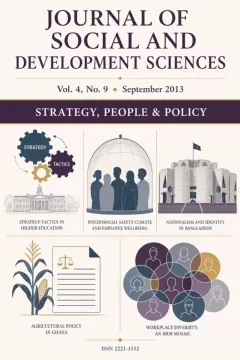
The central role agriculture plays in the development of Ghana’s economy has been recognized by several authors, particularly because Ghana’s economy is basically agrarian. Nevertheless, the contributions agriculture can make to economic development depend on the policy environment within which agriculture thrives. Several policies, both general and specific to agriculture, which have been pursued under various governments have either promoted or mitigated against the performance of agriculture in Ghana. This paper reviews the various policies under which Ghana's agricultural sector has operated since independence, and provides a synthesis of the major existing policies and recent changes and how these have affected the agricultural sector. The analysis shows that the socialist model of the 1960s contrasted sharply with the liberalized market approach of the 1980s and 1990s, particularly under structural adjustment. These differing policy orientations have had significant effects on agricultural performance in Ghana, and the roles of agriculture at different periods. For instance, the policy effects of agricultural activities on the environment, such as the promotion of export commodities, the exploitation of timber and forest resources, mining, and indiscriminate sale and use of agro-chemicals in Ghana have been negative. On the other hand, promotion of cash and export crops through government policy incentives have improved rural incomes for farmers that cultivate such crops, and helped to reduce poverty among this group. In general, the policy effects on agriculture in Ghana have been mixed.
Keywords
- Agriculture Search this journal for Agriculture (opens in a new tab)
- Policies Search this journal for Policies (opens in a new tab)
- Forest Resources Search this journal for Forest Resources (opens in a new tab)
- Liberalization Search this journal for Liberalization (opens in a new tab)
- Policy Effects Search this journal for Policy Effects (opens in a new tab)
References
- Aneani, F. (1995). Commodity Concentration and Export Earnings Instability: A case of Ghana’s Agricultural Exports. An MPhil. Thesis submitted to the Department of Agricultural Economy and Farm Management, Faculty of Agriculture, University of Ghana, Legon.
- Aryeetey, E. (1996). The Formal Financial Sector in Ghana after the Reforms. Working Paper No. 86. London. Overseas Development Institute.
- Food and Agriculture Organization of the United Nations (FAO). (2004). Socio-Economic Analysis and Policy Implications of the Roles of Agriculture in Developing Countries. Research Programme Summary Report 2004. Rome.
- Institute of Statistical, Social and Economic Research (ISSER). (2000). The State of the Ghanaian Economy. University of Ghana, Legon.
- Kuwornu, J. K. M., Abboah, R., Amegashie, D. P. K. & Kuiper, W. E. (2009). Econometric Analysis of Marketing Costs: A Case Study. Journal of Food Distribution Research, 40(1), 83-89.
- Kuwornu, J. K. M., Demi M. S. & Amegashie, D. P. K. (2013). Comparative Analysis of Food Security Status of Farming Households in the Coastal and the Forest Communities of Central Region of Ghana. Asian Journal of Empirical Research , 3(1), 39 – 61.
- Leith, J. C. (1971). Export Concentration and Instability: The case of Ghana. The Economic Bulletin of Ghana , 1, 45-55.
- Ministry of Food and Agriculture (MoFA). (1997). Agriculture in Ghana: Facts and Figures, PPMED, Accra.
- Ministry of Food and Agriculture (MoFA). (2002). Agriculture in Ghana: Facts and Figures, PPMED, Accra.
- Ministry of Food and Agriculture (MoFA). (2006). Agriculture in Ghana: Facts and Figures, PPMED, Accra.
- Ministry of Food and Agriculture (MoFA). (2007). Agriculture in Ghana: Facts and Figures, PPMED, Accra.
Downloads
No downloads have been recorded for this article yet. Figures appear here once readers begin downloading the full text.
How to Cite
Share this article
License
Copyright (c) 2013 Samuel Asuming-Brempong, John K. M. Kuwornu (Author)

This work is licensed under a Creative Commons Attribution 4.0 International License.
Author (s) should affirm that the material has not been published previously. It has not been submitted and it is not under consideration by any other journal. At the same time author (s) need to execute a publication permission agreement to assume the responsibility of the submitted content and any omissions and errors therein. After submission of revised paper in the light of suggestions of the reviewers, the editorial team edits and formats manuscripts to bring uniformity and standardization in published material.
This work will be licensed under Creative Commons Attribution 4.0 International (CC BY 4.0) and under condition of the license, users are free to read, copy, remix, transform, redistribute, download, print, search or link to the full texts of articles and even build upon their work as long as they credit the author for the original work. Moreover, as per journal policy author (s) hold and retain copyrights without any restrictions.
Keywords
- Agriculture Search this journal for Agriculture (opens in a new tab)
- Policies Search this journal for Policies (opens in a new tab)
- Forest Resources Search this journal for Forest Resources (opens in a new tab)
- Liberalization Search this journal for Liberalization (opens in a new tab)
- Policy Effects Search this journal for Policy Effects (opens in a new tab)
Section
Published
Submissions
Have research to publish? Journal of Social and Development Sciences welcomes submissions.
Make a Submission