Abstract
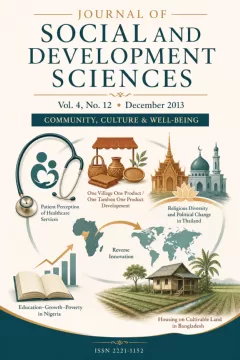
Following the 1997 Asian Financial Crisis, Thailand’s economy which did rely on external capital and resources suffered from an imbalanced economic growth. As a solution to the economic restructuring process, endogenous development concept proved to be an alternative development paradigm which prioritizes the community development, human empowerment in the transformation of local resources. Accordingly, One Tambon One Product (OTOP) was designed to unlock grass-root potentials by generating income through developing local products in a national, regional, and global scale. This initiative was first developed under the name of One Village One Product (OVOP) by local people in the poorest Oita Prefecture, Japan in 1961. The aim of the paper is to compare two development models of OVOP and OTOP. The comparative study draws useful lessons from the experience of OTOP for future applications of the OVOP model in developing economies. The paper finds that there are inevitable differences in terms of administration, finance management, human resource management, and marketing promotion management between bottom-up OVOP in Japan and top-down OTOP because of social diversity, political culture, and economic capability in Thailand. The paper contributes to provide a comparative study into models of sustainable development in the context of increasing gap between the urban and rural in globalization.
Keywords
- OVOP Search this journal for OVOP (opens in a new tab)
- OTOP Search this journal for OTOP (opens in a new tab)
- Sustainable Endogenous Development Search this journal for Sustainable Endogenous Development (opens in a new tab)
- Regional Growth Search this journal for Regional Growth (opens in a new tab)
- Grass-Root Search this journal for Grass-Root (opens in a new tab)
References
- Bornstein, D. (2007). How to Change the World: Social Entrepreneurs and the Power of New Ideas (2nd ed.), New York: Oxford University Press.
- Coleman, J. S. (1988). Social Capital in the Creation of Human Capital. American Journal of Sociology , 94, 95120.
- Coleman, J. S. (1990). Foundation of Social Theory. Cambridge: MA, Harvard University Press.
- Dees, G. (2007). Taking Social Entrepreneurship Seriously. Society, 44(3), 24-31.
- Friedmann, J. (2007). The Wealth of Cities: Towards an Assets-based Development of Newly Urbanizing Regions. Development and Change, 38(6), 987-998.
- Fujioka, R. (2006). Thai OTOP Project: Lights and Shadow of Grassroots Development Policy. Chapter 6, OVOP and Developing countries. Institute of Developing Economies, Japan External Trade Organization (IDEJETRO), ISBN4-258-29003-3
- Hiramatsu, M. (2008). One Village, One Product Spreading throughout the World. Oita Japan: Office: Oita OVOP International Exchange Promotion Committee. Igusa, K (n, d). Globalization in Asia and Local Revitalization Efforts: A view from One Village One Product (OVOP). Retrieved from http://www.ide.go.jp/English/Ideas/School/pdf/igusa.pdf
- Jonathan, M. H. (2000). Basic Principles of Sustainable Development. Global Development and Environment institute working paper 00-04. Tufts University Medford MA, USA.
- Kaoru, N., Kunio, I., Wiboonpongse, A., Cheamuangphan, A., Shingkharat, S. & Thoburn, J. (2011). One Village One Product- Rural Development Strategy in Asia: The Case of OTOP in Thailand. Ritsumeikan Center for Asia Pacific Studies RCAPS Working Paper, 11 (3). Retrieved from http://www.apu.ac.jp/rcaps/
- Kirzner, I. M. (1997). How Markets Work: Disequilibrium, Entrepreneurship and Discovery. London: The Institute of Economic Affairs
- Kuhonta, E. M. (2003). The Political Economy of Equitable Development in Thailand. American Asian Review, 21(4), 69-108.
- Kilkenny, M., Nalbarte, L. & Besser, T. (1999). Reciprocated Community Support and Small Town Small Business Success. Entrepreneurship & Regional Development, 11, 231-46.
- Kurokawa, K., Tembo, F. & Dirk, W. V. (2010). Challenges for The OVOP Movement in Sub-Saharan Africa - Insights from Malawi, Japan and Thailand. JICARI Japan International Cooperation Agency Research Institute 18. Retrieved from: http://www.isn.ethz.ch/isn/DigitalLibrary/Publications/Detail/? ots591=0c54e3b3-1e9c-be1e-2c24- a6a8c7060233&lng=en&id=116727
- Lyons, T. (2002). Building Social Capital for Rural Enterprise Development: Three Case Studies in the United State. Journal of Developmental Entrepreneurship, 7(2), 193-216.
- Marshall, A. (1948). Principles of Economics: An Introductionary (8th ed). London, Macmillan.
- Missingham, B. (2003). Forging Solidarity and Identity in the Assembly of the Poor: From Local Struggles to a National Social Movement in Thailand. Asian Studies Review, 27(3), 317-340.
- National Sustainable Development Strategy: A Guidance Manual. (2008). The Office of National Economic and Social Development Board, United Nations Environment Program, and Thailand Environment Institute.
- Nixon, J. (2009). Sustainable Economic Development: Initiatives, Programs, and Strategies for Cities and Regions. Urban Sustainability Associates. Sustainable System, Inc.
- Pitchayapisut, N. (2008). The Roles of Government and Social Sectors in Local Revitalization in Japan: The Case of Oita’s OVOP (One Village One Product). Unpublished Master Thesis, Thammasat University, Thailand.
- OSMEP. (2008) OTOP Summary Report 2003-2008. The Office of Small and Medium Enterprises Promotion (OSMEP).
- Shinawatra, T. (2005). Empower the Grassroots - Essential Factors for Sustainable Development. Government Saving Bank, Bangkok, Thailand.
- Schumpeter, J. A. (1991). Essays on Entrepreneurs, Innovations, Business Cycles and the Evaluation of Capitalism. New Brunswick and London, Transactions Publications.
- Torri, M. C. (2009). Community Entrepreneurship among Lower Castes in India: A Grassroots Contribution toward Poverty Alleviation and Rural Development under Conditions of Adversity and Environmental Uncertainty. Journal of Developmental Entrepreneurship, 14(4), 413-432.
- Torri, M. C. (2010). Community-based Enterprises: a Promising Basis towards an Alternative Entrepreneurial Model for Sustainability Enhancing Livelihoods and Promoting Socio-economic Development in Rural India. Journal of Small Business and Entrepreneurship, 23(2), 237-248.
- UNHABITAT. (2011). State of the World’s Cities 2010/2011 – Cities for All: Bridging the Urban Divide. Retrieved from http://www.unhabitat.org/pmss/listitemdetails.aspx?publicationID=2917
- Wahlin, W. & Natsuda, K. (2008). One Village One Product: Japan’s Rural Entrepreneurial Scheme Goes Abroad. Japan Inc., 75, 60-61.
- Wysocka, A. J. (2009). Theories of Regional and Local Development-Abridged Review. Bulletin of Geography Socio-Economic Series , 12, 76-90.
Downloads
No downloads have been recorded for this article yet. Figures appear here once readers begin downloading the full text.
How to Cite
Share this article
License
Copyright (c) 2013 Nguyen Thi Anh Thu (Author)

This work is licensed under a Creative Commons Attribution 4.0 International License.
Author (s) should affirm that the material has not been published previously. It has not been submitted and it is not under consideration by any other journal. At the same time author (s) need to execute a publication permission agreement to assume the responsibility of the submitted content and any omissions and errors therein. After submission of revised paper in the light of suggestions of the reviewers, the editorial team edits and formats manuscripts to bring uniformity and standardization in published material.
This work will be licensed under Creative Commons Attribution 4.0 International (CC BY 4.0) and under condition of the license, users are free to read, copy, remix, transform, redistribute, download, print, search or link to the full texts of articles and even build upon their work as long as they credit the author for the original work. Moreover, as per journal policy author (s) hold and retain copyrights without any restrictions.
Keywords
- OVOP Search this journal for OVOP (opens in a new tab)
- OTOP Search this journal for OTOP (opens in a new tab)
- Sustainable Endogenous Development Search this journal for Sustainable Endogenous Development (opens in a new tab)
- Regional Growth Search this journal for Regional Growth (opens in a new tab)
- Grass-Root Search this journal for Grass-Root (opens in a new tab)
Section
Published
Submissions
Have research to publish? Journal of Social and Development Sciences welcomes submissions.
Make a Submission