Abstract
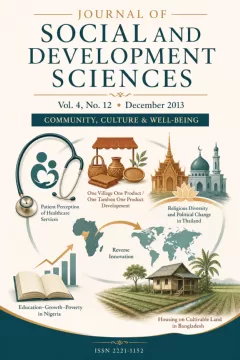
Society faces numerous problems due to high population growth where housing along with other settlements is a notable concern. Horizontal expansion of housing on cultivable land in rural area reduces the availability of land for cultivation. The study is a combination of both quantitative and qualitative in nature based on primary data, carried out in a village in Comilla, an eastern district of Bangladesh during April 2012. The study finds that the households receive returns both in cash as well as in kind from new homesteads made on cultivable land. The cash benefit received by households at new place is Tk. 156238.14 on an average per year in 2011 price and on an average the cash investment per year in 2011 price (inflation adjusted) for housing is Tk. 213108.1818 (weighted average). This clearly indicates a cash loss from housing on cultivable land from household’s perspective. However, statistically the cash investment for housing in rural area is not significantly different from the cash return received by the households at 5% level of significance. Thus it becomes an important question whether the household’s choice of making new home on cultivable land is a rational choice or not. Further, the amount of money each household spent for housing could have been used for a higher cash return through some alternative investments. The study reveals, households derive positive utility (non cash returns) from new homes notwithstanding cash loss and other investment options forgone. The study further argues that if the government or any authority is to take some steps regarding the declining trend of cultivable land in rural areas, the perspectives of the households must be considered with great attention.
Keywords
- Horizontal Expansion Search this journal for Horizontal Expansion (opens in a new tab)
- Housing Search this journal for Housing (opens in a new tab)
- Cultivable Land Search this journal for Cultivable Land (opens in a new tab)
- Non-cash Search this journal for Non-cash (opens in a new tab)
- Return Search this journal for Return (opens in a new tab)
References
- Ahmed, Z. & Marzuk, A. O. (2013). Horizontal Expansion of Housing in Rural Areas of Bangladesh: Does Population Growth Matter? Developing Country Studies , 3(10).
- Barakat, A., Ara, R., Taheruddin, M., Hoque, S. & Islam, N. (2007). Towards a Feasible Land Use Policy of Bangladesh, Dhaka: HRDC.
- Hertel, T. W. (2010). The Global Supply and Demand for Agricultural Land in 2050: A Perfect Storm in the Making? GTAP Working Paper No. 63, 2010, Available at https://www.gtap.agecon.purdue.edu/resources/download/5115.pdf .
- Islam, M. N. (2008). An Introduction to Research Methods, Second Edition, Dhaka: Mullick Brothers
- Jamil, G. M. H. & Ahmed, M. (2006). Housing for Low Income People in Bangladesh: Problems and Prospects . The Cost and Management , 34 (5), 25–33.
- Nabi, A. K. M. N. (2012). Demographic Trends in Bangladesh, Institute of Epidemiology, Disease Control and Research, Available at http://www.iedcr.org/pdf/files/NPHC%20WEB/UPLOAD4/Dr.Nurun%20Nabi.pdf .
- National Housing Authority (2008). National Housing Policy [rough], Available at http://www.nha.gov.bd/pdf/national_housing_policy_(rough).pdf .
- Rahman, M. A. (2012). Impact of Foreign Remittance on Land Holding and Land Relation in Rural Area of Bangladesh: A Case Study the Jirtoly, Village in the District of Noakhali [Draft] Dhaka: Department of Development Studies, University of Dhaka.
- Rahman, M. D. H. & Manprasert, S. (2006). Landlessness and its Impact on Economic Development: A Case Study on Bangladesh. Journal of Social Sciences , 2(2), 54-60
- Rahmatullah, B. (2007). Broad Land Use Planning of Entire Bangladesh: A National Priority for Sustainable Development, Dhaka: Bangladesh.
- Trading Economics (2012). Rural Population (% Of Total Population) In Bangladesh, Available At http://www.tradingeconomics.com/bangladesh/rural-population-percent-of-total-population-wbdata.html .
Downloads
No downloads have been recorded for this article yet. Figures appear here once readers begin downloading the full text.
How to Cite
Share this article
License
Copyright (c) 2013 Zobayer Ahmed, Pronab Kumar Saha (Author)

This work is licensed under a Creative Commons Attribution 4.0 International License.
Author (s) should affirm that the material has not been published previously. It has not been submitted and it is not under consideration by any other journal. At the same time author (s) need to execute a publication permission agreement to assume the responsibility of the submitted content and any omissions and errors therein. After submission of revised paper in the light of suggestions of the reviewers, the editorial team edits and formats manuscripts to bring uniformity and standardization in published material.
This work will be licensed under Creative Commons Attribution 4.0 International (CC BY 4.0) and under condition of the license, users are free to read, copy, remix, transform, redistribute, download, print, search or link to the full texts of articles and even build upon their work as long as they credit the author for the original work. Moreover, as per journal policy author (s) hold and retain copyrights without any restrictions.
Keywords
- Horizontal Expansion Search this journal for Horizontal Expansion (opens in a new tab)
- Housing Search this journal for Housing (opens in a new tab)
- Cultivable Land Search this journal for Cultivable Land (opens in a new tab)
- Non-cash Search this journal for Non-cash (opens in a new tab)
- Return Search this journal for Return (opens in a new tab)
Section
Published
Submissions
Have research to publish? Journal of Social and Development Sciences welcomes submissions.
Make a Submission