Abstract
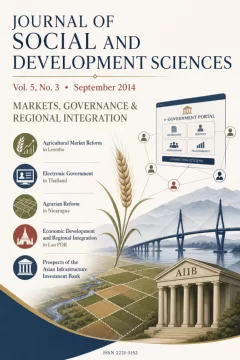
Infrastructure investment is one of the new sources of growth beside trade. However, the availability of infrastructure has become one of the major problems in the process of economic development in the region. Given the need for huge capital infrastructure in the region and the presence of the financing gap in infrastructure financing, the People Republic of Chinese (PRC) initiated the establishment of the Asian Infrastructure Investment Bank (AIIB). Thus, AIIB is expected to accelerate economic development and integration of Asia through the promotion of investment in the infrastructure sector. AIIB have several priority areas include transport, energy, communication, industry, and agriculture. The study used qualitative methods to compare the performance of various Multi Development Banks (MDBs) that existed such as IMF, ADB, IDB and WB with AIIB work plan. The results of this study will be expected to produce policy recommendations related to the formation of AIIB. AIIB initiative is the establishment of a relevant step with the spirit of accelerating economic development and integration of Asia to promote investment in the infrastructure sector. AIIB priority areas including transportation, energy, communication, industry, and agriculture is also a priority in developing countries. Openness in terms of membership (open regionalism) also showed that AIIB not only managed exclusively by the emerging countries in Asia but also opened to countries outside the region. The prospects of AIIB will be determined by how far the founding of PRC government transparency in every process both on stage and in the establishment of operational AIIB, how funding of AIIB direction forward and ensure it will not happen tied financing. This condition will be considered countries in the Asian region to join as founding members of AIIB.
Keywords
References
- Anat, A. & Martin, H. (2014). Banks are not a special case on debt-equity ratio, http://www.ft.com/intl/cms/s/0/25e34b6c-befb-11e2-87ff-00144feab7de.html.
- Ali, A. E. E. S. (2013). The Challenges of Islamic Trade Finance in Promoting SMEs in IDB Member Countries, Islamic Research and Training Institute, IRT Working Paper 1434-06 Desember.
- Armendáriz de Aghion, B. & Morduch, J. (2000). Microfinance Beyond Group Lending. Economics of Transition , 8(2), 401-420.
- Aschauer, D. A. (1989). Is Publik Expenditure Productive? Journal of Monetary Economics , 2, 177-200.
- Berndt, E. R. & Hansson, B. (1991). Measuring the Contribution of Publik Infrastructure Capital in Sweden, National Bureau of Economic Research Working Paper Number 3842.
- Buiter, W. & Steven, F. (2002). What should the multilateral development banks do? European Bank for Reconstruction and Development, Working Paper No. 74.
- Calderon, C. & Serven, L. (2002). The Output Cost of Latin America’s Infrastructure Gap, Central Bank of Chile Working Papers Number 186.
- Canadian International Development Agency (CIDA). (2013). Development Effectiveness Review of the Asian Development Bank 2006-2010, final report.
- Canning, D. (1999). The Contribution of Infrastructure to Aggregate Output, World Bank Working Paper Number 2246.
- Kimura, H. & Todo, Y. (2010). Is Foreign Aid a Vanguard of Foreign Direct Investment? A Gravity-Equation Approach. World Development , 38(4), 482-497.
- Lamdani, R. (2009). Assessing the Effectiveness of IMF Structural Conditionality. The Journal of Social Science , 3, 133-148
- Marianne, F. (1999). Financing The Future: Infrastructure Needs in Latin America, 2000-05, World Bank Working Paper Number 2545.
- Morduch, J. (1999). The Microfinance Promise. Journal of Economic Literature , 37(4), 1569-1614.
- Morrison, C. J. & Schwartz, A. E. (1992). State Infrastructure and Productive Performance, National Bureau of Economic Research Working Paper Number 3981.
- Nelson, R. M. (2013). Multilateral Development Banks: Overview and Issues for Congress, Congressional Research Service, November.
- Norton, S. W. (1992). Transaction Costs, Telecommunications, and the Microeconomics of Macroeconomic Growth. Economic Development and Cultural Change , 40, 175-196.
- OECD. (2010). Infrastructure to 2030: Mapping Policy For Electricity, Water And Transport, Volume 2.
- OECD. (2010). Global Infrastructure Needs and Financing into the Future, OECD Secretary-General’s Advisory Unit and International Futures Program RUSI, London, October.
- Poulus, S. (2011). Peringkat Obligasi, bahan pelatihan manajemen obligasi daerah tahap middle bagi staff BPKD Pemprof DKI Jakarta, 23-27 Mei.
- Röller, L. H. & Waverman, L. (1996). The Impact of Telecommunications Infrastructure on Economic Growth and Development: A first Look at the Data, in The Implications of Knowledge-Based Growth for Micro-Economic Policies, The University of Calgory Press.
- Scott, L. (2008). Assessing Multilateral Organization Effectiveness, Ministry of Foreign Affairs of Denmark, evaluation Study, March 2008/3.
- United Nation-ESCAP. (2006). Enhancing Regional Cooperation Including That Related To Disaster Management, United Nations publication Sales No. E.06.II.F.13 New York.
- World Bank. (1994). World Development Report 1994: Infrastructure for Development, New York: Oxford University Press.
- The World Bank. (2011). The World Bank Aid and Effectiveness: Performance to Date and Agenda Ahead, November.
Downloads
No downloads have been recorded for this article yet. Figures appear here once readers begin downloading the full text.
How to Cite
Share this article
License
Copyright (c) 2014 Makmun Syadullah (Author)

This work is licensed under a Creative Commons Attribution 4.0 International License.
Author (s) should affirm that the material has not been published previously. It has not been submitted and it is not under consideration by any other journal. At the same time author (s) need to execute a publication permission agreement to assume the responsibility of the submitted content and any omissions and errors therein. After submission of revised paper in the light of suggestions of the reviewers, the editorial team edits and formats manuscripts to bring uniformity and standardization in published material.
This work will be licensed under Creative Commons Attribution 4.0 International (CC BY 4.0) and under condition of the license, users are free to read, copy, remix, transform, redistribute, download, print, search or link to the full texts of articles and even build upon their work as long as they credit the author for the original work. Moreover, as per journal policy author (s) hold and retain copyrights without any restrictions.
Keywords
Section
Published
Submissions
Have research to publish? Journal of Social and Development Sciences welcomes submissions.
Make a Submission