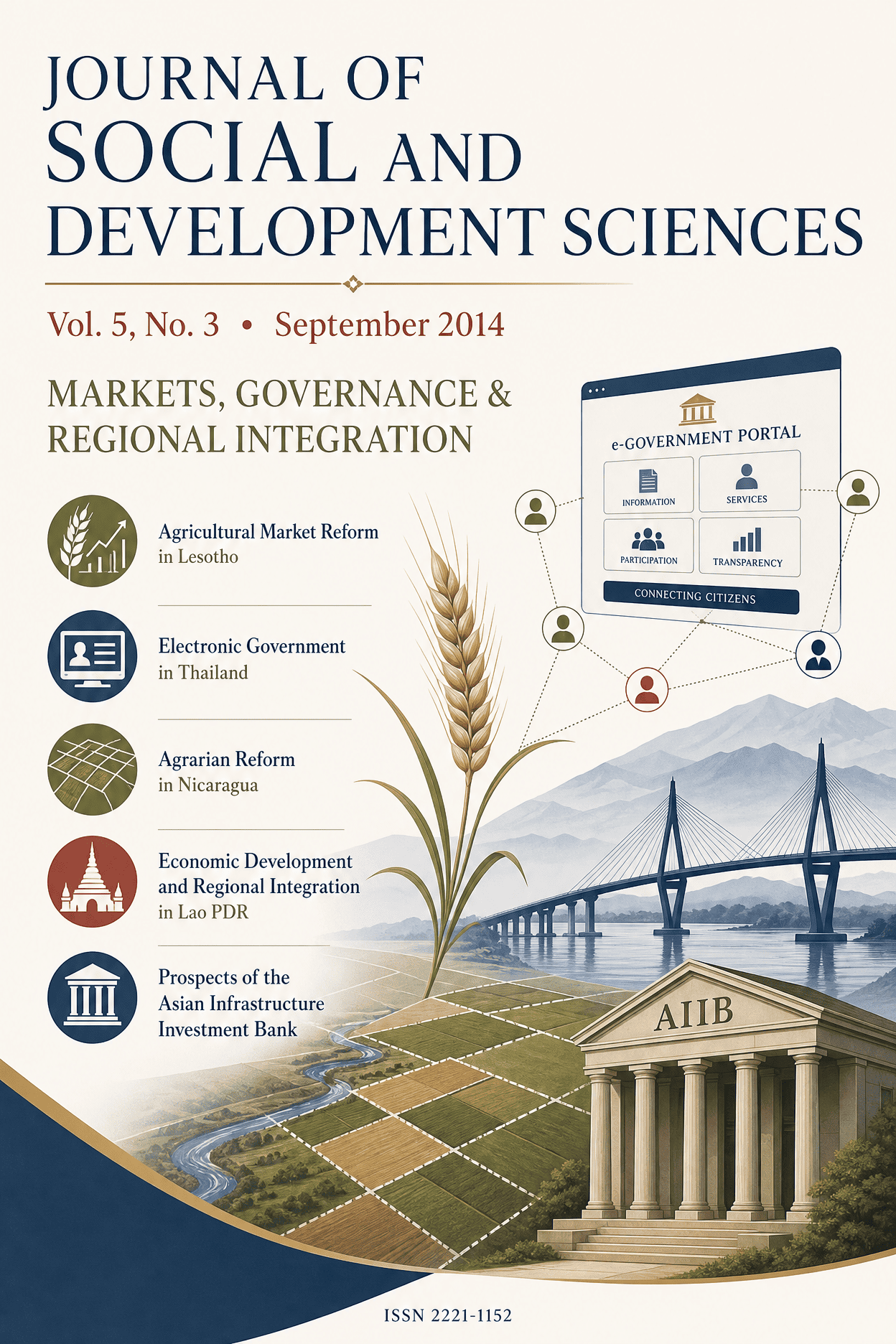
Articles

  • Article 1 in this issue

    The Structural Market Shift Review of Lesotho: Transitory Situational Analytic Market Policy Introspection for Sustainable Development

    • Author: Moses M. M. Daemane

    This paper analyzes Lesotho’s agricultural market in both state-regulated and liberalized policy. It identifies institutional constraints inhibiting efficient marketing in both policy systems. Realization of such constraints constitutes an analytic illumination on the formulation of strategies for poverty alleviation and sustainable development through agricultural marketing as the main sector with 86% of Lesotho’s poor subsistence producers. This desk-study comprehends the state and the market as imperfect institutions in sustainable development and alleviating poverty by unearthing constraints to pre and post agricultural market reforms in Lesotho. It thus examines Lesotho’s agricultural market transitory situational analysis and organization, providing empowering lessons in poverty reduction and sustainable development at grassroots level. Forms of state intervention before market reform, market reform process and progress and the institutional constraints and implications in poverty reduction and sustainable development are covered to attain critical lessons as cognitive knowledge applicable in empowering the poor in crops production, food security and sustainable development. State and the market and their active interaction have globally been believed to be institutional agencies with the main role of distributing resources towards poverty reduction and sustainable development but their imperfections and constraints hampering effectiveness and efficiency of such a role still lack adequate contextual review to effectively increase productivity and enrich lives of the poor agricultural producers, particularly in Lesotho.

    Pages 123-129

    PDF - The Structural Market Shift Review of Lesotho: Transitory Situational Analytic Market Policy Introspection for Sustainable Development (opens in a new tab)
  • Article 2 in this issue

    Approach of Electronic Government to Closing the Gap between Public and Citizens

    • Author: Krish Rugchatjaroen

    Electronic government uses ICT to improve public activities, bringing also greater organizational efficiency and effectiveness. The aim of this research is to study electronic government in Thailand to move towards success. The questionnaire obtained information on the current status of electronic government in Thailand which intendeds to investigate factors relating to information technology by interviewing state employees in National Electronics and Computer Technology Center: NECTEC. The results reveal 6 conclusion based upon the following area of study; 1) Investment: budget allocations for the integration of ICT in the public sector by considering the national strategic plan and the ASEAN community strategies, to increase the competitiveness and investigate in infrastructure and logistics. 2) Officials’ knowledge and understanding: involving the full cooperation from government agencies workshops on the development of information systems for public sector officials to allow implementation of the projects to restructure more efficiently the form of electronic government. 3) Citizens’ understanding: which investigated the public sectors acceptance of public participation and people-centered government services? There are wide gaps between those used in municipal and non-municipal area. 4) Networking: the form of networking through a collaborative network of TOT and CAT in the core layer, which makes the network redundancy and high availability. 5) Promoting: using website to promote activities and disseminate knowledge about technology in electronics and computer project or training. and 6) Policies: the manner the Ministry of Information and Communication Technology, allocates resources in their expansion of telecommunications infrastructure and communication channels and the way they encourage full access to ICT that will lead to close the gap.

    Pages 130-137

    PDF - Approach of Electronic Government to Closing the Gap between Public and Citizens (opens in a new tab)
  • Article 3 in this issue

    The Significance of the Agrarian reform in Nicaragua

    • Author: Wilm Johannes

    The term "land reform" is in Nicaragua often-times presented as a feature only associated with the government of the Frente Sandinista de Liberación Nacional (FSLN) of the 1980s (see for example Rocha, 2010; “Land reform reformed,” 1997; Zalkin, 1990), yet in this article I argue that some type of land redistribution has been the policy of all governments both before and after the 1980s, and that this process continues during the current FSLN government, but that the direction and the magnitude of the redistribution has changed significantly over time. One needs to understand this history and the considerations about Nicaraguans make about previous land redistribution patterns in order to make sense of what land ownership means in this country. While the land reform of the 1980s was the most direct redistribution, this article argues that land reform in favor of small-scale producers has been taken up again after 2007, even though it does not form part of official government policy. At the same time other factors seem to be if more importance in lowering economic differences.

    Pages 138-144

    PDF - The Significance of the Agrarian reform in Nicaragua (opens in a new tab)
  • Article 4 in this issue

    Recalibrating Asymmetric Relationships through Economic and Business Development: The Case of Lao PDR

    • Author: John Walsh, Nittana Southiseng

    Poor and land-locked, communist-ruled Laos began opening its economy to capitalist methods at the end of the 1980s. With a sparse population and very limited technical capacity, the country’s principal economic activities involve foreign investors building dams for hydroelectricity or mining for minerals that are destined for export. The local economy is dominated by small and uncoordinated enterprises operating in mostly undeveloped and unsophisticated markets. Laos is in the process of becoming more integrated into the Mekong Region by virtue of the building of parts of the Asian Highway Network across its territory and some opportunities arising from the planned single market of the ASEAN Economic Community which reaches a new phase in 2015. The vision is for Laos to become a bridge for economic development. However, it is not clear that the mere presence of infrastructure will be sufficient for Laotian companies and institutions to receive benefits on a substantial and sustainable basis. Principal difficulties are (i) underdeveloped public human resource capacities and institutional support systems, (ii) lack of industry clusters and facilities that can provide SMEs access to regional and global value chains and (iii) limited endowment of resources, logistics, finance and limited capabilities to meet market demand. This paper examines the conjunction between ability of Lao actors to participate in emergent economic activities and the country’s ability at government level to articulate its own developmental priorities and attempt to achieve these through negotiation with other states. This requires seeking to recalibrate hugely asymmetric relationships with China, Japan and Thailand, among others.

    Pages 145-154

    PDF - Recalibrating Asymmetric Relationships through Economic and Business Development: The Case of Lao PDR (opens in a new tab)
  • Article 5 in this issue

    Prospects of Asian Infrastructure Investment Bank

    • Author: Makmun Syadullah

    Infrastructure investment is one of the new sources of growth beside trade. However, the availability of infrastructure has become one of the major problems in the process of economic development in the region. Given the need for huge capital infrastructure in the region and the presence of the financing gap in infrastructure financing, the People Republic of Chinese (PRC) initiated the establishment of the Asian Infrastructure Investment Bank (AIIB). Thus, AIIB is expected to accelerate economic development and integration of Asia through the promotion of investment in the infrastructure sector. AIIB have several priority areas include transport, energy, communication, industry, and agriculture. The study used qualitative methods to compare the performance of various Multi Development Banks (MDBs) that existed such as IMF, ADB, IDB and WB with AIIB work plan. The results of this study will be expected to produce policy recommendations related to the formation of AIIB. AIIB initiative is the establishment of a relevant step with the spirit of accelerating economic development and integration of Asia to promote investment in the infrastructure sector. AIIB priority areas including transportation, energy, communication, industry, and agriculture is also a priority in developing countries. Openness in terms of membership (open regionalism) also showed that AIIB not only managed exclusively by the emerging countries in Asia but also opened to countries outside the region. The prospects of AIIB will be determined by how far the founding of PRC government transparency in every process both on stage and in the establishment of operational AIIB, how funding of AIIB direction forward and ensure it will not happen tied financing. This condition will be considered countries in the Asian region to join as founding members of AIIB.

    Pages 155-167

    PDF - Prospects of Asian Infrastructure Investment Bank (opens in a new tab)