Abstract
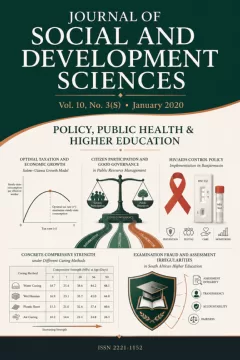
The structural use of concrete depends largely on its strength, especially compressive strength. Various tests were carried out to ascertain the properties of concrete materials, whereas test performances of the concrete with different mix ratios at specific ages of curing were undertaken. The study determined the compressive strength of concrete using different curing methods. Four different methods of curing (ponding, continuous wetting, open-air curing and sprinkling with water) were used. Seventy-two (72) cubes were cast using a mix ratio of 1:2:4 and 1:3:6 with 0.5 water cement ratio and with 0.6 waters cement ratio respectively. The compressive strengths were determined after 7 days, 14 days and at 28 days of curing. Findings show that for 1:2:4 concrete, maximum of 28-day compressive was the highest for concrete cured by ponding and the least was by sprinkling water. Further findings show that for 1:3:6 concrete, maximum of 28-day compressive strength was obtained using ponding and the least was open air curing. Despite ponding method producing the highest compressive strength of concrete, it is practically impossible to cure cubes above ground structural elements. Wet-covering method is recommended for structural elements, such as columns, beams and slabs in other to produce concrete of a required compressive strength.
Keywords
- Control Strength Search this journal for Control Strength (opens in a new tab)
- Compatibility Search this journal for Compatibility (opens in a new tab)
- Curing Conditions Search this journal for Curing Conditions (opens in a new tab)
- Concrete Development Search this journal for Concrete Development (opens in a new tab)
- Concrete Production Search this journal for Concrete Production (opens in a new tab)
References
- Al-Gahtani, A. S. (2010). Effect of curing methods on the properties of plain and blended cement concretes, Construction and Building Materials, 24(3), 308-314.
- Anum, I., Williams, F. N. & Adole, A. M. (2014). Properties of different grades of concrete using mix design method.
- Bediako, M., Kevern, J. & Amankwah, E. (2015). Effect of Curing Environment on the Strength Properties of Cement and Cement Extenders. Materials Sciences and Applications, 6, 33-39.
- Bingöl A. F. & Tohumcu İ. (2013). Effects of different curing regimes on the compressive strength properties of self-compacting concrete incorporating fly ash and silica fume, Materials & Design, 51, 12-18.
- BS, 1881. (1992). Method for determination of density of partially compacted semi-dry fresh concrete, part 3, British Standards Institution.
- BS, 1881-102. (1983). Methods of testing concrete. Method for determination of slump (AMD 6090) (AMD 6727).
- BS, 812. (1985). Testing aggregates - Part 103: Methods for determination of particle size distribution - Section 103.1- Sieve tests. British Standards Institution, London.
- BS, 882. (1992). Specification for aggregates from natural sources for concrete. British Standards Institution, London.
- Bushlaibi, A. B. (2004). Effects of environment and curing methods on the compressive strength of silica fume high-strength concrete, Advances in Cement Research, 16(1), 17-22.
- Ferreira, L., de Brito, J. & Saikia, N. (2012). Influence of curing conditions on the mechanical performance of concrete containing recycled plastic aggregate, Construction and Building Materials, 36, 196-204.
- Fonseca, N., de Brito, J. & Evangelista, L. (2011). The influence of curing conditions on the mechanical performance of concrete made with recycled concrete waste, Cement and Concrete Composites, 33(6), 637-643.
- Goel, A., Narwal, J., Verma, V., Sharma, D. & Singh, B. (2013). Comparative Study on the Effect of Curing on The Strength of Concrete, International Journal of Engineering and Advanced Technology (IJEAT), 2 (6), 401-406.
- IS, 456. (2000). Plain and Reinforced Concrete—Code of Practice—Bureau of Indian Standards, New Delhi.
- Jackson, E. N. & Akomah, B. B. (2018). Comparative Analysis of the Strength of Concrete with different Curing Methods in Ghana. The International Journal of Engineering and Science (IJES), 7(9), 39-44
- Jackson, E. N., Mustapha, Z. & Kotey, S. (2019). Compressive Strength of Concrete Produced with Proportions of Coconut and Palm Kernel Shells. International Journal of Architecture, Engineering and Construction, 8(1), 35-41.
- Ling, I. H. & Teo, D. C. L. (2011). Properties of EPS RHA lightweight concrete bricks under different curing conditions, Construction and Building Materials, 25(8), 3648-3655.
- Mohamed, H. A. (2011). Effect of fly ash and silica fume on compressive strength of self-compacting concrete under different curing conditions, Ain Shams Engineering Journal, 2, 79-86.
- Nahata, Y., Kholia, N. & Tank, T. (2014). Effect of curing methods on efficiency of curing of cement mortar, APCBEE Procedia, 9, 222–229.
- Neville, A. M. (2010). Properties of concrete, Longman Group Ltd, England.
- Ogah, O. (2016). Effect of Curing Methods on the Compressive Strength of Concrete, International Journal of Advanced Trends in Computer Science and Engineering.
- Olanitori, L. M. (2012). Cost Implication of Mitigating the Effect of Clay/Silt Content of Sand on Concrete, Compressive Strength. J. Civil Eng. Urban, 2(4), 143-148.
- Osama, M. and Omar, N. (2019). IOP Conf. Ser.: Mater. Sci. Eng. 471 032059.
- Padhi, S. (2014). 6 Methods of curing concrete.
- Raheem, A. A., Soyingbe, A. A. & Emenike, A. J. (2013). Effect of curing methods on density and compressive strength of concrete. International Journal of Applied Science and Technology, 3(4).
- Raheem, A. A., Soyingbe, A. A. & Emenike, A. J. (2013). Effect of curing methods on density and compressive strength of concrete. International Journal of Applied Science and Technology, 3(4), 55-64.
- Shih-Wei, C. (2013). Effect of Silt Fines on the Durability Properties of Concrete, Journal of Applied Science and Engineering, 16(4), 425-430.
- Silva, R., de Brito, J. & Saikia, N. (2013). Influence of curing conditions on the durability-related performance of concrete made with selected plastic waste aggregates. Cement and Concrete Composites, 35(1), 23-31.
- Surana, S., Pillai, R. & Santhanam. (2017). Performance evaluation of field curing methods using durability index tests. Indian Concrete Journal, 91.
- Teo, D. C. L., Mannan, M. A. & Kurian, V. J. (2010). Durability of lightweight OPS concrete under different curing conditions. Mater Struct, 43(1).
- Tijani, A. M. & Mustapha, Z. (2017). Compressive Strength of Concrete Based on Laterite and Sea Sand Mixture. International Journal of Architecture, Engineering and Construction, 6(4), 44-49.
- Velosa A. L. & Cachim P. B. (2009). Hydraulic-lime based concrete: Strength development using a pozzolanic addition and different curing conditions, Construction and Building Materials, 23(5), 2107-2111.
- YazicI, H., Yardımcı, M. Y., Aydın, S. & Karabulut, A. Ş. (2009). Mechanical properties of reactive powder concrete containing mineral admixtures under different curing regimes, Construction and Building Materials, 23(3), 1223-1231.
Downloads
No downloads have been recorded for this article yet. Figures appear here once readers begin downloading the full text.
How to Cite
Share this article
License
Copyright (c) 2020 Daniel Yaw Osei, Zakari Mustapha, Mohammed D.H. Zebilila (Author)

This work is licensed under a Creative Commons Attribution 4.0 International License.
Author (s) should affirm that the material has not been published previously. It has not been submitted and it is not under consideration by any other journal. At the same time author (s) need to execute a publication permission agreement to assume the responsibility of the submitted content and any omissions and errors therein. After submission of revised paper in the light of suggestions of the reviewers, the editorial team edits and formats manuscripts to bring uniformity and standardization in published material.
This work will be licensed under Creative Commons Attribution 4.0 International (CC BY 4.0) and under condition of the license, users are free to read, copy, remix, transform, redistribute, download, print, search or link to the full texts of articles and even build upon their work as long as they credit the author for the original work. Moreover, as per journal policy author (s) hold and retain copyrights without any restrictions.
Keywords
- Control Strength Search this journal for Control Strength (opens in a new tab)
- Compatibility Search this journal for Compatibility (opens in a new tab)
- Curing Conditions Search this journal for Curing Conditions (opens in a new tab)
- Concrete Development Search this journal for Concrete Development (opens in a new tab)
- Concrete Production Search this journal for Concrete Production (opens in a new tab)
Section
Published
Submissions
Have research to publish? Journal of Social and Development Sciences welcomes submissions.
Make a Submission