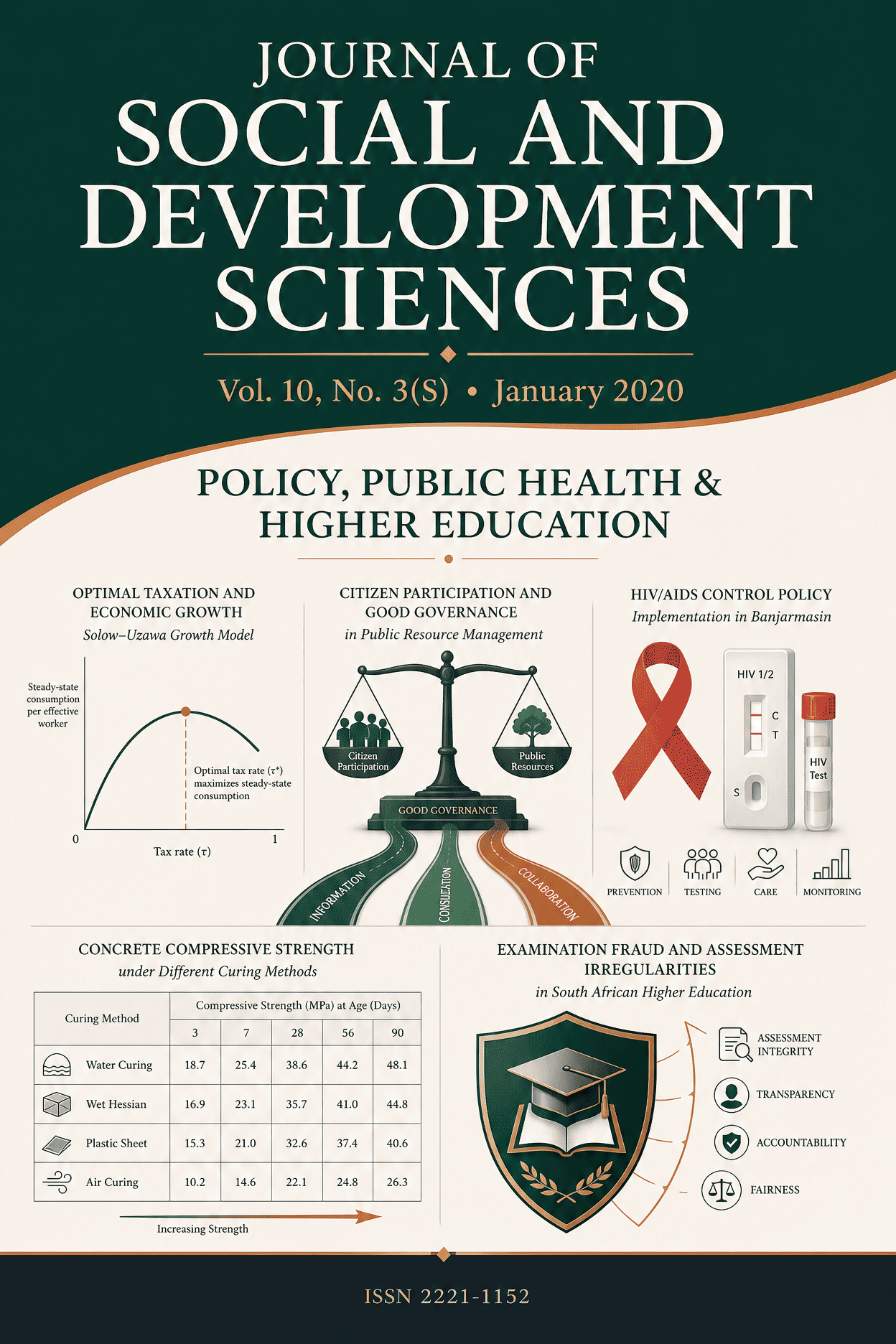
Articles

  • Article 1 in this issue

    Optimal Taxation in the Solow-Uzawa Growth Model with Public Goods

    • Author: Wei-Bin Zhang

    This paper makes an original contribution to the literature of optimal taxation by introducing Ramsey taxation to the Solow-Uzawa growth model to examine genuine dynamic interdependence between growth and optimal taxation. We introduce a public sector to the Uzawa two-sector growth model. The public sector supplies public goods and services. The government financially supports by the public sector by collecting taxes on the household’s wage income and wealth income under the assumption that the utility level is maximized. We derive the optimal taxation rule and construct the dynamics of the national economy. The model studies a nonlinear dynamics between national and sectoral growth, economic structural change, wealth/capital accumulation, and optimal tax rates in perfect competitive markets with the government intervention. The model has a unique stable equilibrium point with the chosen parameter values. We carry out comparative dynamic analysis to analyze effects of exogenous changes in a few parameters on the transitional process and long-term economic structure of the economic dynamics.

    Pages 1-11

    PDF - Optimal Taxation in the Solow-Uzawa Growth Model with Public Goods (opens in a new tab)
  • Article 2 in this issue

    The Socio-Political Dynamic Import of Citizens Participation in Public Resource Management in Relation to Good Governance for South Africa

    • Author: Andrew Osehi Enaifoghe, Tafadzwa C. Maramura, Israel K. Ekanade, Hannah Muzee

    This article looks at the social fundamentals in Africa’s political governance in relation to basic leadership and its system of administration regarding public office holders vis-a-vis political leaders. In an attempt to address the research question, it conceptualizes the dynamics of having a transparent government, in the changing pattern in leadership in relation to good administration of governance and the management of public goods and delivery of services to general public, a system for which the discourse changes in Africa’s legislative issues. This article focuses on the structures of interaction from the national to local level it then brings up development of events that seem to be basic to all African politics, which may have been inciting the changes in the original patterns. It identifies socio-political and economic policies as bedrock that is central to a country’s stability and development. Inevitably, a properly established economic policy is needed to ensure the sustainability, strength, development, and delivery, of public goods efficiently. This article contributes to the political discourse in Africa, which may have continued to this day and findings shows the obvious failures on the part of political leaders’ and their inability to manage public resources, thereby making them deviate from their campaign manifestos or become detached from people-centred fundamental issues of governance. Qualitatively, this article is conducted and guided by Stewardship and Corporate Governance theory. It objectively looks at the keys of good governance as its objective in the post-independence African public sector in providing an enabling environment and effective regulatory framework.

    Pages 12-21

    PDF - The Socio-Political Dynamic Import of Citizens Participation in Public Resource Management in Relation to Good Governance for South Africa (opens in a new tab)
  • Article 3 in this issue

    Suitability of the HIV/AIDS Control Program in the HIV/AIDS Control Policy in Banjarmasin to Achieve "Getting to Zero"

    • Author: Nana Noviana, Sri Suwitri, Bambang Supriyono, Sutopo Patria Jati

    Increasing HIV/AIDS infection has made Banjarmasin City government increasingly worried, so that the realization of policy implementation is needed to solve the problem. Because if the problem of HIV/AIDs is allowed to have an impact on regional development, budgeting and also have an impact on poverty. Based on these, this research is focused on the suitability of the program with the needs of the community in implementing HIV/AIDS control policies. This study aims to describe, analyze and interpret matters relating to the suitability of the program with the need to implement policies in an effort to control HIV/AIDS in the city of Banjarmasin. The qualitative research method uses a descriptive approach based on a public policy perspective. This study seeks to present the empirical facts of the Banjarmasin City government's naturalistic actions and reveal hidden values. So it is expected to illustrate the phenomenon of the implementation of government policies regarding the suitability of the program with the need to control HIV/AIDS in the city of Banjarmasin. Based on the results of the study, it can be concluded that the suitability of the program with the needs in the Implementation of HIV/AIDS Control Policy in the city of Banjarmasin has not run in accordance with the contents of the local regulations. Incompatibility of HIV/AIDS control programs with community needs in the city of Banjarmasin and the lack of stakeholder support and coordination in efforts to control HIV/AIDS based on these findings and the suggestion of this research, it will help the Banjarmasin City Government take HIV/AIDS control policies that are oriented towards the needs of the people in Banjarmasin City. This research also aims to contribute to the public policy scientific literature and individuals involved in controlling HIV/AIDS in the City of Banjarmasin.

    Pages 22-29

    PDF - Suitability of the HIV/AIDS Control Program in the HIV/AIDS Control Policy in Banjarmasin to Achieve "Getting to Zero" (opens in a new tab)
  • Article 4 in this issue

    Compressive Strength of Concrete Using Different Curing Methods

    • Author: Daniel Yaw Osei, Zakari Mustapha, Mohammed D.H. Zebilila

    The structural use of concrete depends largely on its strength, especially compressive strength. Various tests were carried out to ascertain the properties of concrete materials, whereas test performances of the concrete with different mix ratios at specific ages of curing were undertaken. The study determined the compressive strength of concrete using different curing methods. Four different methods of curing (ponding, continuous wetting, open-air curing and sprinkling with water) were used. Seventy-two (72) cubes were cast using a mix ratio of 1:2:4 and 1:3:6 with 0.5 water cement ratio and with 0.6 waters cement ratio respectively. The compressive strengths were determined after 7 days, 14 days and at 28 days of curing. Findings show that for 1:2:4 concrete, maximum of 28-day compressive was the highest for concrete cured by ponding and the least was by sprinkling water. Further findings show that for 1:3:6 concrete, maximum of 28-day compressive strength was obtained using ponding and the least was open air curing. Despite ponding method producing the highest compressive strength of concrete, it is practically impossible to cure cubes above ground structural elements. Wet-covering method is recommended for structural elements, such as columns, beams and slabs in other to produce concrete of a required compressive strength.

    Pages 30-38

    PDF - Compressive Strength of Concrete Using Different Curing Methods (opens in a new tab)
  • Article 5 in this issue

    Socioeconomic Implications of Examination Fraud and Assessment Irregularities in South Africa’s Higher Education Sector: A Futuristic View

    • Author: Chux Gervase Iwu

    This paper, based on scholarly as well as documentary evidence, intends to highlight the socioeconomic implications of fraud and assessment irregularities in South Africa’s higher education. Higher education institutions serve nation building purposes and as such it is expected that what they produce should be of high standard in order to further this purpose. Lately, owing to the rise in assessment malpractices across South African institutions of higher learning, calls have been made by business and society for ways to deal with this. This paper asks a few questions related to what constitutes fraud and assessment irregularities and the sources of these. The paper also points out what these portend for higher education in South Africa while at the same suggesting some recommendations. This paper contributes to the literature on the growing concerns of educators and researchers regarding high levels of examination malpractice and assessment irregularities within higher education sector globally, but in particular South Africa.

    Pages 39-47

    PDF - Socioeconomic Implications of Examination Fraud and Assessment Irregularities in South Africa’s Higher Education Sector: A Futuristic View (opens in a new tab)