Abstract
Employee turnover is stated as a huge issue concerning business organizations in Qatar. The organizations in the food and beverage industry of Qatar try to retain the employees by using suitable and appropriate human resource policies. Consequently, the paper analyzed the influence of human resources management practices on employee’s retention in the food and beverage industry of Qatar. In the present study, the researcher used a simple random sampling method to select the employees in the F&B industry in Qatar to minimize the chances of sampling error or fluctuations and biases in the data. According to the sample size calculation, 41 samples were used for data collection. But only 35 respondents were given responses to questionnaire filling. Therefore, 35 samples were only used in this study. Thus, a survey questionnaire was the research instrument. The questionnaire contained 14 close-ended questions, divided, into two sections, demographic and non-demographic. Considering the study objectives, the quantitative, data analysis method was applied in this study. The survey responses were converted into numeric values as those were collected through a replicable scale. Inferential, reliability, correlation and multiple regression analysis were applied to test the hypotheses. The study concluded that HR Recruitment policy, Training, and development program, Performance appraisal system; Reward system are important determinants of employee retention in the food and beverage industry of Qatar. Specifically, the reasons for increasing employee's turnover are lack of growth opportunities, poor communication, improper promotional activities, and misalignment of culture and value system, lack of decision-making ability, employee welfare, work-life imbalance and regular changes in job responsibilities. The study, therefore, recommended the following: greater employee’s involvement in the HRM policy formulation and implementation, improved employee’s compensation, social recognition, efficient top management support, as well as improved training and development in the food and beverage industry in Qatar .
Keywords
- Human Resource Management Practices Search this journal for Human Resource Management Practices (opens in a new tab)
- Employee’s Retention Search this journal for Employee’s Retention (opens in a new tab)
- Factor Analysis Search this journal for Factor Analysis (opens in a new tab)
- Food and Beverage Industry Search this journal for Food and Beverage Industry (opens in a new tab)
- Qatar Search this journal for Qatar (opens in a new tab)
References
- Abaker, M. O. S. M., Al-Titi, O. A. K. & Al-Nasr, N. S. (2018). Organizational policies and diversity management in Saudi Arabia. Employee Relations , 23(5), 17-36 .
- Abelson, M. A. & Baysinger, B. D. (2017). The impact of training intensity on establishment productivity. In The Economics of Trade Unions: A Study of a Research Field and Its Findings. Madison, WI: Garland.
- Abston, K. & Kupritz, V. (2011). Employees as customers: Exploring service climate, employee patronage, and turnover. Performance Improvement Quarterly , 23(4), 7-26.
- Aguenza, B. B. & Som, A. P. M. (2018). Motivational factors of employee retention and engagement in organizations. IJAME.
- Aktaş, E. & Yeasmin, N. (2015). Market Entry Strategies of Multinational Companies in Qatar: An Empirical Analysis of Food and Beverage Industry. AV Akademikerverlag.
- Albrecht, S. L., Bakker, A. B., Gruman, J. A., Macey, W. H. & Saks, A. M. (2015). Employee engagement, human resource management practices and competitive advantage: An integrated approach. Journal of Organizational Effectiveness: People and Performance , 2(1), 7-35.
- Arkalgud, R. (2017). Contributions of the Corporate Sector to Sustainable Development. In Biodiversity for Sustainable Development (pp. 31-78). Springer, Cham.
- Awolusi, O. D. (2021). Economic Growth and Socioeconomic Sustainability in BRICS Countries: A Vector Error Correction Modeling Approach, Journal of Economics and Behavioral Studies , 13(3), 1-23.
- Awolusi, O. D., Pelser, T. G. & Adelekan, A. S. (2016). Determinants of Foreign Direct Investment: New Granger Causality Evidence from Asian and African Economies, Journal of Economics and Behavioral Studies , 8(1), 104-119.
- Awolusi, O. D. & Atiku, O. S. (2019). Business Process Re-Engineering and Profitability in the Nigerian Oil and Gas Industry: The Mediating Influence of Operational Performance, Information Management and Business Review , 11(3), 13-26.
- Awolusi, O. D., Onikoyi, I. A. & Akindele, K. T. (2015). An Empirical Investigation of Leadership Styles and Their Effect on Organisational Performance of Banks in Ado Ekiti, Nigeria, International Journal of Investment Management and Financial Innovations , 1(2), 49-55.
- Awosusi, O. O. & Awolusi, O. D. (2014). Technology Transfer, Foreign Direct Investment and Economic Growth in Nigeria, Africa Development, 39(2), 1–20.
- Barua, A. (2013). Methods for decision-making in survey questionnaires based on Likert scale. Journal of Asian Scientific Research , 3(1), 35-38.
- Bauer, T. N. & Erdogan, B. (2015). Leader-member exchange (LMX) theory. In The Oxford Handbook of Leader-Member Exchange.
- Baumann-Pauly, D. & Nolan, J. (2016). Business and human rights: from principles to practice. Routledge.
- Benjamin, L. (2003). Keeping good people in today's labor market. Journal of Housing and Community Development , 60(5), 42-45.
- Bolarinwa, O. A. (2015). Principles and methods of validity and reliability testing of questionnaires used in social and health science researches. Nigerian Postgraduate Medical Journal , 22(4), 189-195.
- Bratton, J. & Gold, J. (2017). Human resource management: theory and practice. Palgrave.
- Brewster, C., Chung, C. & Sparrow, P. (2016). Globalizing human resource management. Routledge.
- Bryman, A. & Bell, E. (2015). Business research methods. Oxford University Press, USA.
- Chen, L., Feldmann, A. & Tang, O. (2015). The relationship between disclosures of corporate social performance and financial performance: Evidence from GRI reports in manufacturing industry. International Journal of Production Economics , 170, 445-456.
- Davis, D. N. & Luiz, J. M. (2015). The devolution of the human resources function in South African multinational companies. The International Journal of Human Resource Management , 26(21), 27632785.
- De Vaus, D. (2013). Surveys in social research. Routledge.
- Dzenopoljac, V., Yaacoub, C., Elkanj, N. & Bontis, N. (2017). Impact of intellectual capital on corporate performance: Evidence from the Arab region. Journal of Intellectual Capital , 18(4), 884-903.
- Elbanna, S. & Kamel, H. (2015). Measuring hotel performance using the balanced scorecard: A theoretical construct development and its empirical validation. International Journal of Hospitality Management , 51(1), 105-114.
- Escamirosa, F. P., Flores, R. M. O., García, I. O., Vidal, C. R. Z. & Martínez, A. M. (2015). Face, content, and construct validity of the EndoViS training system for objective assessment of psychomotor skills of laparoscopic surgeons. Surgical endoscopy , 29(11), 3392-3403.
- Farouk, S., Abu Elanain, H. M., Obeidat, S. M. & Al-Nahyan, M. (2016). HRM practices and organizational performance in the UAE banking sector: The mediating role of organizational innovation. International Journal of Productivity and Performance Management , 65(6), 773-791.
- Glebbeek, A. & Bax, E. (2004). Is High Employee Turnover Really Harmful? An Empirical Test Using Company Records. Academy of Management Journal , 47(2), 277-286.
- Heale, R. & Twycross, A. (2015). Validity and reliability in quantitative studies. Evidence-based nursing, pp.ebnurs-2015.
- Heiman, G. (2013). Basic statistics for the behavioral sciences. Cengage Learning.
- Hollenbeck, J. R. & Jamieson, B. B. (2015). Human capital, social capital, and social network analysis: Implications for strategic human resource management. Academy of management perspectives , 29(3), 370-385.
- Hollis, C. (2017). Developing Generation Z Fast Food Service Industry Leaders through Training. Joshi, A., Kale, S., Chandel, S. & Pal, D. K. (2015). Likert scale: Explored and explained. British Journal of Applied Science & Technology, 7(4), 178-396.
- Kavanagh, M. J. & Johnson, R. D. (2017). Human resource information systems: Basics, applications, and future directions. Sage Publications.
- Lasrado, F. (2018). Achieving Organizational Excellence: A Quality Management Program for Culturally Diverse Organizations. Springer.
- Levy, P. S. & Lemeshow, S. (2013). Sampling of populations: methods and applications. John Wiley & Sons.
- Lewis, S. (2015). Qualitative inquiry and research design: Choosing among five approaches. Health promotion practice, 16(4), 473-475.
- Manalili, N. M. (2017). Scoping Study on Reducing Unnecessary Regulatory Burdens in the Qatar Food Manufacturing Industry.
- McDaniel, C. & Gates, R. (2013). Marketing research. Singapore.
- Michele Kacmar, K., Andrews, M. C., Van Rooy, D. L., Chris Steilberg, R. & Cerrone, S. (2006). Sure everyone can be replaced but at what cost? Turnover as a predictor of unit-level performance. Academy of Management Journal , 49(1), 133-144.
- Moayeri, R. (2014). Effects of Perception of Performance Appraisal Politics on Organizational Commitment and Job Satisfaction in Food and Beverage Industry in Qatar (Doctoral dissertation, Eastern Mediterranean University (EMU)-Doğu Akdeniz Üniversitesi (DAÜ)).
- Nardi, P. M. (2018). Doing survey research: A guide to quantitative methods. Routledge.
- Neuman, W. L. (2013). Social research methods: Qualitative and quantitative approaches. Pearson education.
- Oladejo, M. J. & Awolusi, O. D. (2017). Effect of Work-Family Role Conflicts on Employees’ Commitment and Organisational Performance: A study of AKLAD Interlink concept, Nigeria, Global Journal of Commerce and Management Perspective, 7(2), 81-96.
- Olayisade, A. & Awolusi, O. D. (2021). The Effect of Leadership Styles on Employee’s Productivity in the Nigerian Oil and Gas Industry, Information Management and Business Review , 13(1), 47-64
- Onikoyi, I. A. & Awolusi, O. D. (2015). Mission Statement and Bank Performance: Evidence from Nigerian Banking Industry, International Journal of Management Sciences , 4(7), 290–297.
- Parsa, H. G. & Kwansa, F. A. (2014). Quick service restaurants, franchising, and multi-unit chain management. Routledge.
- Peng, M. W. (2016). Global business . Cengage Learning.
- Roloff, M. E. (2015). Social Exchange Theories. The International Encyclopaedia of Interpersonal Communication, 1-19.
- Rovai, A. P., Baker, J. D. & Ponton, M. K. (2013). Social science research design and statistics: A practitioner's guide to research methods and IBM SPSS. Watertree Press LLC.
- Selden, S. C. & Sowa, J. E. (2015). Voluntary turnover in non-profit human service organizations: The impact of high-performance work practices. Human Service Organizations: Management, Leadership & Governance , 39(3), 182-207.
- Setia, M. S. (2016). Methodology series module 5: Sampling strategies. Indian journal of dermatology, 61(5), 498-505.
- Stone, D. L. & Deadrick, D. L. (2015). Challenges and opportunities affecting the future of human resource management. Human Resource Management Review , 25(2), 139-145.
- Van der Wagen, L. & White, L. (2014). Human resource management for the event industry. Routledge.
- Zak, P. (2017). Trust factor: The science of creating high-performance companies. Amazon.
- Chew, J. & Chan, C. C. A. (2008). Human resource practices, organizational commitment and intention to stay. International Journal of Manpower, 29(6), 503–522.
- Hong, E. N. C., Hao, L. Z. & Kumar, R. (2012). An effectiveness of human resource management practices on employee retention in the institute of higher learning: a regression analysis. International Journal of Business Research and Management , 3(2), 60–79.
- Hsin-His, Lai. (2011). The influence of compensation system design on employee satisfaction. African Journal of Business Management, 5(26), 23-34.
Downloads
No downloads have been recorded for this article yet. Figures appear here once readers begin downloading the full text.
How to Cite
Share this article
License
Copyright (c) 2022 Olawumi Dele Awolusi, Shirley Shamen Jayakody (Author)

This work is licensed under a Creative Commons Attribution 4.0 International License.
Author (s) should affirm that the material has not been published previously. It has not been submitted and it is not under consideration by any other journal. At the same time author (s) need to execute a publication permission agreement to assume the responsibility of the submitted content and any omissions and errors therein. After submission of revised paper in the light of suggestions of the reviewers, the editorial team edits and formats manuscripts to bring uniformity and standardization in published material.
This work will be licensed under Creative Commons Attribution 4.0 International (CC BY 4.0) and under condition of the license, users are free to read, copy, remix, transform, redistribute, download, print, search or link to the full texts of articles and even build upon their work as long as they credit the author for the original work. Moreover, as per journal policy author (s) hold and retain copyrights without any restrictions.
Keywords
- Human Resource Management Practices Search this journal for Human Resource Management Practices (opens in a new tab)
- Employee’s Retention Search this journal for Employee’s Retention (opens in a new tab)
- Factor Analysis Search this journal for Factor Analysis (opens in a new tab)
- Food and Beverage Industry Search this journal for Food and Beverage Industry (opens in a new tab)
- Qatar Search this journal for Qatar (opens in a new tab)
Section
Published in
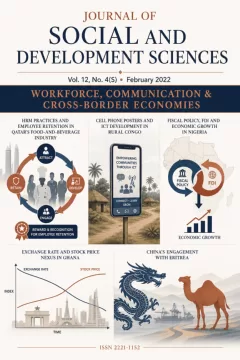 Vol. 12 No. 4(S) (2021)
Workforce, Communication & Cross-Border Economies
View issue contents
Published
Submissions
Have research to publish? Journal of Social and Development Sciences welcomes submissions.
Make a Submission