Articles

  • Article 1 in this issue

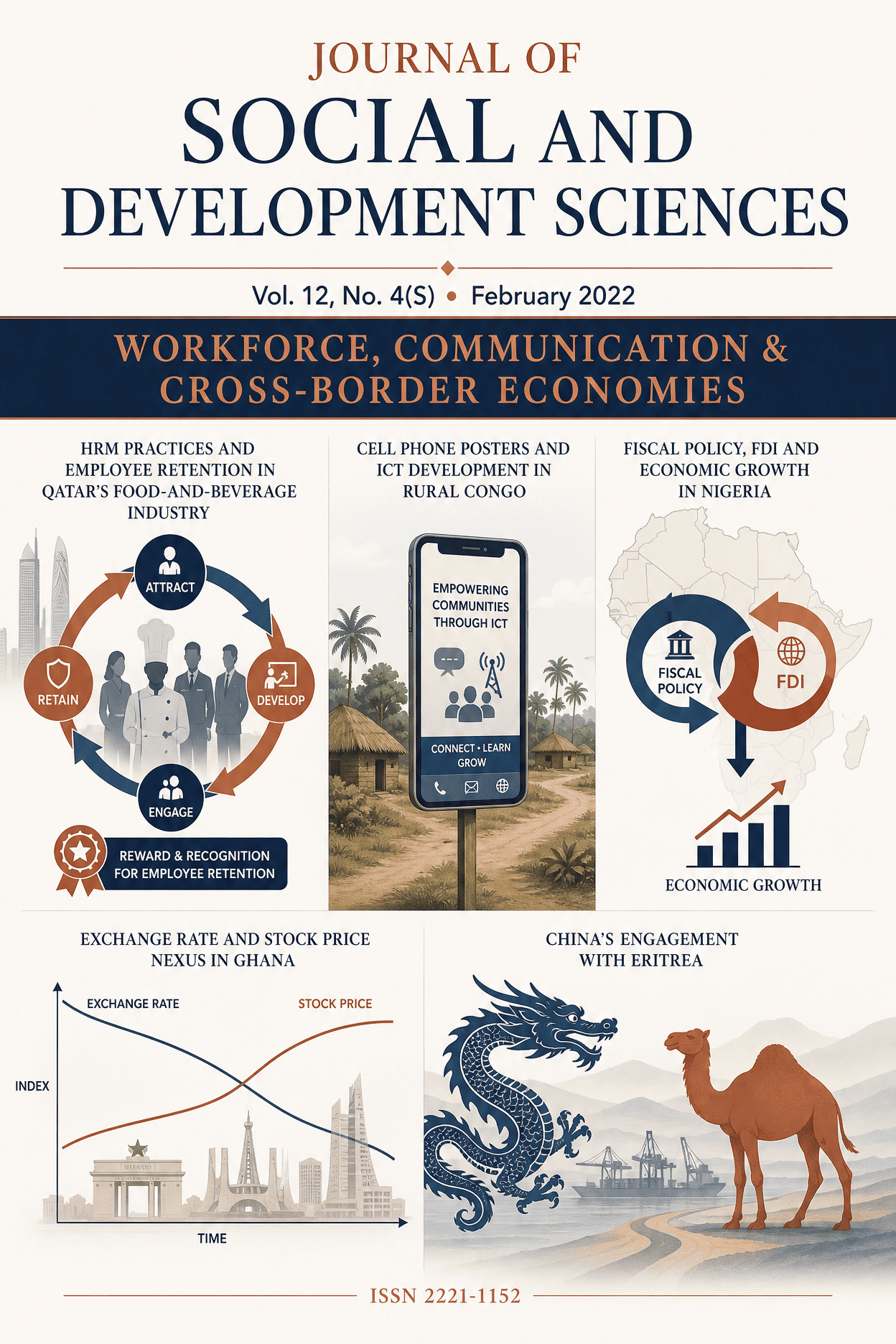
    An Investigation into the Nexus between Fiscal Policy, Foreign Direct Investment and Economic Growth in Nigeria

    • Author: Patrick, OLOGBENLA

    The study examined the relationship between foreign direct investment and fiscal policy and the implication of the relationship on the Nigerian economic growth, the years under review were 1980 to 2019. Variables such as government expenditure, government revenue among others were used to proxy fiscal policy while data on foreign direct investment were used for FDI. The GDP growth rate was used as a proxy for the Nigerian economic growth. The study applied Autoregressive Distributed Lags estimating techniques. The result from the analysis indicated that the association between foreign direct investment and fiscal policy could not have a significant effect on the economic growth of Nigeria in the long run but, in the short run, the association was significant. The study recommends more collaboration between fiscal policy and foreign direct investment in such a way that it will promote the growth of the Nigerian economy.

    Pages 1-8

    PDF - An Investigation into the Nexus between Fiscal Policy, Foreign Direct Investment and Economic Growth in Nigeria (opens in a new tab)
  • Article 2 in this issue

    Exchange Rate and Stock Price Nexus: Evidence from Ghana

    • Author: Peter Arhenful, Richard Fosu, Mathew Owusu-Mensah

    This study aimed at investigating the link between the Ghanaian exchange rate and stock prices from July 2007 to December 2019, to establish whether appreciation in exchange rate causes stock price increases or otherwise. The Ghana Stock Exchange's (GSE) All-Share Index; served as a proxy for stock prices, while nominal monthly exchange rates for the Ghana Cedi in terms of the US Dollar were utilized as a proxy exchange rate. The Pearson's Product Moment Correlation test was employed to evaluate the link between the two variables, and the Augmented Dickey-Fuller (ADF) test was employed to determine the data's stationarity qualities. The series were all non-stationary since they had unit roots; however, stationarity was attained at the first difference. The results of the regression and correlation analysis conducted revealed that the two macroeconomic variables are negatively connected in the Ghanaian context. In view of the negative association between the exchange rate and stock prices in Ghana, the study advises policymakers to be cautious when implementing exchange rate measures.

    Pages 9-15

    PDF - Exchange Rate and Stock Price Nexus: Evidence from Ghana (opens in a new tab)
  • Article 3 in this issue

    Posters and Development: A Case Study of Cell Phone Posters in the Rural Congo

    • Author: Sylvain Cibangu

    One of the benchmarks of the information age often forgotten is the proliferation of posters or billboards in and around workplaces, neighborhoods, airports, shopping centers, restaurants, theaters, libraries, schools, etc. More interestingly, through cell phones, posters are rapidly entering rural areas in developing countries. Although these posters come with specific messages and graphics – continually upgraded and tailored to people’s attention -- they hardly undergo scientific inquiry in circles concerned with information and communication technologies [ICTs]. The lack of attention raises questions on the role of information systems and related wireless devices being deployed in developing countries. The present paper aimed to canvass cell phone posters and unbundle the underlying practices and routines. As well as positioning posters at the center stage of ICT research, the present paper applied critical discourse analysis to inquire into ways in which development was represented or affected among populations in the rural Congo. The paper determined that posters were not centered on local populations and their day-to-day struggles/needs and that the information conveyed on posters was not geared toward the development of the world’s poorest. The paper crafted some paths for future work in ICT fields and cell phone bodies of work.

    Pages 16-38

    PDF - Posters and Development: A Case Study of Cell Phone Posters in the Rural Congo (opens in a new tab)
  • Article 4 in this issue

    Exploring the Impact of Human Resource Management Practices on Employee's Retention: Evidence from the Food and Beverage Industry in the State of Qatar

    • Author: Olawumi Dele Awolusi, Shirley Shamen Jayakody

    Employee turnover is stated as a huge issue concerning business organizations in Qatar. The organizations in the food and beverage industry of Qatar try to retain the employees by using suitable and appropriate human resource policies. Consequently, the paper analyzed the influence of human resources management practices on employee’s retention in the food and beverage industry of Qatar. In the present study, the researcher used a simple random sampling method to select the employees in the F&B industry in Qatar to minimize the chances of sampling error or fluctuations and biases in the data. According to the sample size calculation, 41 samples were used for data collection. But only 35 respondents were given responses to questionnaire filling. Therefore, 35 samples were only used in this study. Thus, a survey questionnaire was the research instrument. The questionnaire contained 14 close-ended questions, divided, into two sections, demographic and non-demographic. Considering the study objectives, the quantitative, data analysis method was applied in this study. The survey responses were converted into numeric values as those were collected through a replicable scale. Inferential, reliability, correlation and multiple regression analysis were applied to test the hypotheses. The study concluded that HR Recruitment policy, Training, and development program, Performance appraisal system; Reward system are important determinants of employee retention in the food and beverage industry of Qatar. Specifically, the reasons for increasing employee's turnover are lack of growth opportunities, poor communication, improper promotional activities, and misalignment of culture and value system, lack of decision-making ability, employee welfare, work-life imbalance and regular changes in job responsibilities. The study, therefore, recommended the following: greater employee’s involvement in the HRM policy formulation and implementation, improved employee’s compensation, social recognition, efficient top management support, as well as improved training and development in the food and beverage industry in Qatar .

    Pages 39-58

    PDF - Exploring the Impact of Human Resource Management Practices on Employee's Retention: Evidence from the Food and Beverage Industry in the State of Qatar (opens in a new tab)
  • Article 5 in this issue

    Dragon Meets Camel: An Exploration of China’s Engagement with Eritrea

    • Author: Dr Fikresus Amahazion

    Over the past several decades, the People’s Republic of China’s engagement with African countries has grown tremendously. China has emerged as Africa’s largest trading partner, while Chinese investment and lending to African countries has grown rapidly. In Eritrea, a young, developing country located in the Horn of Africa, Chinese involvement has also considerably increased in recent years. However, although there has been extensive study of China’s partnerships across the continent, very little work has been dedicated to examining its ties with Eritrea. What are the history and current scale of involvement? What has been the impact of this engagement on Eritrean society? What are locals’ overall perceptions about the relationship or about China more generally? Utilizing a mix of qualitative research methods, including surveys, the current paper explores China’s engagement with Eritrea, adding to the voluminous, ever-growing body of literature and helping to diversify and deepen understanding of this important topic. Additionally, although various narratives about the China-Africa relationship have arisen, often led and framed by non-Africans, the present study broadens the discussion by offering local, African perspectives on China-Africa links. Engagement and cooperation between China and Eritrea are longstanding and extend to numerous areas, driven by a range of interests, while local perceptions are quite nuanced and largely consistent with many cross-national studies.

    Pages 59-85

    PDF - Dragon Meets Camel: An Exploration of China’s Engagement with Eritrea (opens in a new tab)