Abstract
The research investigated how incentive alignment, together with information sharing and joint decision-making, impacts the supply chain performance of small and medium enterprises in Bushenyi District, Uganda. The study employed Relational Exchange Theory to analyze the supply chain performance of SMEs through a cross-sectional quantitative design, which collected data from 327 owners/managers using structured questionnaires. The results from Pearson correlation and multiple regression analysis showed that information sharing and joint decision-making positively affected supply chain performance but incentive alignment failed to produce a significant impact. The research results showed information sharing produced the most significant impact (β = 0.559, p < 0.01) followed by joint decision-making (β = 0.073, p < 0.05) yet incentive alignment did not produce a significant effect (β = –0.068, p > 0.05). The model explained 29.5% of the variance in supply chain performance (Adjusted R² = 0.295). The research indicates that better communication and collaborative planning serve as essential factors for achieving supply chain efficiency among rural SMEs. The study reveals that informal SME networks face specific challenges when attempting to establish formal reward systems because incentive alignment shows minimal impact. The research demonstrates that Bushenyi requires improved information systems together with enhanced participatory planning and digital infrastructure development to enhance supply chain outcomes. The recommendations include supporting digital communication platforms and providing institutional backing for collaborative decision-making processes and educating stakeholders about incentive-based partnership models.
Keywords
- Collaborative Relationships Search this journal for Collaborative Relationships (opens in a new tab)
- Incentive Alignment Search this journal for Incentive Alignment (opens in a new tab)
- Information Sharing Search this journal for Information Sharing (opens in a new tab)
- Joint Decision Making Search this journal for Joint Decision Making (opens in a new tab)
- Supply Chain Performance Search this journal for Supply Chain Performance (opens in a new tab)
- SMEs Search this journal for SMEs (opens in a new tab)
- Bushenyi District Search this journal for Bushenyi District (opens in a new tab)
References
- Agyapong, A., Acquah, I. S. K., & Aidoo, M. (2021). Informality and SME supply chains in Africa: Exploring the challenges of incentive structures. African Journal of Business Management, 15(2), 55–67.
- Akello, G., Tumwesigye, B., & Musinguzi, D. (2025). Supply chain constraints among SMEs in Uganda: A case of rural markets. Journal of African Business Studies, 21(1), 34–47.
- Argyropoulou, M., Sharma, M. K., Bhagwat, R., Lazarides, T., Koufopoulos, D. N., & Ioannou, G. (2010). Measuring supply chain performance in SMEs. Handbook on Business Information Systems, 699–715.
- Boyce, W. S., Mano, H., & Kent, J. L. (2016). The influence of collaboration in procurement relationships. International Journal of Managing Value and Supply Chains, 7(3), 43–56.
- Brinkhoff, A., Özer, Ö., & Sargut, G. (2015). All you need is trust. An examination of interorganizational supply chain projects. Production and Operations Management, 24(2), 181–200.
- Cao, M., Vonderembse, M. A., Zhang, Q., & Ragu-Nathan, T. S. (2010). Supply chain collaboration: Conceptualisation and instrument development. International Journal of Production Research, 48(22), 6613–6635.
- Chen, I. J., Yang, C., & Li, Y. (2007). Supply chain collaboration for service quality: A case study of telecom companies in China. Supply Chain Management: An International Journal, 12(2), 100–112.
- Christopher, M. (2005). Logistics and Supply Chain Management. Prentice Hall.
- Dwyer, F. R., Schurr, P. H., & Oh, S. (1987). Developing buyer-seller relationships. Journal of Marketing, 51(2), 11–27.
- Eyaa, S. and Ntayi, J.M. (2010). Procurement practices and supply chain performance of SMEs in Kampala. Asian Journal of Business Management, 2(4), 82–88.
- Fawcett, S. E., Magnan, G. M., & McCarter, M. W. (2011). Benefits, barriers, and bridges to effective supply chain management. Supply Chain Management: An International Journal, 13(1), 35–48.
- Fynes, B., Voss, C., & de Búrca, S. (2005). The impact of supply chain relationship quality on quality performance. International Journal of Production Economics, 96(3), 339–354.
- Graca, S. S., Barry, J. M., & Doney, P. M. (2015). Performance outcomes of behavioral attributes in buyer-supplier relationships. Industrial Marketing Management, 46, 135–144.
- Hamiza, Y. and Isoh, M.A. (2019). The effect of procurement practices on organizational performance: A case of selected manufacturing firms in Nigeria. International Journal of Supply Chain Management, 8(5), 1041–1048.
- Heide, J. B., & John, G. (1990). Alliances in industrial purchasing: The determinants of joint action in buyer-supplier relationships. Journal of Marketing Research, 27(1), 24–36.
- Jain, V., Wadhwa, S., & Deshmukh, S. G. (2009). Revisiting information systems to support a supply chain. Industrial Management & Data Systems, 109(1), 1–23.
- Javanmardi, F., Shahraki, M. and Moinzadeh, A. (2012). The relationship between achievement goal orientation and academic achievement: A study on Iranian EFL students. Procedia - Social and Behavioral Sciences, 46, 4012–4016.
- Kim, S. W., Umanath, N. S., & Kim, K. K. (2005). An assessment of electronic information transfer in B2B supply-chain relationships. Journal of Management Information Systems, 22(3), 293–320.
- Kohli, R., & Jensen, T. (2010). Assessing information value in supply chains. Decision Support Systems, 48(4), 635–641.
- Krause, D. R., Handfield, R. B., & Tyler, B. B. (2007). The relationships between supplier development, commitment, social capital accumulation and performance improvement. Journal of Operations Management, 25(2), 528–545.
- Krejcie, R.V. and Morgan, D.W. (1970). Determining sample size for research activities. Educational and Psychological Measurement, 30(3), 607–610.
- Leng, C., & Zailani, S. (2012). The impact of information sharing on supply chain performance: A study of Malaysian SMEs. International Journal of Physical Distribution & Logistics Management, 42(6), 475–501.
- Li, S., Yang, Y., Sun, B., & Sohal, A. (2009). Supply chain collaboration: How do interorganizational relationships affect information sharing? Supply Chain Management: An International Journal, 14(5), 401–414.
- Mensah, I. K., & Boateng, R. (2023). Supply chain agility and resilience: The role of incentive alignment in Ghanaian SMEs. Journal of Small Business and Enterprise Development, 30(2), 325–340.
- Min, S. (2005). The role of information technology in supply chain collaboration. Journal of Business Logistics, 26(1), 127–155.
- Morgan, R. M., & Hunt, S. D. (1994). The commitment-trust theory of relationship marketing. Journal of Marketing, 58(3), 20–38.
- Nabimanya, A., & Tukamushaba, E. K. (2023). Information system adoption and SME performance in Uganda. African Journal of Management Science, 12(1), 48–63.
- Ntayi, J.M., Eyaa, S. and Ngoma, M. (2010). Moral values and unethical procurement practices in the Ugandan public sector. Journal of Public Procurement, 10(1), 67–95.
- Nyaga, G. N., Whipple, J. M., & Lynch, D. F. (2010). Examining supply chain relationships: Do buyer and supplier perspectives on collaborative relationships differ? Journal of Operations Management, 28(2), 101–114.
- Prajogo, D., & Olhager, J. (2012). Supply chain integration and performance: The effects of long-term relationships, information technology and sharing, and logistics integration. International Journal of Production Economics, 135(1), 514–522.
- Sánchez-Florez, M., Álvarez-García, J., & Del Río-Rama, M. D. (2020). Supply chain performance in SMEs: A bibliometric analysis. Sustainability, 12(14), 5675.
- Simatupang, T. M., & Sridharan, R. (2002). The collaborative supply chain. International Journal of Logistics Management, 13(1), 15–30.
- Simatupang, T. M., & Sridharan, R. (2005). An integrative framework for supply chain collaboration. International Journal of Logistics Management, 16(2), 257–274.
- Tukamuhabwa, B. R. (2011). Antecedents and consequences of procurement contract management: Theoretical perspectives. Journal of Public Procurement, 11(3), 398–423.
- Tumusiime, G., & Kato, D. (2024). Barriers to ICT adoption among rural SMEs in Uganda. East African Journal of Business and Economics, 8(2), 79–94.
- UBOS. (2023). Uganda Business Establishment Census Report. Uganda Bureau of Statistics.
- Uganda Investment Authority. (2019). SME Policy Framework. Kampala: UIA.
- Wagner, S. M., & Bode, C. (2008). An empirical investigation into supply chain vulnerability. Journal of Purchasing and Supply Management, 14(4), 301–312.
- Yildiz, H., & Feyzio?lu, E. (2019). Trust and incentive alignment in informal markets: A study of small business partnerships. Journal of Development Economics, 140, 1–15.
- Zhou, H., & Benton, W. C. (2007). Supply chain practice and information sharing. Journal of Operations Management, 25(6), 1348–1365.
- Zhu, Q., Wang, C. and Li, S. (2022). Green supply chain management and firm performance: Evidence from China. Journal of Cleaner Production, 347, 131209. https://doi.org/10.1016/j.jclepro.2022.131209
Downloads
No downloads have been recorded for this article yet. Figures appear here once readers begin downloading the full text.
How to Cite
Share this article
License
Copyright (c) 2025 Alex Twinomuhwezi, Benjamin Musiita (Author)

This work is licensed under a Creative Commons Attribution 4.0 International License.
Author (s) should affirm that the material has not been published previously. It has not been submitted and it is not under consideration by any other journal. At the same time author (s) need to execute a publication permission agreement to assume the responsibility of the submitted content and any omissions and errors therein. After submission of revised paper in the light of suggestions of the reviewers, the editorial team edits and formats manuscripts to bring uniformity and standardization in published material.
This work will be licensed under Creative Commons Attribution 4.0 International (CC BY 4.0) and under condition of the license, users are free to read, copy, remix, transform, redistribute, download, print, search or link to the full texts of articles and even build upon their work as long as they credit the author for the original work. Moreover, as per journal policy author (s) hold and retain copyrights without any restrictions.
Keywords
- Collaborative Relationships Search this journal for Collaborative Relationships (opens in a new tab)
- Incentive Alignment Search this journal for Incentive Alignment (opens in a new tab)
- Information Sharing Search this journal for Information Sharing (opens in a new tab)
- Joint Decision Making Search this journal for Joint Decision Making (opens in a new tab)
- Supply Chain Performance Search this journal for Supply Chain Performance (opens in a new tab)
- SMEs Search this journal for SMEs (opens in a new tab)
- Bushenyi District Search this journal for Bushenyi District (opens in a new tab)
Section
Published in
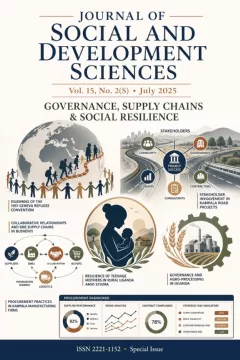 Vol. 15 No. 2(S) (2025)
Governance, Supply Chains & Social Resilience
View issue contents
Published
Submissions
Have research to publish? Journal of Social and Development Sciences welcomes submissions.
Make a Submission