Articles

  • Article 1 in this issue

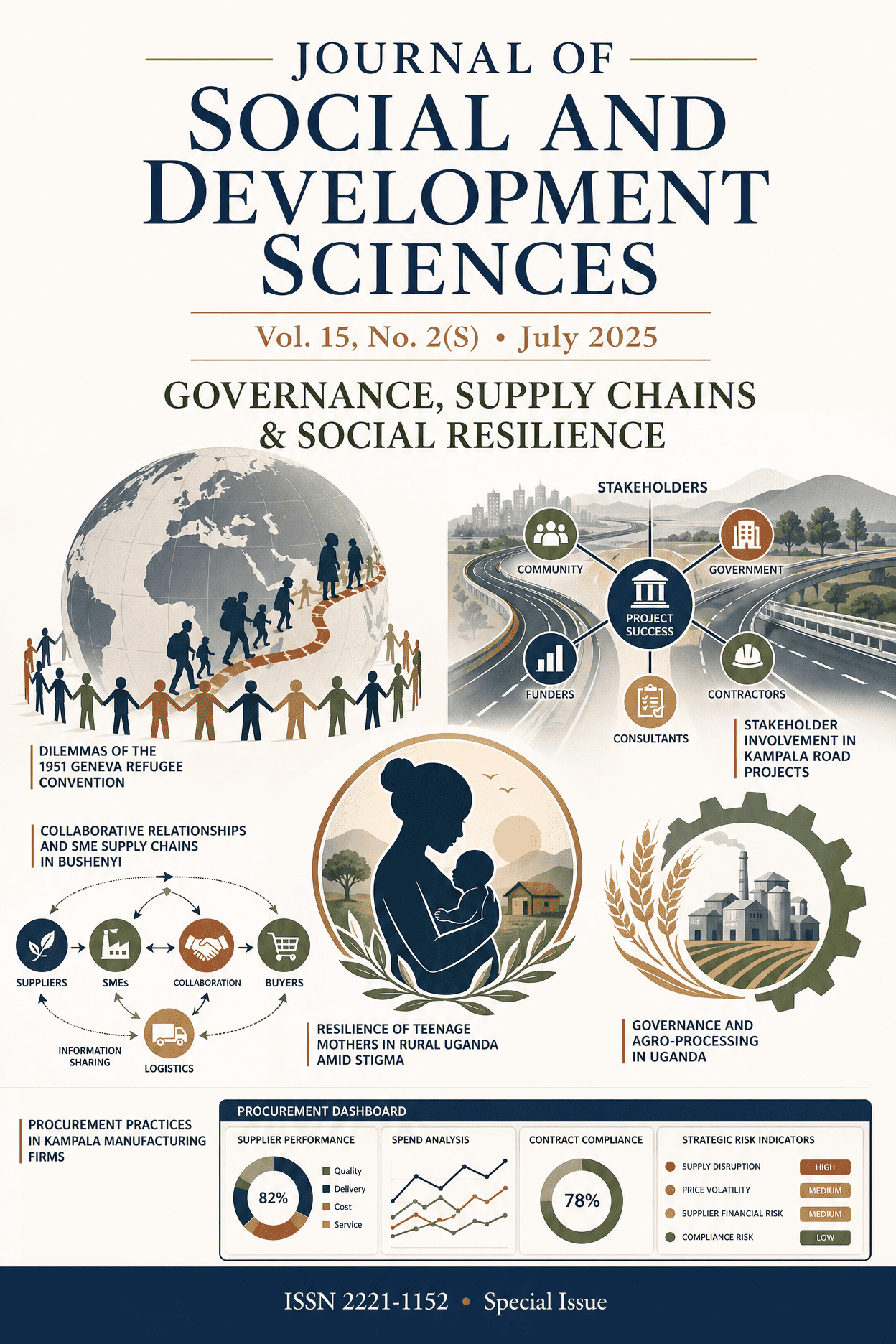
    Stakeholder Involvement, Resource Availability and Performance of Road Projects Under Kampala Capital City Authority, Uganda

    • Author: Junior Jim Mugisha, Alex Twinomuhwezi, Benjamin Musiita

    This study examines the impact of stakeholder involvement and availability of resources on the performance of Kampala Capital City Authority (KCCA)-managed road works in Uganda. Road building is essential to the acceleration of economic growth and the quality of life, but delays and cost escalation threaten its success. The study aims to understand the extent to which the two variables contribute to ensuring the success of projects. Data were gathered over two months from 62 out of 76 road projects, including project managers, division councillors, and KCCA supervision team members. Qualitative and quantitative approaches were used, including surveys and questionnaires, and statistical analysis was done using SPSS. The findings reveal a positive correlation between stakeholder participation, available resources, and project performance. All these variables together explain 33.3% of the difference in the quality of the projects done. It emphasizes the importance of effective stakeholder engagement and adequate resources to ensure road projects are completed within time, budget, and quality. It proposes implementing formal policies for stakeholder interaction, improving accountability, encouraging public-private partnerships, and merging stakeholder feedback with resource planning. The study further calls upon additional research to facilitate comparison with other regions of the globe to determine better ways of improving project performance.

    Pages 1-11

    PDF - Stakeholder Involvement, Resource Availability and Performance of Road Projects Under Kampala Capital City Authority, Uganda (opens in a new tab)
  • Article 2 in this issue

    Elements of Collaborative Relationships and Supply Chain Performance Of SMEs in Bushenyi District

    • Author: Alex Twinomuhwezi, Benjamin Musiita

    The research investigated how incentive alignment, together with information sharing and joint decision-making, impacts the supply chain performance of small and medium enterprises in Bushenyi District, Uganda. The study employed Relational Exchange Theory to analyze the supply chain performance of SMEs through a cross-sectional quantitative design, which collected data from 327 owners/managers using structured questionnaires. The results from Pearson correlation and multiple regression analysis showed that information sharing and joint decision-making positively affected supply chain performance but incentive alignment failed to produce a significant impact. The research results showed information sharing produced the most significant impact (β = 0.559, p < 0.01) followed by joint decision-making (β = 0.073, p < 0.05) yet incentive alignment did not produce a significant effect (β = –0.068, p > 0.05). The model explained 29.5% of the variance in supply chain performance (Adjusted R² = 0.295). The research indicates that better communication and collaborative planning serve as essential factors for achieving supply chain efficiency among rural SMEs. The study reveals that informal SME networks face specific challenges when attempting to establish formal reward systems because incentive alignment shows minimal impact. The research demonstrates that Bushenyi requires improved information systems together with enhanced participatory planning and digital infrastructure development to enhance supply chain outcomes. The recommendations include supporting digital communication platforms and providing institutional backing for collaborative decision-making processes and educating stakeholders about incentive-based partnership models.

    Pages 12-18

    PDF - Elements of Collaborative Relationships and Supply Chain Performance Of SMEs in Bushenyi District (opens in a new tab)
  • Article 3 in this issue

    Exploring Dilemmas about the 1951 Geneva Convention and the 1967 Protocol under Modern Refugee Trends: International Refugee Law in Perspective

    • Author: Lawrence Vorvornator

    The study explores the 1951 Convention’s dilemmas to assess whether it is abreast with modern refugee trends or not. Mixed-bag migration is explored under the Convention, unlike previous studies that concentrated on pull and push factors. Mixed-bag migration adoption sets this study apart from others. AimsThe study is necessary due to the open arms and solidarity of Europeans to receive Ukrainian refugees. In contrast, Syrian and Afghan refugees were discriminated against. Design- Grounded in Civil Solidarity as a Transformative Practice, and Building an infrastructure of Dissent, to explore the Convention’s dilemmas. The study adopts a literature review, otherwise known as a ‘‘meta-study. Findings-The findings reveal that the Convention is outdated with modern refugee trends; mostly children, women, and ordinary men. They commit no crimes to warrant any persecution. They migrated due to unbearable conditions, whereas in the 1950s, refugees were intellectuals, Soviet dissident men with different political opinions. The Protocol’s implementation triggered a ‘‘refugee floodgate. Refugees nowadays are non-Europeans, unlike 1950s. Refugees' floodgate led to civil solidarity withdrawal, and financial costs outweighed human rights, which contravenes the non-refoulement principle. Unsuccessful applicants are repatriated. The Convention neglects internal but protects international refugees. Contribution-I argue that a seventy-four-year refugee policy on inclusivity is needed with refugee-led organizations and governments for a public-private partnership. I recommend the Convention’s re-examination to ensure modern refugee law, which should contain burdensharing mechanisms. Conclusion-In-depth academic debates on the Convention’s dilemmas and factors that trigger current refugee situations are needed. Since refugee demography has changed, but non-refoulement remains static.

    Pages 19-30

    PDF - Exploring Dilemmas about the 1951 Geneva Convention and the 1967 Protocol under Modern Refugee Trends: International Refugee Law in Perspective (opens in a new tab)
  • Article 4 in this issue

    Resilience amid Stigma: Analyzing the Agency and Well-Being of Teenage Mothers in Rural Uganda

    • Author: Miriam Tugiramasiko, Benjamin Musiita, Specioza Twinamasiko

    Teenage motherhood remains a significant public health and socio-economic challenge in Uganda, especially in rural areas where access to education and health care services and economic opportunities is limited and social stigma and rejection are prevalent. The study explores the agency applied by teenage mothers to improve their well-being in rural Uganda particularly in Kanungu District. The study employed a phenomenological research design, and data were collected through in-depth interviews that involved Community Development Officers (CDO’s) and parents, focus group discussions (FGDs) which involved the teenage mothers, and key informant interviews (KIIs) that involved the District officials, Non-Government Organizations (NGO’s), Religious and community leaders. Findings reveal that family structures, parenting styles, cultural norms and institutional gaps significantly shape teenage mothers’ ability to act independently, access services, and plan for their prospects positively. Supportive family relationships were found to be essential in strengthening resilience, self-confidence, and decision-making capability, whereas neglectful and harsh environments compounded vulnerability and isolation. Teenage mothers employed different forms of agency for them to survive such as engaging in vocational training, informal labor and seeking support from (NGO’s). Community actors, particularly CDO’s emphasized the urgent need for family sensitization, better adolescent-friendly services, increased family awareness and targeted empowerment programs. The study recommends community sensitization, strengthening family and institutional support systems, increasing access to youth-friendly health and education services, and integrating tailored vocational and financial programs for young mothers and pregnant teenagers to advance their agency and holistic well-being in rural Uganda.

    Pages 31-41

    PDF - Resilience amid Stigma: Analyzing the Agency and Well-Being of Teenage Mothers in Rural Uganda (opens in a new tab)
  • Article 5 in this issue

    Governance Factors and the Growth of the Agro-Processing Industry in Uganda

    • Author: Grace Tayebwa, Benjamin Musiita, Milton Rwiita Nuwabimpa

    The study examined the influence of governance on the development of Uganda's agro-processing sector against four governance indices: regulatory quality, control of corruption, government effectiveness, and voice and accountability. Rooted in the institutional growth theory, the research employed a quantitative longitudinal study design based on time series data from 2000 to 2023. The secondary data were collected from the World Bank's Worldwide Governance Indicators (WGI) and Uganda's Ministry of Finance Macro Data Portal. Estimation was done using the Auto-Regressive Distributed Lag (ARDL) model, with the diagnostic tests such as the Augmented Dickey-Fuller (ADF) test for stationarity and the Variance Inflation Factor (VIF) test for multicollinearity. Facts revealed that regulatory quality had a statistically significant positive effect on agroprocessing development (β = 0.425, p < 0.01), so also did control of corruption (β = 0.318, p < 0.05), and government effectiveness (β = 0.267, p < 0.05). Voice and accountability, while positive, were not statistically significant (β = 0.112, p > 0.05). The model was strongly explanatory with an adjusted R² being 0.716, indicating that 71.6% of the variation in growth in agro-processing was attributed to governance variables in the model. It was therefore concluded that the quality of governance, particularly regulatory quality and corruption control, plays a critical role in encouraging agro-processing industry development in Uganda through uncertainty mitigation, giving confidence to the investor, and the addition of value. The study recommends periodic review and enforcement of the regulatory frameworks, merger of anti-corruption institutions, and improvement of the service delivery mechanisms in order to foster a conducive environment for industrialization. These findings present significant policy implications for the achievement of Uganda's Vision 2040 and Sustainable Development Goals (SDGs), particularly industrial development and job creation.

    Pages 42-55

    PDF - Governance Factors and the Growth of the Agro-Processing Industry in Uganda (opens in a new tab)
  • Article 6 in this issue

    Procurement Practices and Supply Chain Performance Among Manufacturing Firms in Kampala

    • Author: Alex Twinomuhwezi, Benjamin Musiita

    This study investigates the relationship between procurement practices and supply chain performance among manufacturing firms in Kampala, Uganda. Motivated by the operational challenges faced by the manufacturing sector, the study focuses on three key procurement practices: purchasing risk-taking, purchasing knowledge and skills, and strategic purchasing. The Resource-Based View (RBV) theory serves as the conceptual foundation, positioning procurement as a strategic internal resource capable of enhancing organizational performance. A cross-sectional, quantitative research design was employed, and data were collected from 327 manufacturing firms using stratified random sampling. Analysis was conducted using correlation and multiple regression techniques. Results indicate that both strategic purchasing and purchasing risk-taking are significant and positive predictors of supply chain performance (β = 0.449 and β = 0.295, respectively), while purchasing knowledge and skills showed a negative but marginally insignificant effect (β = -0.085, p = 0.051). Together, the procurement practices explained 31.5% of the variance in supply chain performance (Adjusted R² = 0.315). These findings underscore the importance of integrating procurement within long-term business strategy and embracing innovative procurement behavior while ensuring continuous application of practical skills. The study recommends investment in procurement training, digital systems, and risk-responsive strategies to improve supply chain efficiency in Uganda’s manufacturing sector.

    Pages 56-62

    PDF - Procurement Practices and Supply Chain Performance Among Manufacturing Firms in Kampala (opens in a new tab)