Articles

  • Article 1 in this issue

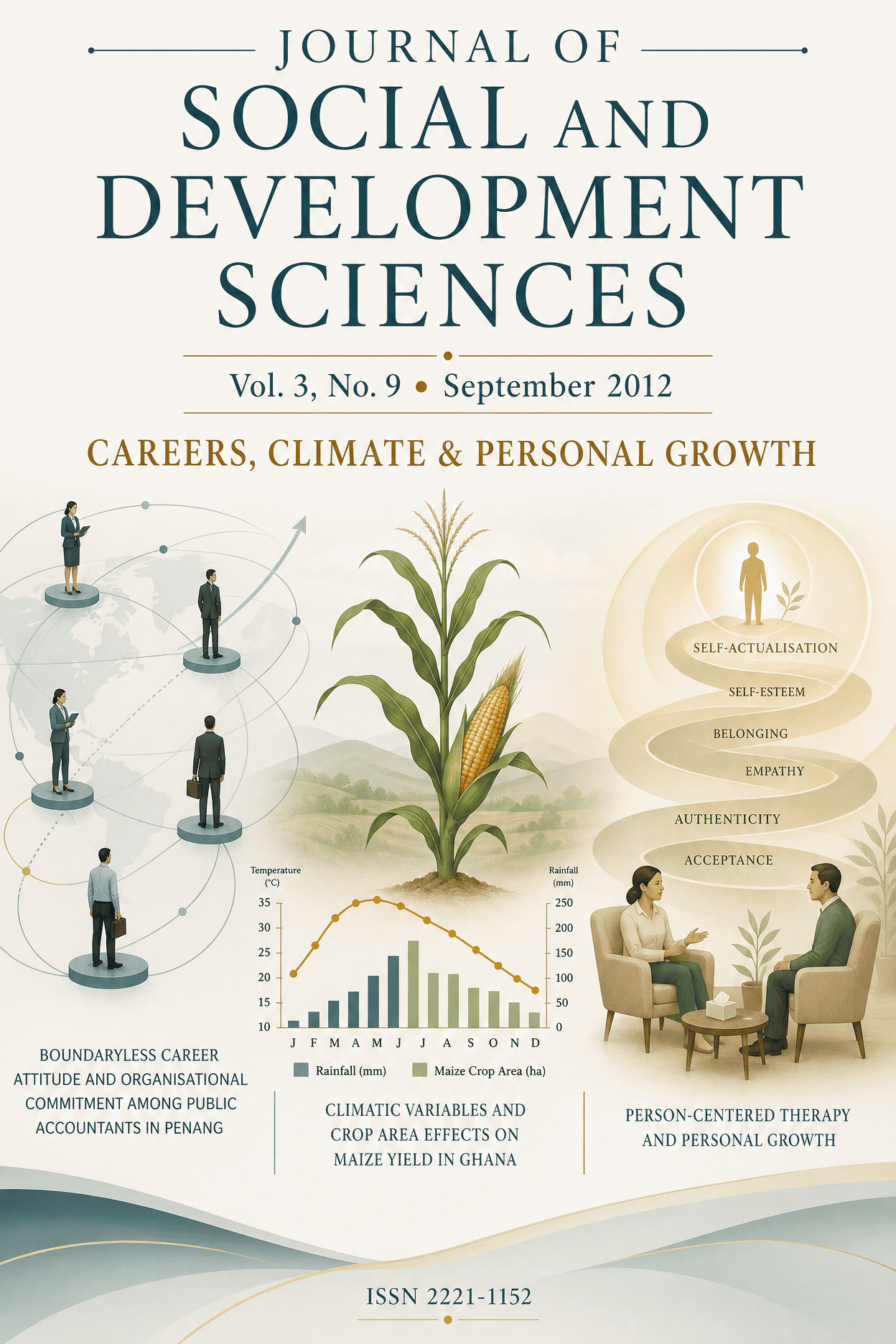
    The Boundaryless Career Attitude and Organisational Commitment among Public Accountants in Penang, Malaysia

    • Author: Gim Chien Wei Gabriel, Mat Desa Nasina

    This paper aims to study the impact of boundaryless career attitude (organisational mobility preference and boundaryless mindset) on organisational commitment (affective commitment, continuance commitment, and normative commitment). Specifically, we predicted that employees who demonstrate a high boundaryless career attitude would be less committed to their employers. A sample of 132 public accountants was drawn from 15 accounting firms in Penang. A three-stage sampling was used in this study started with cluster sampling, followed by systematic sampling, and finally convenience sampling. Multiple regression analysis was used in the study and the results shown that organisational mobility preference was significantly negatively related to affective commitment, continuance commitment, and normative commitment. It also revealed that boundaryless mindset was significantly negatively related only to continuance commitment. Theoretically, the findings mainly supported the findings by Briscoe and Finkelstein (2009). Practically, the findings implied that practitioners of accounting firms should implement policies to cater to the needs of the boundaryless career actors by providing career relevant skills, training, meaningful jobs, and opportunities for secondment. In conclusion, this research revealed the growing importance of the boundaryless career attitude in affecting organisational commitment among public accountants in Penang, Malaysia.

    Pages 304-312

    PDF - The Boundaryless Career Attitude and Organisational Commitment among Public Accountants in Penang, Malaysia (opens in a new tab)
  • Article 2 in this issue

    Estimating the Effect of Climatic Variables and Crop Area on Maize Yield in Ghana

    • Author: Henry De-Graft Acquah, Clement Kweku Kyei

    Climate change tends to have negative effects on crop yield through its influence on crop production. Understanding the relationship between climatic variables, crop area and crop yield will facilitate development of appropriate policies to cope with climate change. This study therefore examines the effects of climatic variables and crop area on maize yield in Ghana based on regression model using historical data (1970-2010). Linear and Non-linear regression model specifications of the production function were employed in the study. The study found that growing season temperature trend is significantly increasing by 0.03o C yearly whereas growing season rainfall trend is insignificantly increasing by 0.25mm on yearly basis. It was also observed that rainfall is becoming increasingly unpredictable with poor distributions throughout the season. Results from the linear and non-linear regression models suggest that rainfall increase and crop area expansion have a positive and significant influence on mean maize yield. However, temperature increase will adversely affect mean maize yield. In conclusion, the study found that there exists not only a linear but also a non-linear relationship between climatic variables and maize yield.

    Pages 313-321

    PDF - Estimating the Effect of Climatic Variables and Crop Area on Maize Yield in Ghana (opens in a new tab)
  • Article 3 in this issue

    Person-Centered Therapy and Personal Growth

    • Author: Boontarika Narknisorn

    Person-centered therapy enhances humans’ personal growth toward self-actualization and deepens quality personal relationship. This article aims to (1) explain the concepts of person-centered therapy and (2) link its contribution to humans’ personal growth and healthy relationship. Personcentered therapy believes in human’s positive qualities as being trustworthy and owning ‘inner resources’ to pursue ‘self-actualization and health.’ The therapeutic goals are to assist clients to be true to themselves and acquire their full potentials. Person-centered therapy emphasizes the qualities of the therapist and therapeutic relationship as the most powerful components to help clients grow. The therapist needs to maintain positive attitudes, to believe in client’s potentials and motivation to become actualized, to accept one’s and others’ uniqueness and needs and to be trustworthy, warm, open and kind. Person-centered therapy reflects that pain and obstacles in life are necessary and can stimulate humans to grow. Person-centered therapy helps the therapist; clients and humans pursue self-actualization and possess better humans’ qualities, which can contribute to world peace as Rogers hoped.

    Pages 322-330

    PDF - Person-Centered Therapy and Personal Growth (opens in a new tab)