Articles

  • Article 1 in this issue

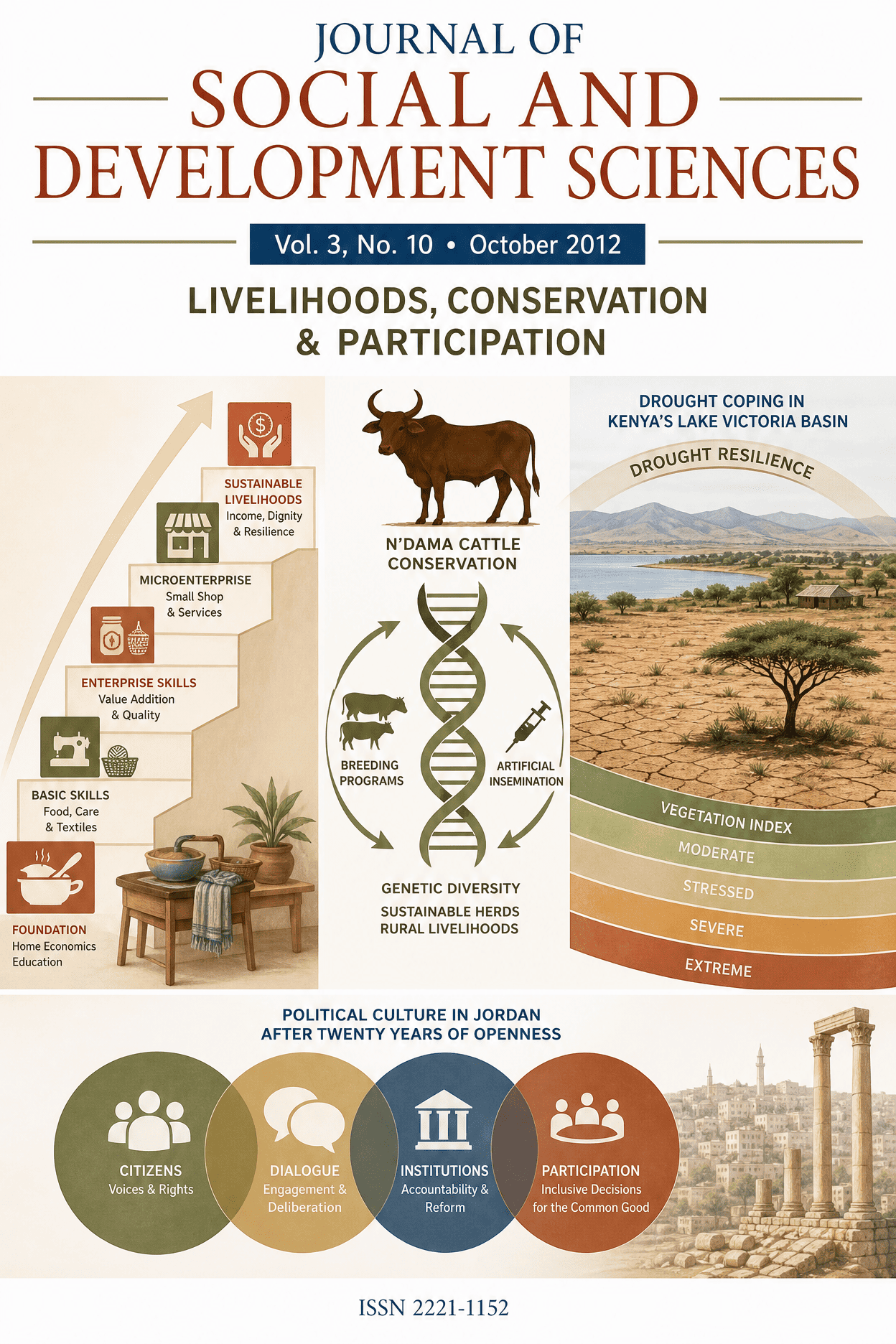
    Competency Strategies in Alleviating Poverty for Sustainable Development in the Teaching and Learning of Home Economics Education

    • Author: Obasigie, I. O, Omoregbe, I. I

    This study looked at poverty scenario in Edo State and how Home Economics graduate from the universities can use their competency to alleviate poverty for sustainable development. A self-developed questionnaire of 4 point instrument was used for data collection from150 respondents from 25 shops in 2 zones i .e commercial and residential areas in Edo State. The data collected was subjected to frequency distribution count and percentage rating analysis. The findings shows that majority of the home economics graduate from our universities exhibited low competencies of less than 15.0% in business management feasibility, business risk management, business finance management, and creativity ability in alleviating poverty in their chosen business ventures: the reasons being that they were all involved in buying and selling cake items for baking, interior decoration items, provision and toiletries among others. Findings further revealed that all the studied respondents were highly constrained by lack of competency strategies; solutions were thus proffered and established for sustainable development.

    Pages 331-334

    PDF - Competency Strategies in Alleviating Poverty for Sustainable Development in the Teaching and Learning of Home Economics Education (opens in a new tab)
  • Article 2 in this issue

    N Dama Cattle Conservation: The Potential Roles of Artificial Insemination and the National Policy

    • Author: Olaniyan, Olawale Festus, Hiemstra, Sipke-Joost

    Regular access to genetically superior bulls from an open nucleus breeding system is an impetus for N’Dama cattle utilization and conservation. However, shortage in the number of bulls that could be distributed to the farmers for subsequent breeding remains a challenge in some countries of West Africa. In this regard, the potential benefit of artificial insemination (AI) and the roles of national policy were assessed. The open nucleus-breeding scheme of International Trypanotolerance Center (ITC) in the Gambia was used as a case study and the research questions were answered with literature review, focus group discussion, and Likert-scale questionnaire. Introduction of AI into the breeding scheme of N’Dama cattle can create higher selection intensity and promote a wider dissemination of genetic gain made at the nucleus. With improved AI techniques, a better use of improved N’Dama bulls can be achieved. Notwithstanding, there are concerns about low pregnancy rate, quality of the semen, inadequate knowledge of AI technicians, and the regular availability of quality bulls. For the Gambian national policy, the environmental component is the most relevant for conservation of N’Dama cattle. This can be buttressed with more flexibility and a clearer communication of the objectives through workshops and local media.

    Pages 335-341

    PDF - N Dama Cattle Conservation: The Potential Roles of Artificial Insemination and the National Policy (opens in a new tab)
  • Article 3 in this issue

    Coping with Drought among the Communities Living in the Lake Victoria Basin of Kenya

    • Author: J. K. Chumo, D. K. Agui

    Drought is of great concern throughout the continent of Africa because of its devastating effects that it has inflicted on the economy of some of the countries. Drought has been recorded to be one of the most felt disasters in recent years in Kenya. The drought that affected Kenya in the year 2000 and 2010 was indeed remarkable in that the country resorted to loss of lives, loss of livestock, power rationing and drying of agricultural crops among other problems. This study developed a technique to depict spatially, the extent, relative severity and location of areas mostly affected by drought in the Lake Victoria basin of Kenya. This was done using the normalized difference vegetation index (NDVI) plots and maps developed using the Geographical Information System (GIS) software. The indices were generated using the C++ program. NDVI indices revealed that most parts of the basin were moderately dry throughout the year. The study investigated the impacts of drought in the area by use of questionnaires and interviews. The impacts identified were mainly crop failure, depletion of water resources and lack of pasture for livestock. The complex and multidimensional nature of drought requires a long term, well-organized and coordinated research plan and action involving all the stakeholders. This study summarized coping strategies adopted by the communities living within the Lake Victoria basin to mitigate drought phenomenon. Some of the strategies include; planting of drought resistant crops, food storage sharing and purchasing of food among others. Recommendations have been suggested for policy makers, planners and agriculturalists to implement to improve agricultural output in a drought prone area like the Lake Victoria Basin of Kenya. In particular, the study highly recommends development of a comprehensive drought policy to be implemented in managing drought in Kenya.

    Pages 342-349

    PDF - Coping with Drought among the Communities Living in the Lake Victoria Basin of Kenya (opens in a new tab)
  • Article 4 in this issue

    The Reality of Political Culture in Jordan after Twenty Years of Political Openness

    • Author: Amin A. Al-Azzam

    The purpose of this study is to explore the reality of the political culture in Jordan after twenty years of political openness by identifying the most important features of contemporary Jordanian political culture. In addition, the study aims to examine the main factors that shape this political culture. To build the argument on a solid ground, the study raises some significant questions about the reality of the Jordanian political culture such as: has political culture changed significantly since 1989 (after the political openness)?, what are the main factors that contributed in shaping the political culture in Jordan?, and what is the main type of political culture that clearly prevails in the society?. The study is carried out by using the descriptive analytical approach, as a method for examining the findings of the survey through distribution of 400 questionnaires to five groups of political elite in Jordan. The study concludes that there cannot be a real democratic system in Jordan without the establishment and consolidation of democratic values in the political culture of Jordanian citizens. Another conclusion of the study is that traditional political culture is still prevailing in Jordanian society, which is social, tribal, and family ties prominence despite the passage of twenty years on the political liberalization.

    Pages 350-359

    PDF - The Reality of Political Culture in Jordan after Twenty Years of Political Openness (opens in a new tab)