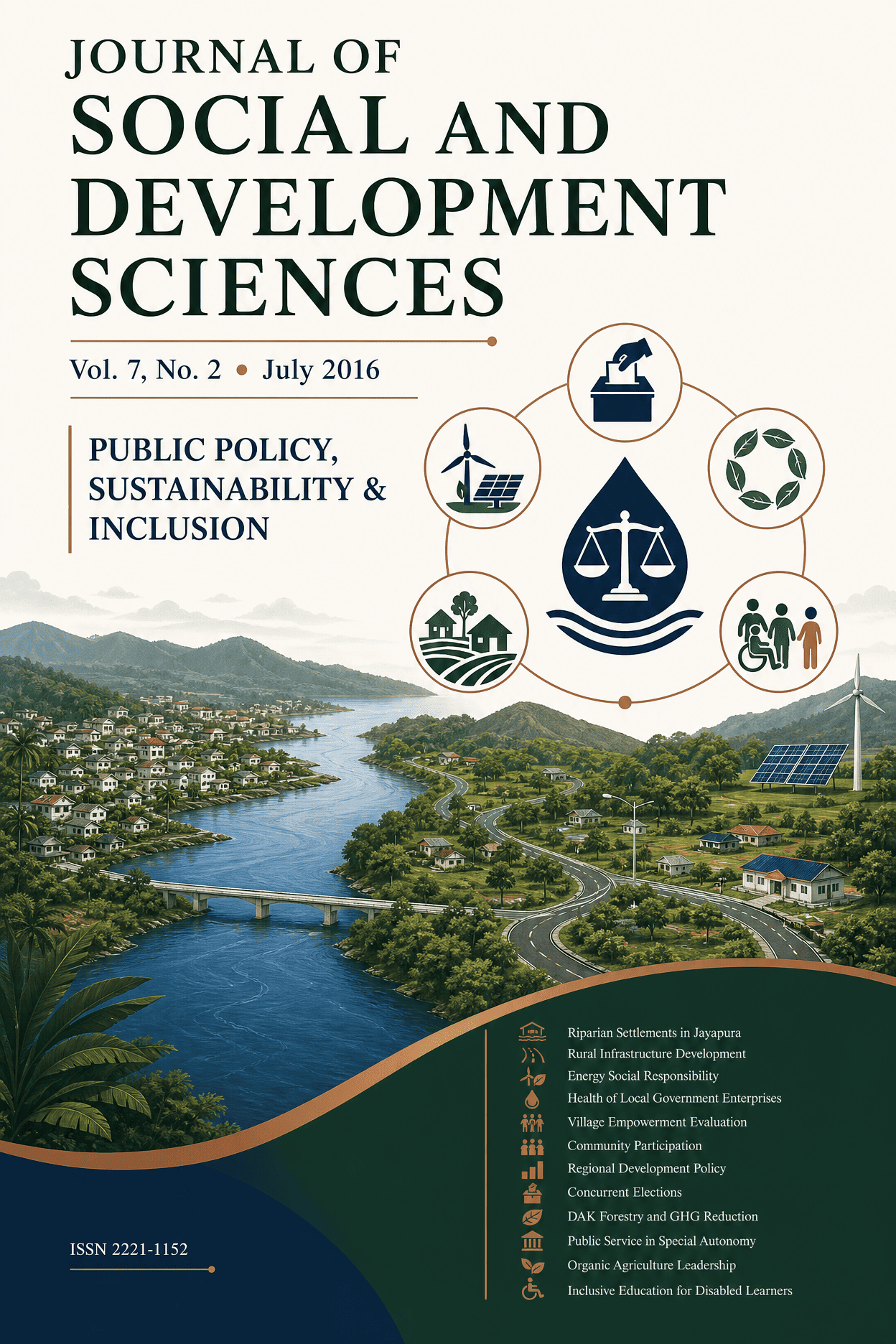
Articles 1–10 of 12

  • Article 1 in this issue

    The Impact of the Utilization of Riparian Area for Settlements (Case Study of North Jayapura District, Jayapura City)

    • Author: Suwandi, Rahmat Daun

    The limitedness of area and plot of land in Jayapura City which are allocated for settlements has become a problem in Jayapura city. Population growth and high-rate of urbanization are impacted on the utilization of land which is not in accordance with its allocation. The modification of riparian area on the right and left sides of the river for settlements has reduced the function of the river, because in addition to river conservation, river has a double role as the securer of water source and as the protector of its surrounding area. Therefore, riparian area becomes more important to be considered. The riparian area in settlement area is assumed to be adequate for a 10-15 meters inspection road to be built on. The real condition of the rivers in North Jayapura District of Jayapura City, compared to the criteria of riparian area for settlement area, has not been inappropriate. The river’s function as the protector of its surrounding area has gone astray. If there is someday a flood, the impact may cause material damage or even life victims.

    Pages 6-9

    PDF - The Impact of the Utilization of Riparian Area for Settlements (Case Study of North Jayapura District, Jayapura City) (opens in a new tab)
  • Article 2 in this issue

    Rural Area Development Strategy through Rural Infrastructure Development Program

    • Author: Suwandi, Wilmina Pesurnay

    This study was conducted in Biak District of Papua employing the quantitative method. The strategic concept in the development of local institutional capacity was to maximise the role of institutions as social capital not taken over, such as driving as farmers’ cooperatives, cooperatives as agro-tourism objects, and integrating the local institutional system under the auspices of Papua local institutions.

    Pages 10-13

    PDF - Rural Area Development Strategy through Rural Infrastructure Development Program (opens in a new tab)
  • Article 3 in this issue

    Proposal for Energy Social Responsibility

    • Author: Vishakha Agrawal, Dhyani Mehta

    The paper significantly works upon, how as per the newly implemented mandate under ‘The Companies Act, 2013’ organizations in India having turnover >100 cr &>200 cr (PAN India) or having net profit of at least 5 Crore have to spend 2 percent of their profit as part of CSR Corporate Social Responsibility to carry a philanthropic activity. As a social responsibility towards environment sustainability, India needs to change to renewable sources of energy which are non-polluting which will also support increasing demand for power and electricity. For economic as well as environmental rationales, this paper tries to recommend ESR (Energy Sustainability Responsibility) that can be accumulated through monetary support by all of the BSE (Bombay Stock Exchange) and NSE (National Stock Exchange) companies that in contrast can be accommodated on the research and development as well as infrastructural development of non-conventional and renewable sources of energy. The proposal can support India as well as countries across time zones to save fossil fuel reserves for future and create sustainability of these reserves. For the same objective the paper is addressing the applicability of ESR for setting up projects for renewable source of energy and cost involved in setting up of these projects vis-a-vis the efficient use of funds accumulated by the target companies by way of ESR: Energy Social Responsibility. The research design used is both descriptive and exploratory.

    Pages 14-19

    PDF - Proposal for Energy Social Responsibility (opens in a new tab)
  • Article 4 in this issue

    Analysis on Health Level of Local Government Owned Enterprises (BUMD) toward Papua Regional Income

    • Author: Yohanis Rante, Westim Ratang, B. Elita Bharanti

    In the effort to carry out the principal functions and duties for the population in Papua, Papua provincial government set up several enterprises (BUMD) purposed to provide services to the public. BUMD is also expected to give contribution on regional income. The objectives of this research are: (1) Determining the health level of Local Government Owned Enterprises in Water Supply Company in Jayapura and Nabire from the financial aspect, (2) the health level of Local Government Owned Enterprises in Water Supply Company in Jayapura from the operational aspect, (3) the health level of Local Government Owned Enterprises in Water Supply Company in Jayapura and Nabire from the administration aspect. The method used in this research is survey research method toward BUMD by distributing questionnaires in several enterprises. The analytical tool used is the analysis on the health level of Water Supply Company on the financial, operational and administration aspects. Jayapura Water Supply Company health level in terms of financial aspects, operations and administration in 2011 to 2013 showed a reduction, but it was still sufficient indication. The total value of these three aspects has decreased in the last two years, 60.49 in 2011, decrease to 59.22 in 2012 and 54.59 by the end of 2013. However, this reduction was still at fairly healthcategory. Nabire Water Supply Company health level based on the financial aspect shows that from 2010 to 2013, the financial performance of Nabire Water Supply Company was experiencing unhealthy condition. Service aspect of the rate of complaints solving in 2010 to 2013 was always above 100%, it means that Nabire Water Supply Company have solved the problem of water services and other complaints that come from customers or not customer. The next indicator is water quality was 0% from 2010 to 2013. It means that they have not been able to serve the customers with the drinking water quality as provided in Ministry of Health Regulationnumber 492/MENKES/PER/IV/ 2010.

    Pages 20-24

    PDF - Analysis on Health Level of Local Government Owned Enterprises (BUMD) toward Papua Regional Income (opens in a new tab)
  • Article 5 in this issue

    Policy Evaluation Analysis on Empowerment of Village Development Program in Ayapo Village, East Sentani District, Jayapura Regency

    • Author: Vince Tebay, Elsyan R.Marlissa

    This research analyzes the policy evaluation and measure the successful of such a program. It also prevents irregularity on implementation of government program. By evaluating the program of village empowerment, we are able to determine the success performance rate of that program, whether in province, district, and village. When the evaluation of village empowerment goes well, it will be a correction for next year. So, for the next budgeting year focus on the village empowerment program that increase society participation in development village. It can be concluded that the research aspect on effectively, equalization, determination as the indicator of variable (X) proved that development by Ayapo’s society do not maximal. Since, the society participation has not yet been seen on the most of empowerment programs. Then, there are improvements and increasing on variable (Y) which consist of development health facilities, quality of education, and income. Because, there are physical construction and the society in Ayapo village directly feel the positive impacts.

    Pages 25-27

    PDF - Policy Evaluation Analysis on Empowerment of Village Development Program in Ayapo Village, East Sentani District, Jayapura Regency (opens in a new tab)
  • Article 6 in this issue

    Study of Community Participation in the Process of Villages Infrastructure Development on Program PNPM Mandiri in Jayapura Regency

    • Author: Flora Yvonne de Quelyoe, Elsyan Reinette Marlissa, Sarlota Ratang

    Community participation in each process of public policy making is an important issue as the mirror of principle of democracy in a country. It would be very precise when participation of community later became one of the principles that should be implemented by the government in an effort to realize good governance. The importance of participation and form of participation given a supporting factor for the success of the government program. The aim of Road Infrastructure development program is to increase local community welfare so they are able to access a wide range economy, social and politic activities. For example, in economic activity, the local producer can easily carry and sell their product to the local market when compared to the previous moment when road was damaged, especially during the rainy seasons. Therefore it is necessary participation of community to engage in solving the road infrastructure problem in their respective villages and districts. This research is located in Jayapura Regency, and using explanatory research with qualitative approach. The Techniques of data collection on this study is using questionnaire, distributed to 80 respondents. The result of this research shows that community participation community in the planning, implementation and evaluation is very good. Community participation on implementation phase of National Program of Community Empowerment (PNPM Mandiri) is really determined by the level community involvement in the planning stages. The important reasons related to community participation are: a) the engagement of community, either directly or indirectly, are able to create feel of belongings to all public asset that has been built with high cost. b) Through community participation, they know about the limitation of government resources (funds, manpower). c) Involvement of local society in those development stages could be a control tools to supervise all development financing in the level of village, district, and regency as well.

    Pages 28-31

    PDF - Study of Community Participation in the Process of Villages Infrastructure Development on Program PNPM Mandiri in Jayapura Regency (opens in a new tab)
  • Article 7 in this issue

    Strategic Issues of Regional Development: Government Policy Evaluation of Papua

    • Author: Akbar Silo

    The five-year period of development as outlined in the document RPJMD (Medium-Term Regional Development Plan), has achieved significant success, although there are still conscious strategic issues that are unsolved optimally. It can be traced from a series of evaluation studies to ensure consistency between the programs organized in 5 years with defined policy agenda to achieve the vision of local government. This study was conducted in a pragmatic approach that emphasizes the evaluation of policies: First, I ntegratif. An evaluation of the program and its financial package on cross institutions (Ind: SKPD/regional work unit). Secondly, c omparatively, the achievements of development program compared with: (a) the goals stated in the document of Medium-Term Regional Development Plan (RJPMD/Ind), (b) development of mean achievement average per year, (c) the achievements of other areas, including a national scale and the achievement of the MDG's (Millennium Development Goal's).Object of the study are: All the goals set out in the mission to realize its vision of regional development as well as development programs and activities to achieve the targets and affect from various sources of financial. This study covers the gains of development programs within 5 years, including: macro achievements and outcomes for each development field. In addition, it is also obtained a description of the degree of relevancy, coherence, and correspondence between the realization of programs and activities with targeted goals, as well as the achievement of the mission and the development agenda so it can be measured the degree of the medium-term vision achievement. The district/city as a target sample of the study is Jayapura District, Puncak Jaya, District, Mimika District, and Jayapura city.

    Pages 32-43

    PDF - Strategic Issues of Regional Development: Government Policy Evaluation of Papua (opens in a new tab)
  • Article 8 in this issue

    Democratic System Strengthening Through Concurrent Election Implementation To Improve Political Stability and National Development

    • Author: Muhammad Baharuddin Zubakhrum Tjenreng

    Indonesian recently held a regional head concurrent elections in the first phase on December 9, 2015. Concurrent elections has been a historic moment for Indonesia to elect regional heads organized and structured massively. Concurrent election significance for Indonesian politics, especially at the local level, not only to read limited local democratic party, but rather an instrument for strengthening the democratic process. This research seeks to examine and analyze the democracy strengthening through concurrent election implementation in order to improve political stability of national development. In carrying out this study, researchers using qualitative methods. Whereabout the main data from this study is the researchers observation result on the concurrent election day, which is supported by several secondary data from the media. Featured models concurrent election (local concurrent election) is believed to be the best solution to counter the problems remaining in the elections execution, especially in two important reasons: First, the elections implementation effectiveness in order to realize the elections are more qualified and dignified from both the process and elections outcome aspects; second, the elections efficiency especially from the budget efficiency aspect which must be issued by the state to finance the electoral process.

    Pages 44-56

    PDF - Democratic System Strengthening Through Concurrent Election Implementation To Improve Political Stability and National Development (opens in a new tab)
  • Article 9 in this issue

    Study on Relationship between DAK Forestry Program and GHG Reduction Target in Indonesia

    • Author: Joko Tri Haryanto

    It has been agreed that forestry is a key sector in the effort to tackle global warming. The government has demonstrated actual commitment to reduce GHG emissions by 26% with their own budget and by 41% with international financing. This commitment is set forth in Presidential Decree No. 61 Year 2011. This regulation indicates that one of the largest emitters is the forestry sector. The government has already allocated Specific Allocation Fund (DAK) Forestry in the State Budget annually to support forest rehabilitation. Despite the relatively small amount, the fund allocation is increasing significantly each year. The question is how the allocation for DAK Forestry can be synchronized with the GHG emission reduction target set forth in Presidential Decree No. 61 of 2011. For that reason, this study has been conducted in order to analyze the conformity of DAK Forestry funding with the emission reduction targets set forth in Presidential Decree No. 61 of 2011. By using qualitative descriptive statistical approach, it is known that the use of DAK Forestry fund as from 2010 to 2014 has had a significant alignment in support of GHG emission reduction target set forth in Presidential Decree No. 61 of 2011.

    Pages 57-71

    PDF - Study on Relationship between DAK Forestry Program and GHG Reduction Target in Indonesia (opens in a new tab)
  • Article 10 in this issue

    Public Service by the Government of Papua Province in the Special Autonomy

    • Author: Efraim Kambu

    Special Autonomy assigns its rights and obligations to local governments to regulate and manage their own affairs and interests of the society so that people increasingly can be served well. But in fact, public services provided is not maximized. This study used qualitative methods, data sources are divided into two types of data sources, namely primary and secondary data sources. The results of this study indicate that there is still lack of public services the Government of Papua Province visible from the weak aspects of responsiveness, which local governments less responsive to some of the problems in the field of education, economy and industry growth and physical development as well as non-physical. From the aspect of responsibility is also still found their weaknesses, which the Government of Papua Province is still not fully overcome the problems of corruption and poverty. Meanwhile, from the aspect of accountability, it is known that the performance of governance in Papua in providing public services are not running optimally, one reason is the lack of competence and capability of local government officials.

    Pages 72-78

    PDF - Public Service by the Government of Papua Province in the Special Autonomy (opens in a new tab)