Articles

  • Article 1 in this issue

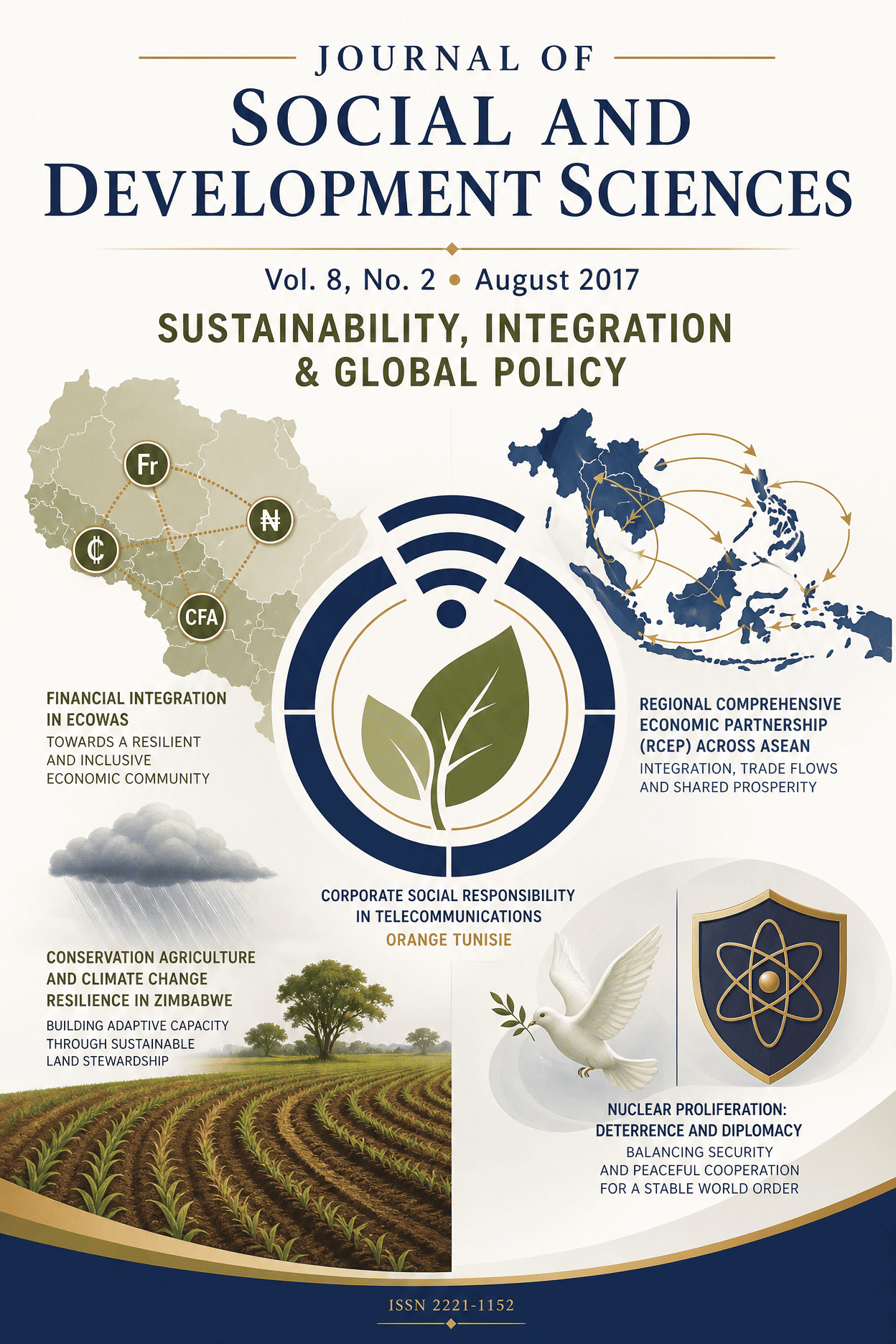
    The Role of Corporate Social Responsibility (CSR) in the Telecommunications Industry : An Overview of the Case of "Orange Tunisie" Operator

    • Author: Ines Kahloul Nafti

    The aim of this paper is to present new orientations for research in the field of information systems in the context of CSR. It offers an original conceptual analysis that integrates the CSR approach, which enables decision making, governance and strategic alignment of the Information and Communication Technologies (ICT), business and sustainability. In the actual context of the changing environment, a consensus regarding the need to change the pattern of development and growth comes to light. The CSR emerges as a new paradigm for economics. Its alliance with other economic concepts seems to become a necessity that aims at an approach for a global and sustainable performance for the company. As long as the firms’ IT departments are energy consumers, it is of paramount importance to reconcile the new technologies and the CSR. Hence, in order for the company to stand out and increase its competitiveness, it has to think in terms of global, economic, social and environmental performance that would ensure a sustainable growth. The importance of the small and medium-sized enterprises in the Maghreb’s economies and the challenges of the CSR implementation in such institutions should prompt us to wonder about the incentives and the engagement factors of managers in favor of the CSR while incorporating the ICT. It seems interesting, then, to discover the way to combine the ICT and the social practices, in order to ensure a sustainable performance for the company. An illustration of the case of "Orange Tunisie" operator will be advanced.

    Pages 6-13

    PDF - The Role of Corporate Social Responsibility (CSR) in the Telecommunications Industry : An Overview of the Case of "Orange Tunisie" Operator (opens in a new tab)
  • Article 2 in this issue

    Does Financial Integration Exist in ECOWAS?

    • Author: Matthew Oladapo Gidigbi, Benedict Akanegbu

    Free movement of goods, capital, and persons have been the long-term strategic goals of the Economic Community of West Africa States (ECOWAS) since its establishment. Notwithstanding, financial integration has become more important in deepening political integration in the region than ever. Assessing how far the Regional Economic Community (REC) has achieved her objective of free movement of capital among the member states. Therefore, this study investigated the existence of financial integration in ECOWAS by employing savings-investment equality, popularly known as Feldstein-Horioka Criterion; a panel data for all the 15 member states was fitted into the specified model. The study found that there is the existence of financial integration in the REC, and that language inhibits financial integration and that the coefficient of language dummy stands at -4.8 percent. However, it found that language inhibition of the financial integration in the REC will gradually disappear over time, as the interactive coefficient of language and time stands at - 0.12 percent. This study concludes that a level of financial integration is in existence in the REC. Therefore, the REC is prepared for monetary unification assuming that there will be more substantial trade among the member states.

    Pages 14-27

    PDF - Does Financial Integration Exist in ECOWAS? (opens in a new tab)
  • Article 3 in this issue

    Analysis of The Potential Impact of Regional Comprehensive Economic Partnership on the ASEAN Member Countries

    • Author: Makmun Syadullah, Miftahudin, Benny Gunawan Ardiansyah

    This paper aims to analyze the potential impacts of the RCEP concept developed in the working group and the potential impact on market expansion. Based on the results achieved in the working group discussions, we used a qualitative approach. We put together a simulation of how the impact on trade and market development has been the goal of the establishment of RCEP. We concluded that the unification of the 16 countries in the RCEP expected to reduce the spaghetti bowl effect caused by a number of free trade agreements followed by a country. However, because RCEP does not eliminate regional free trade agreements that exist, RCEP tend to add to the chain's new spaghetti bowl. In addition, the opening of market access among partner countries in the ASEAN-expected results in increased trade intra-ASEAN partner countries so that the impact on economic growth in the region in general and ASEAN in particular.

    Pages 28-37

    PDF - Analysis of The Potential Impact of Regional Comprehensive Economic Partnership on the ASEAN Member Countries (opens in a new tab)
  • Article 4 in this issue

    Conservation Agriculture and Climate Change: Implications for Sustainable Rural Development in Sanyati, Zimbabwe

    • Author: Munyaradzi Admire Dzvimbo, Tinashe Mitchell Mashizha, Monica Monga, Cornelias Ncube

    Zimbabwe is one of the most developed countries in Sub-Saharan Africa in that markets and rural industrialization are likely to function relatively well. Thus, Zimbabwe’s agricultural sector has been severely affected by climate change. The worsening agricultural conditions have led to undernourishment of many in rural areas and this has drawn so much attention. Young women have turned into prostitution, in their bid to ensure the survival of their families. Farmers in rural areas depend heavily on rain-fed water and with rainfall variability and extreme weather patterns records, their livelihoods are being threatened. To cope with the adverse impact of climate change on rural development, different coping strategies and mechanisms are being implemented. The government, non-governmental organizations (NGOs) and the private sector have all introduced various programmes and projects at grassroots levels. The information used in this paper was gathered using data from interviews, questionnaires, and focused group discussion. This article explores how conservation agriculture being one of the coping strategies, has helped rural farmers to deal with climate change and how it has sustained rural development in Sanyati District.

    Pages 38-46

    PDF - Conservation Agriculture and Climate Change: Implications for Sustainable Rural Development in Sanyati, Zimbabwe (opens in a new tab)
  • Article 5 in this issue

    Nuclear Proliferation Deterrence: Bullying vs Diplomacy

    • Author: Chidiebere C. Ogbonna

    The article examines the plausibility of using sanctions as an instrument that can deter nuclear proliferation. Sanctions have been a favored policy tool in the arsenal of the international community, when it comes to issues relating to deterring nuclear proliferation. The adoptions of sanctions as a policy instrument that can quench the nuclear ambition of states and/or regimes are based on two main assumptions. First, it is believed that they add cost to the regime aspiring to acquire nuclear weapons, by limiting the regime’s access to finance and thus discourage it from furthering its nuclear ambition. Second, it is believed that the impact of sanctions on the welfare and well-being of the citizens of a targeted regime will prompt the citizens to rebel against the regime and perhaps force it to comply with the demands of the sanctions imposing party. This article however, took a dissimilar view and argues that sanctions as a single policy tool cannot check nuclear proliferation. At best they can be used to express discontent or signal displeasure to a regime with nuclear ambition. The article concludes that diplomacy devoid of rapacity is and will remain the plausible mechanism to deter nuclear proliferation.

    Pages 47-55

    PDF - Nuclear Proliferation Deterrence: Bullying vs Diplomacy (opens in a new tab)