Articles

  • Article 1 in this issue

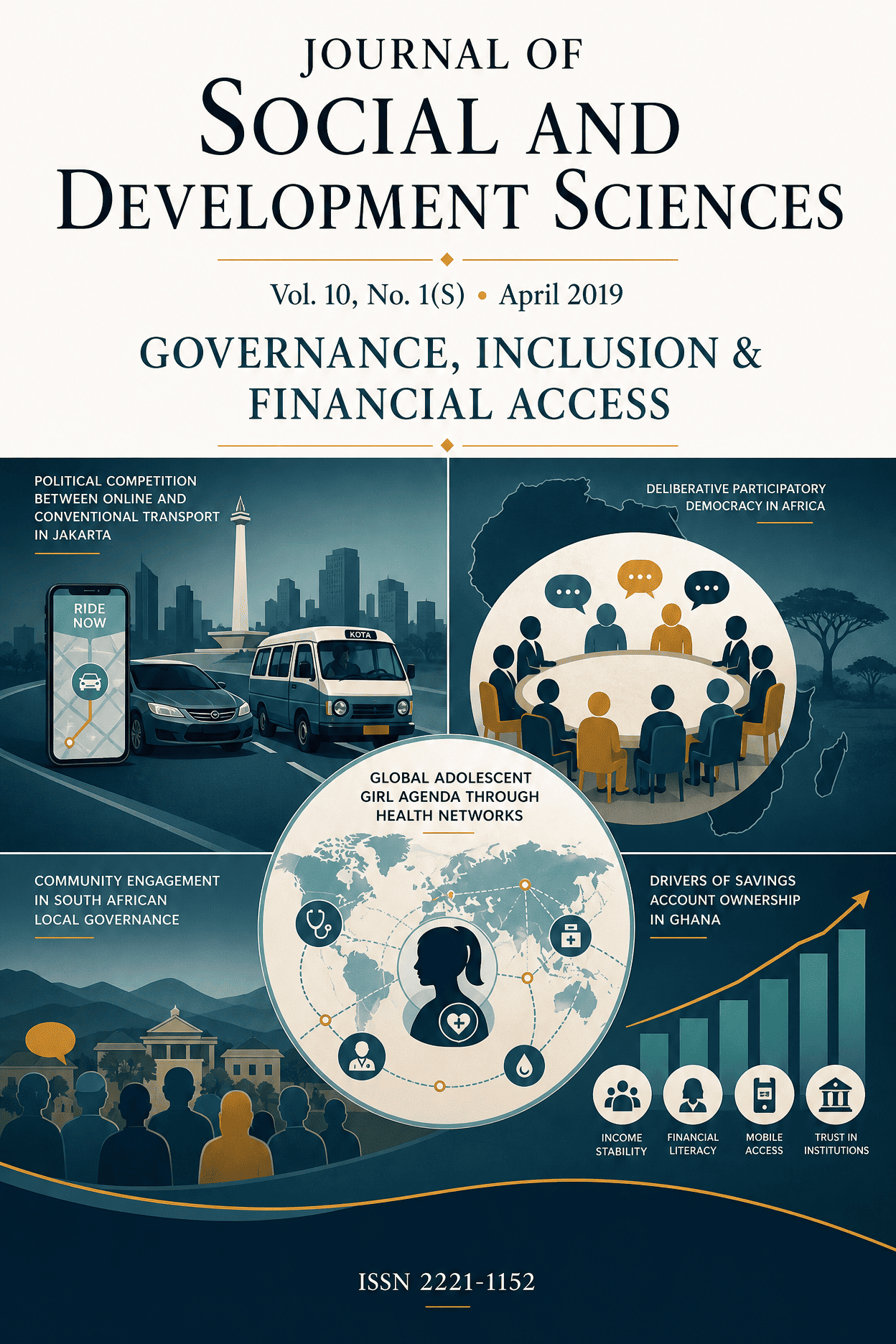
    Political Space Competition between Online and Conventional Transportation in Jakarta, Indonesia

    • Author: Yusa Djuyandi, Arief Hidayat, Jumroh

    The Presence of online transportation brings a new problem in Indonesia transportation market competition, many conventional transportation drivers, such as taxis, buses, motorcycle taxis, city transportation (Angkot) that reject the presence of online-based transportation. For conventional transportation drivers, the existence of online transportation has reduced their income because people prefer to use online transportation rather than conventional transportation. As the power holder, the government certainly has the right and authority to regulate and create policy harmonization for public transportation. This study uses qualitative method where primary data is obtained from 8 months observations, from November 2017 to June 2018. Secondary data are obtained from transportation ministerial regulations, regional regulations issued by the DKI Jakarta Provincial Government, and various discourses that developed in the media mass. Various data obtained are then sorted or filtered and crosschecked against other data. Based on our findings, the government has not been arranged adequate political space, especially for conventional transportation and online transportation in Jakarta. The slow pace of the central government to revise regulations regarding online transportation has triggered serious conflicts in the community. Digital revolution in the dimensions of online transportation in the public interest is what should be an integral part of previous government policies, and that never happened.

    Pages 1-10

    PDF - Political Space Competition between Online and Conventional Transportation in Jakarta, Indonesia (opens in a new tab)
  • Article 2 in this issue

    Deliberative Politics through Citizens’ Participatory Democracy: A model for Africa Political Processes

    • Author: Andrew Osehi Enaifoghe

    This article explores the present crisis of democratic governance or administration in Africa and examines the elective capability of deliberative majority rules system of democracy, in which the desire of the general public is educated by mindful, engaged citizen’s commitment and conversation. There are various questions needing answers; are the various and spellbound citizenry even equipped for consultation? How likely is amass thought of deliberation to achieve a very much contemplated choice? Wouldn’t it gather consultation reproduce a similar power lopsided characteristics blocking different sorts of talk? Deliberative models are displayed in principle and practical discourse, with contextual investigations including the furious populism of the Brexit vote, the ascent of deliberative components. What the contributing creators do share is the acknowledgement that the authenticity of appointive portrayal or representatives endures when individuals in the majority rule system of governments end up frustrated, disillusioned, and repelled. This study gives challenging and convincing thoughts regarding how to re-establish confidence in popular democratic governments by making them stronger and responsive. This study adopted a qualitative method of analysis.

    Pages 11-21

    PDF - Deliberative Politics through Citizens’ Participatory Democracy: A model for Africa Political Processes (opens in a new tab)
  • Article 3 in this issue

    Understanding Dynamic Engagement of Community in Local Governance, Enhancing Grassroots Development in South Africa

    • Author: Andrew Osehi Enaifoghe, Cotties Toyin Adetiba

    The discourse on "Community engagement and commitment” is a critical subject that requires the interest of individuals within communities to fully participate in activities that address community needs. A meaningful citizen engagement reaches out beyond physical inclusion to incorporate the generation of thoughts and deliberations. In addition, it includes the commitments to leadership process in decisionmaking and the involvement of community members in the administrative responsibility. Among the elements that propel individuals to take an interest to participate in local governance need to assume a functioning role in bettering their very own lives, satisfying social or religious commitments feeling a need for a sense of community, and other quantifiable benefits. This study conceptualizes what community engagement, models, and frameworks is about and that can be used as a guide, to inspire communities in meeting various challenges relating to their interest in participation and cooperation. The study does not claim to cover all the accessible and significant human sociology on public cooperation literature. Qualitatively, the study gave an outline of the basic ideas that shed light on community participation, cooperation and commitment to duty and responsibility. As the study adopted a qualitative approach, mostly secondary source was consulted to address the research question. The findings show that the instrumental way to deal with citizens’ concerns, with attention to results and adequacy is considerably more far-reaching than the more transformative method. Furthermore, people ought to review challenges related with gathering politicization of improvement and participatory structures, the absence of responsibility towards organizing community interest, the absence of limit capacity among partners, poor access to data or information, and inability to perceive and work intimately with community-based associations. It was then recommended that the community and different partners take part in the discussions that prompted the last record, as this is required by the South African Municipal Structures Act.

    Pages 22-32

    PDF - Understanding Dynamic Engagement of Community in Local Governance, Enhancing Grassroots Development in South Africa (opens in a new tab)
  • Article 4 in this issue

    The Global Adolescent Girl Agenda: An Analysis of the Emergence and the Political Outcomes of Two Global Health Networks

    • Author: Noha Shawki

    This article applies the framework developed by the Global Health Advocacy and Policy Project (GHAPP) to analyze the emergence and effectiveness of global health networks to two networks. One of them is Girls Not Brides, a global network of stakeholders working to end child, early, and forced marriage. The other is the network that is working to improve menstrual hygiene management (MHM) in schools and that includes the MHM in Ten network. By providing a theoretically informed account of these two networks, the article contributes to the literature by providing accounts of additional networks that can help us deepen our understanding of the factors that shape transnational network emergence and political outcomes. The two networks in this study complement the case studies completed by the GHAPP because they focus on a complex and politically and culturally sensitive set of issues. Furthermore, this article bridges the gap between the scholarly literature and the literature produced by NGOs and international organizations by providing a theoretically informed account of the effort to end child marriage and improve (MHM) in schools.

    Pages 33-51

    PDF - The Global Adolescent Girl Agenda: An Analysis of the Emergence and the Political Outcomes of Two Global Health Networks (opens in a new tab)
  • Article 5 in this issue

    Drivers of Savings Account Ownership Status: A Cross-Sectional Analysis from Ghana

    • Author: Augustine Kwadwo Yeboah

    In view of the evidence that poor savings can inhibit investment decision by borrowers of surplus funds, and that countries with well-established and efficiently utilised financial services have considerably less poverty, the study examines factors influence saving account ownership in Ghana using econometric approach. We used empirical evidence with data sourced from informal market traders in selected major market centres in Ghana. Using probit regression analysis, the results suggest that financial educations, number of income-generating ventures engaged in by the market trader are major predictors of savings account ownership status. Other predictors include demographic characteristics such as gender, age, marital status and number of dependents. It is, therefore, recommended that banks and financial institutions should intensify financial education strategies to boost savings mobilization. Government’s policy intervention should be directed towards informal sector enterprise development to the crowd in revenue in order to motivate decisions to save. Also, the National Board for Small Scale and informal Businesses in Ghana should intensify education on how to sustain diverse income generation ventures to fetch income from multiple sources in order to encourage behavioural intentions to save.

    Pages 52-61

    PDF - Drivers of Savings Account Ownership Status: A Cross-Sectional Analysis from Ghana (opens in a new tab)