Articles

  • Article 1 in this issue

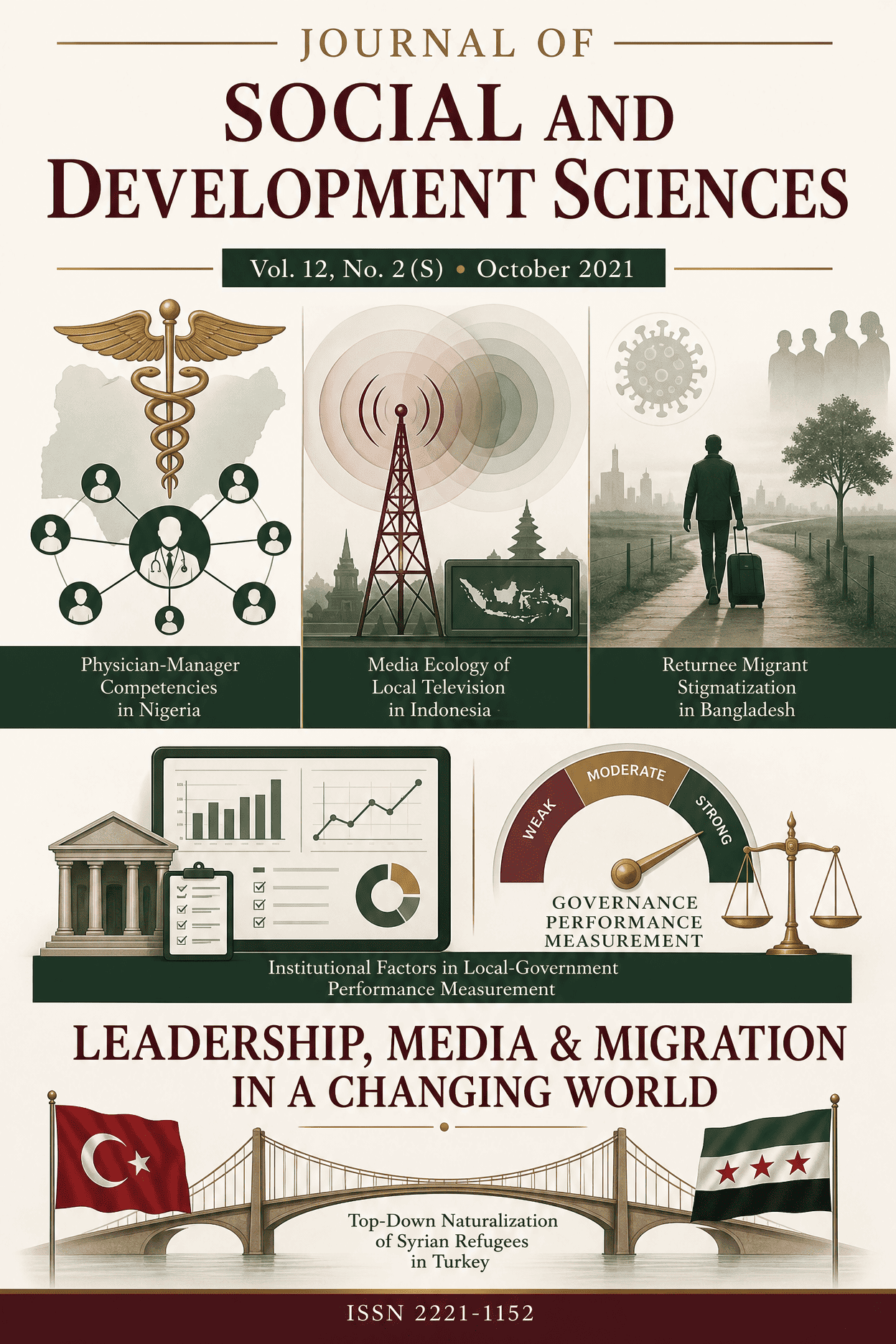
    Competencies and Development Needs of Physician Managers in Nigeria: A Case Study of Selected Hospitals in Ibadan City, Oyo State

    • Author: Gbemisola A. Daramola, Olawumi D. Awolusi

    The physician is traditionally the head of the medical team. To be an effective and efficient team leader is not innate but requires acquiring some competencies. The medical school curriculum was deficient in this regard hence the need for acquisition of these skills through training. Consequently, the present study aims to assess the influence of leadership competencies and Development Needs on the job performance of Physician Mangers. A cross-sectional survey was distributed among Physician Managers in various hospital types that were purposefully selected. Ten Physician Managers were also interviewed for in-depth information of skills they require to perform well. Descriptive and inferential statistics were used to summarize the items of the questionnaire at a 5% level of significance and to determine if a significant difference existed between groups of Physician managers. Results show that possessing the competencies; communication and relationship management, leadership and business skills and knowledge do influence the job performance of Physician Mangers. There was a significant difference between physicians that had formal training in management and those that had none in the communication and professionalism domains. Seven Physician Managers from different types of hospitals were interviewed, two of them females. They had been in managerial positions from 6months to 34 years. They all emphasized communication and leadership skills as important competencies for every physician manager. They all also suggested that management training must be introduced either during undergraduate or postgraduate training and that physician as head of the medical team require regular management update training.

    Pages 1-19

    PDF - Competencies and Development Needs of Physician Managers in Nigeria: A Case Study of Selected Hospitals in Ibadan City, Oyo State (opens in a new tab)
  • Article 2 in this issue

    Media Ecology: The Competition of Local Private Television on Seizing Audiences for Broadcasting Sustainability in South Kalimantan, Indonesia

    • Author: Atika Rusli, Achmad Bayu Chandrabuwono, Muhammad Febri Rahmat Akbari

    Media ecology examined the interrelationships between the media and their supporting environment. This research article aimed to determine the category of life-support sources (niche breadth) and to measure the level of competition (niche overlap) of local private television in South Kalimantan in seizing for viewers. This research used a quantitative approach. Target audience data, as the main data, was obtained by data collection techniques in the form of logbook survey results or management estimates from each television. The collected data was processed using the niche breadth formula to determine the category of each television media, and the niche overlap formula to determine the level of television competition in seizing for its viewers. The findings showed that Duta TV was in the generalist category and Prima TV was in the specialist category. The niche overlap scores differed between a number of target audience types, where the level of competition in seizing for viewers between the two televisions was quite high in the gender category compared to the other four types of target audiences, namely age group, socioeconomic status, recent education, and occupation.

    Pages 20-26

    PDF - Media Ecology: The Competition of Local Private Television on Seizing Audiences for Broadcasting Sustainability in South Kalimantan, Indonesia (opens in a new tab)
  • Article 3 in this issue

    Migrants during COVID-19 Pandemic: A Discursive Class Formation of Returnee Expatriates

    • Author: K. M. Mahmudul Haque, Arafatur Rahaman

    Amidst the outbreak of the Covid-19 pandemic, migrants are the most affected parts after the Health and economy. More than half a million migrants have returned from February to May 2020 to Bangladesh. The state and society have stigmatized returnee expatriates as suspected disease carriers. Some of them are being physically assaulted and humiliated by their neighbor and society. Researchers revealed a new dimension of " Othering " discourse; where consent of hate crime formed being solely blamed for bring coronavirus and ignoring mandatory quarantine period. The government officially stigmatized them by putting quarantined seals at their hands and hoisting red flags at their homes. Interestingly, we have found the distinction of stigmatization between returnee expatriates, where returnee workers were being humiliated rather than high-skilled returnee professionals from a so-called developed country. Returnee expatriates experienced a transformation of identity. Researchers argued about the discursive formation of a class of returnee expatriates who were once highly respected and spoiled of their identity as a probable source of virus carrier. Once labeled as a remittance fighter of the economy have to transients their so-called positions, and has to prove their worthiness as a citizen of the state, after starting the pandemic, governments and their developing partners were not humane, concerned about the returnee expatriates' social discrimination, risk of unemployment, uncertainty, economic crisis, and instability. Returnee expatriates' abandonment as a suspected carrier of the COVID-19 virus by the state and society should be worked out more comprehensively to protect them from social and economic exploitation.

    Pages 27-34

    PDF - Migrants during COVID-19 Pandemic: A Discursive Class Formation of Returnee Expatriates (opens in a new tab)
  • Article 4 in this issue

    Performance Measurement in Local Government: Institutional Factors

    • Author: Rabina Laila, Ermawati

    The purpose of this research is to give empirical evidence of the impact of management commitment, resources, legislative mandate, management innovation, and reward/incentive on performance measurement. This research data was collected through a Google Form, in which 64 questionnaires were sent to the Head of the Planning Subdivision and their staff in each of the Regional Apparatus Organizations in the South Tangerang City Government. With the technique used, census sampling, this study took a quantitative approach employing non-probability sampling. Structural Equation Modeling (SEM) using PLS version 3.0 was used to evaluate the data. Management commitment and legislative mandate have a considerable impact on performance measurement. Meanwhile, resources, management innovation, and reward/incentive do not. This study has implications for local governments in terms of describing how performance measurement is carried out based on institutional factors, as well as making recommendations for improving local government performance measurements in the future to make them more reliable, effective, and efficient.

    Pages 35-44

    PDF - Performance Measurement in Local Government: Institutional Factors (opens in a new tab)
  • Article 5 in this issue

    Top-Down Naturalization: Turkish Government Propensity and Syrian Refugee Attitudes

    • Author: Musallam ABEDTALAS, Wissam Aldien ALOKLAH, Abdulhamid ALAWAK, Abdulnaser ALJASEM, Rohat SHEIKH ESMAEEL ZADA

    Naturalization takes place at the intersection between a host government's propensity to give citizenship and refugees' attitudes towards it. However, the naturalization of Syrian refugees, with its top-down approach, shows the possibility of a divergence between a government’s propensity and refugees’ attitudes, and that divergence may spoil the expected benefits. This study questions the factors that determine government propensity and refugees' attitude, besides the convergence and divergence between them. The regressions have been estimated using data collected from a sample of 296 Syrian students at Mardin University, Turkey. The findings of this study revealed a contradiction between attitude and propensity, although they share factors of education and the hosting context. While the indications of social and cultural integration have a positive effect on attitudes, they do not affect propensity. Besides the contextual factors of hosting province shape attitude and propensity. Moreover, the most important factor in deciding attitude is the perception of the costs and benefits of naturalization.

    Pages 45-57

    PDF - Top-Down Naturalization: Turkish Government Propensity and Syrian Refugee Attitudes (opens in a new tab)