Abstract
Joyful learning evokes happy feelings and subsequently induces positive academic achievement. With the rise of mental health issues due to intense study among students, gamification has recently grown in popularity among academic institutions to make learners happier, more engaged and ultimately improve learning outcomes. However, the management of gamified lessons has been a problem for years for all education levels on a varying basis. Nowadays, it is increasingly recognized that not all learners are acceptive of gamified lessons for learning. Drawing on a survey of 283 students of higher learning institutions, this study found that aesthetics, perceived ease of use, perceived usefulness and perceived enjoyment have a favorable impact on the intention to accept gamification in learning among learners. This study is contributing to under-investigated scholarly works of suitable conditions under which gamified lesson best takes place with regards to aesthetic and learners’ acceptance that would be beneficial for effective management of gamification.
Keywords
- Gamification Acceptance Search this journal for Gamification Acceptance (opens in a new tab)
- Aesthetics Search this journal for Aesthetics (opens in a new tab)
- Perceived Ease of Use Search this journal for Perceived Ease of Use (opens in a new tab)
- Perceived Usefulness Search this journal for Perceived Usefulness (opens in a new tab)
- Perceived Enjoyment Search this journal for Perceived Enjoyment (opens in a new tab)
References
- Alhammad M. M. & Moreno, A. M. (2018). Gamification in software engineering education: A systematic mapping. Journal of Systems and Software, 141, 131–150.
- Alshammari, M. T. (2020). Evaluation of gamification in E-Learning systems for elementary school students. TEM Journal, 9, 806-813. https://doi.org/10.18421/TEM92-51.
- Bencsik, A., Mezeiova, A. & Oszene Samu, B. (2021). Gamification in Higher Education (Case Study on a Management Subject). International Journal of Learning, Teaching and Educational Research, 20(5), 211-231, May 2021
- Bhattacherjee, A. (2001). Understanding information systems continuance: An expectation–confirmation model. MIS Quarterly, 25(3), 351-370.
- Cavana, R. Y., Delahaye, B. L. & Sekaran, U. (2001). Applied business research. Qualitative and quantitative methods. Australia: John Wiley & Sons Australia Ltd.
- Cohen, J. (1992). Quantitative methods in psychology: A power primer. Psychological Bulletin, 112(1), 155-159.
- Davis, F. D. (1989). Perceived usefulness, perceived ease of use and user acceptance of information technology. MIS Quarterly, 13, 319-340.
- Farhan, W., Razmak, J., Demers, S. & Laflamme, S. (2019). E-learning systems versus instructional communication tools: developing and testing a new e-learning user interface from the perspectives of teachers and students. Technology in Society, 59.
- Forndran, F. & Zacharias, C. R. (2019). Gamified experimental physics classes: A promising active learning methodology for higher education. European Journal of Physics, 40(4), 045702.
- Franke, G. & Sarstedt, M. (2019). Heuristics versus statistics in discriminant validity testing: A comparison of four procedures. Internet Research, 29(3), 430-447
- Goksuna, D. O. & Gursoy, G. (2019). Comparing success and engagement in gamified learning experiences via Kahoot and Quizizz, Computers & Education, 135, 15-29. https://doi.org/10.1016/j.compedu.2019.02.015
- Hair, J. F., Risher, J. J., Sarstedt, M. & Ringle, C. M. (2019). When to use and how to report the results of PLS-SEM. European Business Review, 31(1), 2-24.
- Hair, J. F., Thomas, G., Hult, M., Ringle, C. M. & Sarstedt, M. (2017). A Primer on Partial Least Squares Structural Equation Modeling (2nd ed.). Thousand Oakes, CA: Sage.
- Hamari, J. (2013). Transforming homo economics into homo ludens: A field experiment on gamification in a utilitarian peer-to-peer trading service. Electronic commerce research and applications, 12(4), 236-245. https://doi.org/10.1016/j.elerap.2013.01.004
- Henseler, J., Ringle, C. & Sarstedt, M. (2015). A new criterion for assessing discriminant validity in variance-based structural equation modeling. Journal of the Academy of Marketing Science, 43(1), 115-135.
- Huotari, K. & Hamari, J. (2017). A definition for gamification: anchoring gamification in the service marketing literature. Electron. Markets, 27(1), 21-3.
- Jones, V., Jo, J. & Martin, P. (2007). Future schools and how technology can be used to support Millennial and Generation-Z students. ICUT 2007 (Proceedings B, pp. 886-891), 1st International Conference of Ubiquitous Information Technology, Dubai, Feb 12- 14, 2007.
- Kamunya, S. & Mirirti, E. et al. (2020). An adaptive gamification model for e-learning. In 2020 IST-Africa conference (IST-Africa).
- Khaldi, A., Bouzidi, R. & Nader F. (2023). Gamification of e-learning in higher education: a systematic literature review. Smart Learn. Environ, 10(1), 10. doi: 10.1186/s40561-023-00227-z. Epub 2023 Jan 31. PMCID: PMC9887250.
- Korableva, O., Durand, T., Kalimullina, O. & Stepanova, I. (2019). Usability testing of MOOC: Identifying user interface problems. In A. Brodsky, S., Hammoudi, M., Smialek & J. Filipe (Eds), Proceedings of the 21st International Conference on Enterprise Information Systems (ICEIS 2019), 2, 468-475), SciTePress. https://10.5220/ 0007800004680475.
- Landers, R. N. & Callan, R. C. (2011). Casual Social Games as Serious Games: The Psychology of Gamification in Undergraduate Education and Employee Training.
- Lee, D. Y. & Lehto, M. R. (2013). User acceptance of YouTube for procedural learning: An extension of the Technology Acceptance Model. Computers & Education, 61, 193-208.
- Lester, D., Skulmoski, G. J., Fisher, D. P., Mehrotra, V., Lim, I., Lang, A. & Keogh, J. W. L. (2023). Drivers and barriers to the utilization of gamification and game-based learning in universities: A systematic review of educators' perspectives. British Journal of Educational Technology, 00, 1–23. https://doi.org/10.1111/bjet.13311
- McGonigal, J. (2011). Reality Is Broken: Why Games Make Us Better and How They Can Change the World. Penguin Press. New York, NY.
- Murillo-Zamorano, L. R., López Sánchez, J. Á., Godoy-Caballero, A. L. & Bueno Munoz, C. (2021). Gamification and active learning in higher education: Is it possible to match digital society, academia, and students’ interests? International Journal of Educational Technology in Higher Education, 18(1), 1–27.
- Park, Y., Son, H. & Kim, C. (2012). Investigating the determinants of construction professionals’ acceptance of web-based training: an extension of the technology acceptance model. Automation in Construction, 22, 377-386. https://doi.org/10.1016/j.autcon.2011.09.016
- Preacher, K. J. & Hayes, A. F. (2008). Asymptotic and resampling strategies for assessing and comparing indirect effects in multiple mediator models. Behavior Research Methods, 40(3), 879- 891.
- Ramayah, T., Cheah, J., Chuah, F., Ting H. & Memon M. A. (2018). Partial Least Squares Structural Equation Modeling (PLS-SEM) Using Smartpls 3.0: An Updated and Practical Guide to Statistical Analysis. 2nd ed. Malaysia: Pearson Malaysia Sdn Bhd.
- Rosmansyah, Y., Isdiyanto, I., Hardi, A. B. & Putri, A. (2020). Using gami?cation for engaging surveyors: A case study in Statistics Indonesia. Interactive Technology and Smart Education, 17(4), 377-391.
- Salen, K. & Zimmerman, E. (2004). Rules of play: Game Design Fundamentals. Cambridge, MA: MIT Press.
- Schöbel, S. & Söllner, M. (2016). How to gamify information systems—Adapting gamification to individual user preferences.
- Squire, K. (2006). From Content to Context: Videogames as designed experience. Educational Researcher, 35(8), 19- 29.
- Squire, K. & Barab, S. (2004). Replaying History: Engaging Urban Underserved Students in Learning World History through Computer Simulation Games. In 6th International Conference on Learning Sciences. Santa Monica, United States: International Society of the Learning Sciences, 505-512.
- Swacha, J. (2021). State of research on gamification in education: A bibliometric survey. Education Sciences, 11(2), 1–15.
- Thong, J. Y. L., Hong, W. & Tam, K. Y. (2002). Understanding user acceptance of digital libraries: what are the roles of interface characteristics, organizational context, and individual differences? International Journal of Human-Computer Studies, 57(3), 215-242.
- Wei, C. W., Hug, I. C., Lee, L. & Chen, N. S. (2011). A Joyful Classroom Learning System with Robot Learning Companion for Children to Learn Mathematics Multiplication, The Turkish Online Journal of Educational Technology, 10(2), 12, 2011.
- Verdugo, D. R. & Belmonte, I. A. (2007). Using Digital Stories to Improve Listening Comprehension with Spanish Young Learners of English, Language Learning & Technology, 11, 87-101, 2007.
Downloads
No downloads have been recorded for this article yet. Figures appear here once readers begin downloading the full text.
How to Cite
Share this article
License
Copyright (c) 2023 Nor Azairiah Fatimah Othman, Amir Imran Zainoddin, Azila Jaini, Mazida Ismail, Siti Fatimah Mohamad Radzi, Dan Norashikin Hussein (Author)

This work is licensed under a Creative Commons Attribution 4.0 International License.
Author (s) should affirm that the material has not been published previously. It has not been submitted and it is not under consideration by any other journal. At the same time author (s) need to execute a publication permission agreement to assume the responsibility of the submitted content and any omissions and errors therein. After submission of revised paper in the light of suggestions of the reviewers, the editorial team edits and formats manuscripts to bring uniformity and standardization in published material.
This work will be licensed under Creative Commons Attribution 4.0 International (CC BY 4.0) and under condition of the license, users are free to read, copy, remix, transform, redistribute, download, print, search or link to the full texts of articles and even build upon their work as long as they credit the author for the original work. Moreover, as per journal policy author (s) hold and retain copyrights without any restrictions.
Keywords
- Gamification Acceptance Search this journal for Gamification Acceptance (opens in a new tab)
- Aesthetics Search this journal for Aesthetics (opens in a new tab)
- Perceived Ease of Use Search this journal for Perceived Ease of Use (opens in a new tab)
- Perceived Usefulness Search this journal for Perceived Usefulness (opens in a new tab)
- Perceived Enjoyment Search this journal for Perceived Enjoyment (opens in a new tab)
Section
Published in
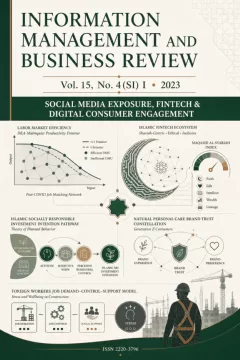 Vol. 15 No. 4(SI)I (2023)
Social Media Exposure, Fintech & Digital Consumer Engagement
View issue contents
Published
Submissions
Have research to publish? Information Management and Business Review welcomes submissions.
Make a Submission