Abstract
The purpose of this article is to identify the existing research gaps in the literature and the practicality of e-wallet acceptance studies in Malaysia. A systematic literature review (SLR) of peer-reviewed journal articles was carried out by the researchers, based on two major databases, namely, Scopus and Web of Science. In total, 60 articles published from January 2017 to April 2021 were reviewed which revealed the research gaps. Several research gaps are identified in the literature and practicality. The article offers suggestions for future research, including how to prioritize understudied subjects and incorporate other points of view. As a result, this study offers new researchers to learn more about the rapidly growing acceptance of e-wallets. Future research can also address these gaps and enhance the level of acceptance for e-wallets globally for a sustainable future. By identifying the factors that influence people's decision to accept e-wallets, researchers can help companies design better services and marketing campaigns. This will require some practical and theoretical implications, primarily demonstrating some nourishment in realizing the cashless society vision.
Keywords
- Fintech Search this journal for Fintech (opens in a new tab)
- E-Wallet Search this journal for E-Wallet (opens in a new tab)
- Acceptance Search this journal for Acceptance (opens in a new tab)
- Cashless Search this journal for Cashless (opens in a new tab)
- Sustainable Development Search this journal for Sustainable Development (opens in a new tab)
References
- eastern region of India. Journal of Payments Strategy & Systems, 14(3), 207–222.
- Nam, Y., Lee, S. T. & Kim, K. T. (2023). Racial/ethnic differences in mobile payment usage: what do we know, and what do we need to know? International Journal of Bank Marketing, 41(1), 52–69.
- Noor Ardiansah, M., Chariri, A., Rahardja, S. (2020). The effect of electronic payments security on e-commerce consumer perception: An extended model of technology acceptance. Management Science Letters, 10(7), 1473–1480. https://doi.org/10.5267/j.msl.2019.12.020
- Odoom, R. & Kosiba, J. P. (2020). Mobile money usage and continuance intention among micro-enterprises in an emerging market – the mediating role of agent credibility. Journal of Systems and Information Technology, 22(4), 97–117. https://doi.org/10.1108/JSIT-03-2019-0062
- Phan, T. N., Ho, T. V. & Le-Hoang, P. V. (2020). Factors Affecting the Behavioral Intention and Behavior of Using E–Wallets of Youth in Vietnam. The Journal of Asian Finance, Economics and Business, 7(10), 295–302. https://doi.org/10.13106/jafeb.2020.vol7.n10.295
- Qi, M., Cui, J., Li, X. & Han, Y. (2021). Perceived factors influencing the public intention to use E-Consultation: Analysis of web-based survey data. Journal of Medical Internet Research, 23(1), 1–20.
- Setiawan, R. A., Setyohadi, D. B. & Pranowo. (2018). Understanding customers’ intention to use social network sites as complaint channel: An analysis of young customers’ perspectives. E3S Web of Conferences, 31. https://doi.org/10.1051/e3sconf/20183111014
- Shen, H., Faklaris, C., Jin, H., Dabbish, L. & Hong, J. I. (2020). I Can’t even Buy Apples if I Don’t Use Mobile Pay. When Mobile Payments Become Infrastructural in China. Proceedings of the ACM on Human-Computer Interaction, 4(CSCW2). https://doi.org/10.1145/3415241
- Simatele, M. & Mbedzi, E. (2021). Consumer payment choices, costs, and risks: Evidence from Zimbabwe. Cogent Economics and Finance, 9(1). https://doi.org/10.1080/23322039.2021.1875564
- Singh, N. & Sinha, N. (2020). How perceived trust mediates a merchant’s intention to use a mobile wallet technology. Journal of Retailing and Consumer Services, 52(July 2019), 101894. https://doi.org/10.1016/j.jretconser.2019.101894
- Singh, S. & Srivastava, R. K. (2020). Understanding the intention to use mobile banking by existing online banking customers: an empirical study. Journal of Financial Services Marketing, 25(3–4), 86–96. https://doi.org/10.1057/s41264-020-00074-w
- Soodan, V. & Rana, A. (2020). Modelling customers’ intention to use e-wallet in a developing nation: Extending UTAUT2 with security, privacy and savings. Journal of Electronic Commerce in Organizations, 18(1), 89–114. https://doi.org/10.4018/JECO.2020010105
- Subawa, N. S., Dewi, N. K. A. & Gama, A. W. O. (2021). Differences of Gender Perception in Adopting Cashless Transaction Using Technology Acceptance Model. Journal of Asian Finance, Economics and Business, 8(2), 617–624. https://doi.org/10.13106/jafeb.2021.vol8.no2.0617
- Surendra, E. (2017). Introduction to Fintech in Malaysia.
- Taylor, S. & Todd, P. A. (1995). Understanding Information Technology Usage: A Test of Competing Models. Information Systems Research, 6, 144–176.
- Teng, S. & Khong, K. W. (2021). Examining actual consumer usage of E-wallet: A case study of big data analytics. Computers in Human Behavior, 121(February), 106778. https://doi.org/10.1016/j.chb.2021.106778
- Tikku, S. R. & Singh, A. K. (2023). Financial Disruption and Microentrepreneurs: Empirical Study on Adoption of E-Wallet Among Micro-Entrepreneurs in India. International Journal of E-Collaboration, 19(1), 1–14. https://doi.org/10.4018/IJeC.315780
- Tounekti, O., Ruiz?martínez, A. & Skarmeta?gómez, A. F. (2021). Users’ evaluation of a new web browser payment interface for facilitating the use of multiple payment systems. Sustainability (Switzerland), 13(9), 14–16. https://doi.org/10.3390/su13094711
- Tran Le Na, N. & Hien, N. N. (2021). A study of user’s m-wallet usage behavior: The role of long-term orientation and perceived value. Cogent Business and Management, 8(1). https://doi.org/10.1080/23311975.2021.1899468
- Tun-Pin, C., Keng-Soon, W. C., Yen-San, Y., Pui-Yee, C. & Hong-Leong, Julian Teh Shwu-Shing, N. (2019). An Adoption of Fintech Service in Malaysia. South East Asia Journal of Contemporary Business, Economics and Law, 18(5), 73–92.
- Wamba, S. F., Queiroz, M. M., Blome, C. & Sivarajah, U. (2021). Fostering Financial Inclusion in a Developing Country: Predicting User Acceptance of Mobile Wallets in Cameroon. Journal of Global Information Management, 29(4), 195–220. https://doi.org/10.4018/JGIM.20210701.oa9
- Wei, Q., Xiao, W., Yaqub, R. M. S., Irfan, M., Murad, M. & Yaqub, M. Z. (2023). Adoption of digital money (e-wallet) in the post COVID-19 era: The moderating role of low distribution charges and low transit time in impulsive buying: A developing country perspective. Frontiers in Environmental Science, 10(January). https://doi.org/10.3389/fenvs.2022.984316
- Worldpay Global Payments Report, F. (2021). In Malaysia, 64% of point of sale transactions are made in cash (FIS, 2020). 2020 Worldpay Global Payments Report. https://www.cashmatters.org/blog/malaysia-64-point-sale-transactions-cash
- Yang, M., Al Mamun, A., Mohiuddin, M., Nawi, N. C. & Zainol, N. R. (2021). Cashless transactions: A study on intention and adoption of e-wallets. Sustainability (Switzerland), 13(2), 1–18. https://doi.org/10.3390/su13020831
- Yeoh, O. K, M. (2019, February 24). Get ready for “vuca” world. https://www.nst.com.my/opinion/letters/2019/02/463071/get-ready-vuca-world.
Downloads
No downloads have been recorded for this article yet. Figures appear here once readers begin downloading the full text.
How to Cite
Share this article
License
Copyright (c) 2023 Rohaiza Kamis, Shafinar Ismail, Nur Hayati Abd Rahman (Author)

This work is licensed under a Creative Commons Attribution 4.0 International License.
Author (s) should affirm that the material has not been published previously. It has not been submitted and it is not under consideration by any other journal. At the same time author (s) need to execute a publication permission agreement to assume the responsibility of the submitted content and any omissions and errors therein. After submission of revised paper in the light of suggestions of the reviewers, the editorial team edits and formats manuscripts to bring uniformity and standardization in published material.
This work will be licensed under Creative Commons Attribution 4.0 International (CC BY 4.0) and under condition of the license, users are free to read, copy, remix, transform, redistribute, download, print, search or link to the full texts of articles and even build upon their work as long as they credit the author for the original work. Moreover, as per journal policy author (s) hold and retain copyrights without any restrictions.
Keywords
- Fintech Search this journal for Fintech (opens in a new tab)
- E-Wallet Search this journal for E-Wallet (opens in a new tab)
- Acceptance Search this journal for Acceptance (opens in a new tab)
- Cashless Search this journal for Cashless (opens in a new tab)
- Sustainable Development Search this journal for Sustainable Development (opens in a new tab)
Section
Published in
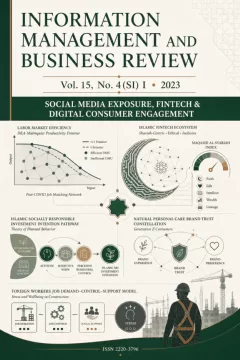 Vol. 15 No. 4(SI)I (2023)
Social Media Exposure, Fintech & Digital Consumer Engagement
View issue contents
Published
Submissions
Have research to publish? Information Management and Business Review welcomes submissions.
Make a Submission