Abstract
The advancement of social media platforms has enhanced communication sharing, interaction and information access. Importantly, the platforms become an integral part of the lives of today's students in updating themselves with current issues around the world and staying informed. Social media offers scammers opportunities to create fake profiles, leading to confusion between genuine investments and scams. However, alongside the benefits, social media also exposed students to deception such as being scammed. Students can be susceptible to falling prey to investment scams that offer high yields with low risk. Students must exercise caution online to avoid falling for fraudulent schemes. Vigilance in evaluating online content is crucial for their financial safety. Therefore, this study was conducted to examine the influence of social media on the intention to invest in investment scams among students. Data was collected among students at Universiti Teknologi MARA, Cawangan Negeri Sembilan. This study employed a quantitative method to collect primary data through an online questionnaire survey. The findings indicate a significant association between social media and intention to invest in investment scams. This study contributes to the existing literature on both social media and investment scam context and offers valuable insights to the policymakers, regulators and social media operators in combatting the fraudulent investment issue.
Keywords
References
- Australian Crime Commission. (2012). Serious and Organized Investment Fraud in Australia,
- Commonwealth of Australia, Canberra.
- Baby, A. & Shilpa, P. (2021). An Integrated Web-based Approach for Security Enhancement by Identification and Prevention of Scam Websites. In 2021 2nd International Conference on Advances in Computing, Communication, Embedded and Secure Systems. IEEE, 38-43.
- Bar-Lev, E., Maha, L. G. & Topliceanu, S. C. (2022). Financial fraud victim profiles in developing countries. Frontiers in Psychology, 13, 999053.
- Barreto, J. E. & Whitehair, C. L. (2017). Social media and web presence for patients and professionals: evolving trends and implications for practice. PM&R, 9(5), 98-105.
- Button, M. & Cross, C. (2017). Cyber frauds, scams and their victims. Taylor & Francis.
- Cong, L. W., Grauer, K., Rabetti, D. & Updegrave, H. (2023). The Dark Side of Crypto and Web3: Crypto-Related Scams. Available at SSRN 4358572.
- Demertzis, A. & Georgousi, F. (2023). Social Media and Personal Finance.
- Dupuis, D., Smith, D. & Gleason, K. (2023). Old frauds with a new sauce: digital assets and space transition. Journal of Financial Crime, 30(1), 205-220.
- Drahošová, M. & Balco, P. (2017). The analysis of advantages and disadvantages of the use of social media in the European Union. Procedia Computer Science, 109, 1005–1009.
- Federal Bureau of Investigation, Business and Investment Fraud. (2022). (Online). Available: https://www.fbi.gov/scams-and-safety/ common-scams-and-crimes/business-and-investment fraud.
- Financial Conduct Authority, “Cryptoasset investment scams. (2022). (Online). Available: https://www.fca.org.uk/scamsmart/ cryptoasset-investment-scams.
- Galanza, M. A. M. C., Aruta, J. J. B. R., Mateo, N. J., Resurreccion, R. R. & Bernardo, A. B. (2023). Mental health of Filipino university students during the COVID-19 pandemic: The distinct associations of fear of COVID-19 and financial difficulties. Educational and Developmental Psychologist, 40(1), 125-130.
- Hakak, S., Khan, W. Z., Imran, M., Choo, K. K. R. & Shoaib, M. (2020). Have you been a victim of COVID-19-related cyber incidents? Survey, taxonomy, and mitigation strategies. IEEE Access, 8, 124134-124144.
- Chiluwa, M. & Chiluwa, I. (2020). We are a mutual fund: how Ponzi scheme operators in Nigeria apply indexical markers to shield deception and fraud on their websites. Social semiotics, 1(26).
- Kahupi, I., Yakovleva, N. & Chen, S. (2023). The significance of SDG16 “Strong institutions” toward the adoption of circular economy approaches for the artisanal and small-scale mining sector in sub-Saharan Africa. In The Social Dimensions of the Circular Economy, 171-200. Cham: Springer International Publishing.
- Kumar, V. & Nanda, P. (2022). Social media as a learning tool: A perspective on formal and informal learning. International Journal of Educational Reform, 10567879221094303.
- Krishna, S. H., Jayanthi, M., Ghosh, P., Tamrakar, A. K., Gopinathan, R. & Dagar, P. (2022). A study on positive and negative effects of social media on society. International Journal of Early Childhood Special Education, 14(5).
- Lacey, D., Goode, S., Pawada, J. & Gibson, D. (2020). The application of scam compliance models to investment fraud offending. Journal of Criminological Research, Policy and Practice.
- Ma, K. W. F. & McKinnon, T. (2022). COVID-19 and cyber fraud: Emerging threats during the pandemic. Journal of Financial Crime, 29(2), 433-446.
- Nathanael, G. K., Angeliawati, D. & Muhadjir, M. (2023). The power of social media to influence people in Indonesia: a case study of crazy rich scam and big data of election postponement. JPPI (Jurnal Penelitian Pendidikan Indonesia), 9(1) 439-448.
- Prabowo, H. Y. (2023). When gullibility becomes us: exploring the cultural roots of Indonesians’ susceptibility to investment fraud. Journal of Financial Crime, (ahead-of-print).
- Raut, V. & Patil, P. (2016). Use of Social Media in Education: Positive and Negative impact on the students. International Journal on Recent and Innovation Trends in Computing and Communication, 4(1), 281-285.
- Reda, O. & Zellou, A. (2023). Assessing the quality of social media data: a systematic literature review. Bulletin of Electrical Engineering and Informatics, 12(2), 1115-1126.
- Sekaran, U. & Bougie, R. (2016). Research Methods for Business: A Skill-Building Approach. 7th Edition, Wiley & Sons, West Sussex.
- Subburayan, B. (2023). Case Study on Social Media Scam Artists Prey on India's Amateur Investors. Finance Educator: Courses, Cases & Teaching eJournal.
- Subramanian, N., Shobana, G., Bushra, S. N. & Maheswari, K. U. (2021, December). A way to explore SMS: Social Media Scams for a secure Digi-world. In 2021 5th International Conference on Electronics, Communication and Aerospace Technology (ICECA), 647.
- Sheth, J. N. (2018). How social media will impact marketing media. Social media marketing: Emerging concepts and applications, 3-18.
- Udeagha, M. C. & Muchapondwa, E. (2023). Green finance, fintech, and environmental sustainability: fresh policy insights from the BRICS nations. International Journal of Sustainable Development & World Ecology, 1-17.
- US Federal Trade Commission. (2022). Who experiences scams? A story for all ages. https://www.ftc.gov/news-events/data-visualizations/data-spotlight/2022/12/who-experiences-scams-story-all-ages
- Valencia, S. J. D., Cabuang, K. K. L. S., Millare, A. A., Reyes, A. C., Orlanda, M. M. & Pascual, M. P. (2022). Experiences of Novo Ecijanos who were Scammed by Investment Companies. International Journal of Advanced Engineering, Management and Science, 8(3).
- Wang, L., Cheng, H., Zheng, Z., Yang, A. & Zhu, X. (2021). Ponzi scheme detection via oversampling-based Long Short-Term Memory for smart contracts. Knowledge-Based Systems, 228, 107312.
- WMBFNews. (2019). Better Business Bureau says scams targeting college students are on the rise. https://www.wmbfnews.com/2019/08/29/better-business-bureau-says-scams-targeting-college-students-are-rise/
- Yadav, K. K. & Reddy, L. J. (2023). PSYCHOLOGICAL EFFECTS OF TECHNOLOGY ON COLLEGE STUDENTS. Journal of Clinical Otorhinolaryngology, Head, and Neck Surgery, 27(1), 1805-1816.
- Yoro, R. E., Aghware, F. O., Malasowe, B. O., Nwankwo, O. & Ojugo, A. A. (2023). Assessing contributor features to phishing susceptibility amongst students of petroleum resources varsity in Nigeria. International Journal of Electrical and Computer Engineering, 13(2), 1922.
Downloads
No downloads have been recorded for this article yet. Figures appear here once readers begin downloading the full text.
How to Cite
Share this article
License
Copyright (c) 2023 Rosniza Ramli, Salwa Muda, Eley Suzana Kasim, Norlaila Md. Zin, Norhidayah Ismail, Hazlina Mohd Padil (Author)

This work is licensed under a Creative Commons Attribution 4.0 International License.
Author (s) should affirm that the material has not been published previously. It has not been submitted and it is not under consideration by any other journal. At the same time author (s) need to execute a publication permission agreement to assume the responsibility of the submitted content and any omissions and errors therein. After submission of revised paper in the light of suggestions of the reviewers, the editorial team edits and formats manuscripts to bring uniformity and standardization in published material.
This work will be licensed under Creative Commons Attribution 4.0 International (CC BY 4.0) and under condition of the license, users are free to read, copy, remix, transform, redistribute, download, print, search or link to the full texts of articles and even build upon their work as long as they credit the author for the original work. Moreover, as per journal policy author (s) hold and retain copyrights without any restrictions.
Keywords
Section
Published in
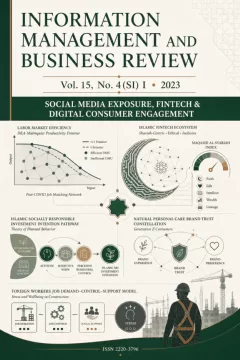 Vol. 15 No. 4(SI)I (2023)
Social Media Exposure, Fintech & Digital Consumer Engagement
View issue contents
Published
Submissions
Have research to publish? Information Management and Business Review welcomes submissions.
Make a Submission