Abstract
Various schools of thought within the field of psychology consider authentic personality to be an essential component of overall well-being. Similarly, people's behavior has changed since the advent of social media. Using Social Cognitive Theory as guidance, this conceptual paper aims to explore how authentic personality and social media postings affect individuals' self-interested charitable behavior, this research aims to delve into the person-centered concept of authentic personality. The sense of giving and charitable behavior includes giving to charity and involving in volunteer activity. This model is deemed appropriate because it further explains authentic personality and exposure to social media posting in an online environment. Throughout the entirety of this study, a search was conducted via a variety of literature on the fields of sociology, psychology, and social science. There was a discussion of the conclusions drawn from the research, and options for more research were outlined.
Keywords
- Authentic Personality Search this journal for Authentic Personality (opens in a new tab)
- Social Media Posting Search this journal for Social Media Posting (opens in a new tab)
- Self-Interested Charitable Behavior Search this journal for Self-Interested Charitable Behavior (opens in a new tab)
- Well-Being Search this journal for Well-Being (opens in a new tab)
- Volunteerism Search this journal for Volunteerism (opens in a new tab)
- Marketing Non-Profit Organization Search this journal for Marketing Non-Profit Organization (opens in a new tab)
- Social Cognitive Theory Search this journal for Social Cognitive Theory (opens in a new tab)
References
- Adhikari, C., Puri, A., Thapa, D., Thapa, R., Magar, S., & Gc, S. (2019). Application of social cognitive theory in obesity prevention: a rapid review. Journal of Health and Allied Sciences, 7(1), 53-62. https://doi.org/10.37107/jhas.23 DOI: https://doi.org/10.37107/jhas.23
- Bailey, E., Matz, S., Youyou, W., & Iyengar, S. (2020). Authentic self-expression on social media is associated with greater subject well-being. Nature Communications, 11(1). https://doi.org/10.1038/s41467-020-18539-w DOI: https://doi.org/10.1038/s41467-020-18539-w
- Bandura, A. (1991). Social cognitive theory of self-regulation. Organizational Behavior and Human Decision Processes, 50(2), 248-287. https://doi.org/10.1016/0749-5978(91)90022-l DOI: https://doi.org/10.1016/0749-5978(91)90022-L
- Bandura, A. (1999). A social cognitive theory of personality. In L. Pervin & O. John (Ed.), Handbook of personality (2nd ed., pp. 154-196). New York: Guilford Publications. (Reprinted in D. Cervone & Y. Shoda [Eds.], The coherence of personality. New York: Guilford Press.)
- Bandura, A. (2002). Social cognitive theory in cultural context. Applied Psychology, 51(2), 269-290. https://doi.org/10.1111/1464-0597.00092 DOI: https://doi.org/10.1111/1464-0597.00092
- Bandura, A. (2004). Health promotion by social cognitive means. Health Education & Behavior, 31(2), 143-164. https://doi.org/10.1177/1090198104263660 DOI: https://doi.org/10.1177/1090198104263660
- Bandura, A. (2009). Social cognitive theory of mass communication. In Media effects (pp. 110-140). Routledge. DOI: https://doi.org/10.4324/9780203877111-12
- Bandura, A. (2019). Applying theory for human betterment. Perspectives on Psychological Science, 14(1), 12-15. https://doi.org/10.1177/1745691618815165 DOI: https://doi.org/10.1177/1745691618815165
- Bulut, C., Nazli, M., Aydin, E., & Haque, A. (2021). The effect of environmental concern on conscious green consumption of post-millennials: the moderating role of greenwashing perceptions. Young Consumers Insight and Ideas for Responsible Marketers, 22(2), 306-319. https://doi.org/10.1108/yc-10-2020-1241 DOI: https://doi.org/10.1108/YC-10-2020-1241
- Cairns, H., Ritch, E., & Bereziat, C. (2021). Think eco, be eco? The tension between attitudes and behaviors of millennial fashion consumers. International Journal of Consumer Studies, 46(4), 1262-1277. https://doi.org/10.1111/ijcs.12756 DOI: https://doi.org/10.1111/ijcs.12756
- Checkoway, B. (2011). What is youth participation? Children and Youth Services Review, 33(2), 340–345. DOI: https://doi.org/10.1016/j.childyouth.2010.09.017
- Cundawan, A., Marchyta, N., & Santoso, T. (2021). The mediating effect of creative self-efficacy on the influence of knowledge sharing towards innovative work behavior among millennial knowledge workers. Jurnal Manajemen Dan Pemasaran Jasa, 14(2), 149-164. https://doi.org/10.25105/jmpj.v14i2.8873 DOI: https://doi.org/10.25105/jmpj.v14i2.8873
- Dubovi, A. and Sheu, H. (2022). Testing the effectiveness of an SCT-based training program in enhancing health self-efficacy and outcome expectations among college peer educators. Journal of Counseling Psychology, 69(3), 361-373. https://doi.org/10.1037/cou0000592 DOI: https://doi.org/10.1037/cou0000592
- Folarin, K. (2021). Cultivating millennial leaders. American Journal of Leadership and Governance, 6(1), 1-7. https://doi.org/10.47672/ajlg.72 DOI: https://doi.org/10.47672/ajlg.727
- Geng, Y., Chen, Y., Huang, C., Ya, T., Zhang, C., & Zhu, S. (2022). Volunteering, charitable donation, and psychological well-being of college students in China. Frontiers in Psychology, 12. https://doi.org/10.3389/fpsyg.2021.790528 DOI: https://doi.org/10.3389/fpsyg.2021.790528
- Gordon, S. (2022). Who helps refugees in South Africa? An examination of cultural and social factors. Voluntas International Journal of Voluntary and Nonprofit Organizations, 34(4), 747-759. https://doi.org/10.1007/s11266-022-00504-4 DOI: https://doi.org/10.1007/s11266-022-00504-4
- Graça, S. and Zwick, H. (2020). The perceived value of charitable involvement: the millennial donor perspective. Journal of Philanthropy and Marketing, 26(4). https://doi.org/10.1002/nvsm.1705 DOI: https://doi.org/10.1002/nvsm.1705
- Handayani, P. W., Zagatti, G. A., Kefi, H., & Bressan, S. (2023). Impact of social media usage on users’ COVID-19 protective behavior: a survey study in Indonesia. JMIR Formative Research, 7, e46661. https://doi.org/10.2196/46661 DOI: https://doi.org/10.2196/46661
- Hsu, W., Niiya, Y., Thelwall, M., Ko, M. L., Knutson, B., & Tsai, J. L. (2021). Social media users produce more effect that supports cultural values but are more influenced by effects that violate cultural values. Journal of Personality and Social Psychology, 121(5), 969-983. https://doi.org/10.1037/pspa0000282 DOI: https://doi.org/10.1037/pspa0000282
- Jamal, A., Yaccob, A., Bartikowski, B., & Slater, S. (2019). Motivations to donate: exploring the role of religiousness in charitable donations. Journal of Business Research, 103, 319-327. https://doi.org/10.1016/j.jbusres.2019.01.064 DOI: https://doi.org/10.1016/j.jbusres.2019.01.064
- Jiao, H., Qian, L., Liu, T., & Ma, L. (2021). Why do people support online crowdfunding charities? A case study from China. Frontiers in Psychology, 12. https://doi.org/10.3389/fpsyg.2021.582508 DOI: https://doi.org/10.3389/fpsyg.2021.582508
- Johnson, C., Santellano, K., & Yazdiha, H. (2020). Linking contexts, intersectionality, and generations: toward a multidimensional theory of millennials and social change. Sociological Perspectives, 63(3), 486-495. https://doi.org/10.1177/0731121420914294 DOI: https://doi.org/10.1177/0731121420914294
- Kahana, N. (2021). The road worth taking, the life worth living, and the person worth being: Morality, authenticity and personhood in volunteer tourism and beyond. Tourist Studies, 21(4), 509-525. https://doi.org/10.1177/14687976211019910 DOI: https://doi.org/10.1177/14687976211019910
- Kamboj, S. and Sharma, M. (2022). Social media adoption behavior: consumer innovativeness and participation intention. International Journal of Consumer Studies, 47(2), 523-544. https://doi.org/10.1111/ijcs.12848 DOI: https://doi.org/10.1111/ijcs.12848
- Konstantinou, I. and Jones, K. (2022). Investigating Gen Z attitudes to charitable giving and donation behavior: social media, peers and authenticity. Journal of Philanthropy and Marketing, 27(3). https://doi.org/10.1002/nvsm.1764 DOI: https://doi.org/10.1002/nvsm.1764
- Kurillová, A. and Marciánová, P. (2020). Factors influencing millennials’ intention to use peer-to-peer accommodation. Economic Research-Ekonomska Istraživanja, 34(1), 1323-1341. https://doi.org/10.1080/1331677x.2020.1825102 DOI: https://doi.org/10.1080/1331677X.2020.1825102
- Lai, I. K. W., & Liu, Y. (2020). The effects of content likeability, content credibility, and social media engagement on users’ acceptance of product placement in mobile social networks. Journal of Theoretical and Applied Electronic Commerce Research, 15(3), 1-19. https://doi.org/10.4067/s0718-18762020000300102 DOI: https://doi.org/10.4067/S0718-18762020000300102
- Lee, Y., Vu, A., & Trim, P. (2021). Millennials and repurchasing behavior: a collectivist emerging market. International Journal of Retail & Distribution Management, 50(5), 561-580. https://doi.org/10.1108/ijrdm-12-2020-0506 DOI: https://doi.org/10.1108/IJRDM-12-2020-0506
- Lent, R. (2016). Self-efficacy in a relational world. The Counseling Psychologist, 44(4), 573-594. https://doi.org/10.1177/0011000016638742 DOI: https://doi.org/10.1177/0011000016638742
- Nizariah, & Suhendrayatna,. (2021). The Impact of Technology on Adolescent Social Change: A Case Study on the Use of Social Media. 10.2991/assehr.k.210909.106. DOI: https://doi.org/10.2991/assehr.k.210909.106
- Pink, C., Wilkie, D. C. H., & Graves, C. (2023). The impact of brand perceptions on the post-to-purchase journey: a family branding perspective. Journal of Product &Amp; Brand Management, 32(5), 737-751. https://doi.org/10.1108/jpbm-11-2021-3752 DOI: https://doi.org/10.1108/JPBM-11-2021-3752
- Pitchay, A., Sukmana, R., Ratnasari, R., & Jalil, M. (2022). A study of cash waqf contribution between millennials of Malaysia and Indonesia. International Journal of Islamic and Middle Eastern Finance and Management, 16(4), 802-818. https://doi.org/10.1108/imefm-01-2022-0034 DOI: https://doi.org/10.1108/IMEFM-01-2022-0034
- Pojman, L. P. (1985). Kierkegaard on freedom and the scala paradise. International journal for philosophy of religion, 141-148. DOI: https://doi.org/10.1007/BF00165048
- Pramono, J., Sumartana, I., Santosa, I., Herlambang, P., & Purwantoro, B. (2020). Destination success factors for millennial travelers case study of Tanah lot temple, Tabanan, Bali. Adi Journal on Recent Innovation (Ajri), 1(2), 136-146. https://doi.org/10.34306/ajri.v1i2.44 DOI: https://doi.org/10.34306/ajri.v1i2.44
- Rasouli, G., & Hamdi, K. (2020). Helping relief campaigns: Social cognitive factors underlying important issues using structural equation modeling. Cogent Business & Management, 7. DOI: https://doi.org/10.1080/23311975.2020.1823596
- Ratten, V. and Ratten, H. (2007). Social cognitive theory in technological innovations. European Journal of Innovation Management, 10(1), 90-108. https://doi.org/10.1108/14601060710720564 DOI: https://doi.org/10.1108/14601060710720564
- Romeo, A., Edney, S., Plotnikoff, R., Olds, T., Vandelanotte, C., Ryan, J., … & Maher, C. (2021). Examining social-cognitive theory constructs as mediators of behavior change in the active team smartphone physical activity program: a mediation analysis. BMC Public Health, 21(1). https://doi.org/10.1186/s12889-020-10100-0 DOI: https://doi.org/10.1186/s12889-020-10100-0
- Roxas, H. and Marte, R. (2022). Effects of institutions on the eco-brand orientation of millennial consumers: a social cognitive perspective. Journal of Consumer Marketing, 39(1), 93-105. https://doi.org/10.1108/jcm-11-2020-4262 DOI: https://doi.org/10.1108/JCM-11-2020-4262
- Sahelices-Pinto, C., Lanero-Carrizo, A., & Burguete, J. (2020). Self?determination, clean conscience, or social pressure? underlying motivations for organic food consumption among young millennials. Journal of Consumer Behavior, 20(2), 449-459. https://doi.org/10.1002/cb.1875 DOI: https://doi.org/10.1002/cb.1875
- Shahbaznezhad, H., Dolan, R., & Rashidirad, M. (2021). The role of social media content format and platform in users' engagement behavior. Journal of Interactive Marketing, 53, 47-65. https://doi.org/10.1016/j.intmar.2020.05.001 DOI: https://doi.org/10.1016/j.intmar.2020.05.001
- Sharmin, F., Sultan, M., Badulescu, A., Bac, D., & Li, B. (2020). Millennial tourists’ environmentally sustainable behavior towards a natural protected area: an integrative framework. Sustainability, 12(20), 8545. https://doi.org/10.3390/su12208545 DOI: https://doi.org/10.3390/su12208545
- Smith, K., Norman, G., & Decety, J. (2019). Medical students’ empathy positively predicts charitable donation behavior. The Journal of Positive Psychology, 15(6), 734-742. https://doi.org/10.1080/17439760.2019.1651889 DOI: https://doi.org/10.1080/17439760.2019.1651889
- Stephens, D. (2021). Strategies to engage millennial employees (a multiple case study). Open Journal of Business and Management, 09(02), 618-658. https://doi.org/10.4236/ojbm.2021.92033 DOI: https://doi.org/10.4236/ojbm.2021.92033
- Subagyo, A., Syari’udin, A., & Yunani, A. (2022). Determinant residential real estate of the millennial generation in adapting housing microfinance case Indonesia chapter. International Journal of Housing Markets and Analysis, 16(5), 1007-1020. https://doi.org/10.1108/ijhma-04-2022-0063 DOI: https://doi.org/10.1108/IJHMA-04-2022-0063
- Teunenbroek, C., Bekkers, R., & Beersma, B. (2019). Look to others before you leap: a systematic literature review of social information effects on donation amounts. Nonprofit and Voluntary Sector Quarterly, 49(1), 53-73. https://doi.org/10.1177/0899764019869537 DOI: https://doi.org/10.1177/0899764019869537
- Tseng, J. (2020). Learning theories and principles in surgical education and technical learning. Journal of Surgical Oncology, 122(1), 11-14. https://doi.org/10.1002/jso.25936 DOI: https://doi.org/10.1002/jso.25936
- Wang, N., Tan, A., Xiao, W., Zeng, F., Jiong, X., & Duan, W. (2021). The effect of learning experiences on interest in stem careers: a structural equation model. Journal of Baltic Science Education, 20(4), 651-663. https://doi.org/10.33225/jbse/21.20.651 DOI: https://doi.org/10.33225/jbse/21.20.651
- Wei, F. and Liang, B. (2019). How millennials’ personality traits influence their eco-fashion purchase behavior. Athens Journal of Business & Economics, 5(3), 207-220. https://doi.org/10.30958/ajbe.5-3-2 DOI: https://doi.org/10.30958/ajbe.5-3-2
- Wood, A. M., Linley, P. A., Maltby, J., Baliousis, M., & Joseph, S. (2008). The authentic personality: A theoretical and empirical conceptualization and the development of the Authenticity Scale. Journal of Counseling Psychology, 55(3), 385. DOI: https://doi.org/10.1037/0022-0167.55.3.385
- Wu Y, Xu L. (2022) The effect of authentic leadership and organizational climate on the volunteering behavior of college students: A moderated mediation model. Psych J. 2022 Dec;11(6):852-862. doi: 10.1002/pchj.555. Epub 2022 May 11. PMID: 35545429. DOI: https://doi.org/10.1002/pchj.555
- Wu, J., Font, X., & Liu, J. (2020). Tourists’ pro-environmental behaviors: a moral obligation or disengagement? Journal of Travel Research, 60(4), 735-748. https://doi.org/10.1177/0047287520910787 DOI: https://doi.org/10.1177/0047287520910787
- Zhang, Z. and Peng, S. (2022). Licensing effect in sustainable charitable behaviors. Sustainability, 14(24), 16431. https://doi.org/10.3390/su142416431 DOI: https://doi.org/10.3390/su142416431
- Zhao, Y., Jiang, L., & Zhou, X. (2020). Having a secret reduces charitable giving. Journal of Pacific Rim Psychology, 14, e9. https://doi.org/10.1017/prp.2020.5 DOI: https://doi.org/10.1017/prp.2020.5
Downloads
Full-text downloads recorded for this article, by month.
No downloads have been recorded for this article yet. Figures appear here once readers begin downloading the full text.
How to Cite
Share this article
License
Copyright (c) 2024 Norhusniyati Husin, Nadhrathul Ain Ibrahim, Najihah Abdul Rahim, Khamisah Abd Manaf, Intan Syafinaz Mat Shafie (Author)

This work is licensed under a Creative Commons Attribution 4.0 International License.
Author (s) should affirm that the material has not been published previously. It has not been submitted and it is not under consideration by any other journal. At the same time author (s) need to execute a publication permission agreement to assume the responsibility of the submitted content and any omissions and errors therein. After submission of revised paper in the light of suggestions of the reviewers, the editorial team edits and formats manuscripts to bring uniformity and standardization in published material.
This work will be licensed under Creative Commons Attribution 4.0 International (CC BY 4.0) and under condition of the license, users are free to read, copy, remix, transform, redistribute, download, print, search or link to the full texts of articles and even build upon their work as long as they credit the author for the original work. Moreover, as per journal policy author (s) hold and retain copyrights without any restrictions.
Keywords
- Authentic Personality Search this journal for Authentic Personality (opens in a new tab)
- Social Media Posting Search this journal for Social Media Posting (opens in a new tab)
- Self-Interested Charitable Behavior Search this journal for Self-Interested Charitable Behavior (opens in a new tab)
- Well-Being Search this journal for Well-Being (opens in a new tab)
- Volunteerism Search this journal for Volunteerism (opens in a new tab)
- Marketing Non-Profit Organization Search this journal for Marketing Non-Profit Organization (opens in a new tab)
- Social Cognitive Theory Search this journal for Social Cognitive Theory (opens in a new tab)
Section
Published in
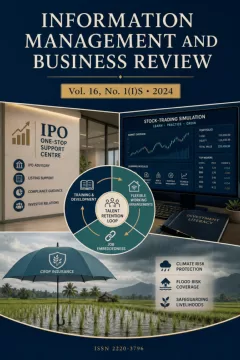 Vol. 16 No. 1(I)S (2024)
Investment Literacy, Talent Retention & Agricultural Risk
View issue contents
Published
Submissions
Have research to publish? Information Management and Business Review welcomes submissions.
Make a Submission