Abstract
The study aims to investigate the relationship between training and development, job embeddedness and flexible working arrangements on talent retention among the young generation of employees in Malaysian pharmaceutical companies. This research will employ a cross-sectional survey design, using the questionnaire survey method to collect data on the study variables. The sampling technique used in this research is nonprobability, purposive sampling. A sample will be collected from 348 young-generation employees working in pharmaceutical companies residing in Malaysia. PLS-SEM will be used to analyze the hypothesized relationships, providing valuable insight into critical factors influencing talent retention in pharmaceutical companies in Malaysia. The scarcity of research in the pharmaceutical context emphasizes the importance of identifying key influences on employee retention, which include training and development, job embeddedness, and flexible working arrangements. Interventions addressing these elements are critical for retaining skilled employees and improving organizational performance. The result of this research contributes to the comprehension of retention schemes, training and development plans, effective flexible work arrangements, and factors promoting job embeddedness. The findings guide organizational leaders in predicting employee preferences, reducing turnover rates, and implementing effective retention strategies, ultimately contributing to enhanced productivity and economic growth in Malaysia's pharmaceutical sector. The research also highlights the positive impact on employees' career advancement, employability, work-life balance, and overall well-being.
Keywords
- Talent Retention Search this journal for Talent Retention (opens in a new tab)
- Training and Development Search this journal for Training and Development (opens in a new tab)
- Flexible Working Arrangements Search this journal for Flexible Working Arrangements (opens in a new tab)
- Job Embeddedness Search this journal for Job Embeddedness (opens in a new tab)
References
- Aina, R. Al, & Atan, T. (2020). The impact of implementing talent management practices on sustainable organizational performance. Sustainability (Switzerland), 12(20), 1–21. Https://doi.org/10.3390/su12208372
- Akther, S., & Tariq, J. (2020). The impact of effective training on employee retention: a study in private banks of Bangladesh. Journal of Economics and Business, 3(1). Https://doi.org/10.31014/aior.1992.03.01.181
- Al Kurdi, B., Alshurideh, M., & Al afaishat, T. (2020). Employee retention and organizational performance: Evidence from the banking industry. Management Science Letters, 10(16), 3981–3990. Https://doi.org/10.5267/j.msl.2020.7.011
- Aleem, M., & Bowra, Z. A. (2020). Role of training & development on employee retention and organizational commitment in the banking sector of Pakistan. Review of Economics and Development Studies, 6(3), 639–650. Https://doi.org/10.47067/reads.v6i3.252
- Al-Emadi, A., Schwabenland, C., & Wei, Q. (2015). The vital role of employee retention in human resource management: a literature review. The IUP Journal of Organizational Behavior, 14(3), 7–32.
- Al-Ghazali, B. M. (2020). Transformational leadership, career adaptability, job embeddedness and perceived career success: a serial mediation model. Leadership & Organization Development Journal, 41(8), 993–1013. https://doi.org/10.1108/LODJ-10-2019-0455
- Alhmoud, A., & Rjoub, H. (2020). Does generation moderate the effect of total rewards on employee retention? Evidence from Jordan. SAGE Open, 10(3). Https://doi.org/10.1177/2158244020957039
- Ali, M., & Ullah, M. S. (2023). Role of laissez-faire leadership in talent management: Evidence from the pharmaceutical industry of Bangladesh. Heliyon, 9(6).
- Aljbour, A., French, E., & Ali, M. (2021). An evidence-based multilevel framework of talent management: a systematic review. International Journal of Productivity and Performance Management. Https://doi.org/10.1108/IJPPM-02-2020-0065
- Allen, D. G., & Shanock, L. R. (2013). Perceived organizational support and embeddedness as key mechanisms connecting socialization tactics to commitment and turnover among new employees. Journal of Organizational Behavior, 34(3), 350 – 369. Https://doi.org/10.1002/job.1805
- Aman-Ullah, A., Aziz, A., & Ibrahim, H. (2020). A systematic review of employee retention: what’s next in Pakistan? Journal of Contemporary Issues and Thought, 10(2), 36–45. Https://doi.org/10.37134/jcit.vol10.sp.4.2020
- Amirul, S. R., & Shaari, S. C. (2021). An overview: twenty years of flexible working arrangements. Advances in Business Research International Journal, 7(2), 27. Https://doi.org/10.24191/abrij.v7i2.14770
- Andrea, B., Gabriella, H. C., & Tímea, J. (2016). Y and Z generations at workplaces. Journal of Competitiveness, 8(3), 90–106. Https://doi.org/10.7441/joc.2016.03.06
- Arasanmi, C. N., & Krishna, A. (2019). Employer branding: perceived organizational support and employee retention – the mediating role of organizational commitment. Industrial and Commercial Training, 51(3), 174–183. Https://doi.org/10.1108/ICT-10-2018-0086
- Arredondo-Trapero, F. G., Vázquez-Parra, J. C., & González-Arredondo, A. S. (2022). Organizational citizenship behavior and job flexibility in Family-Responsible Companies: a study from the perspective of employee family situation. International Journal of Social Economics, 49(2), 251–267. Https://doi.org/10.1108/IJSE-05-2021-0269
- Batool, S., & Kashif, M. (2023). Occupational segregation, microaggression, social exclusion, and turnover intentions: mediating and moderating impact of social invisibility and felt obligation. International Journal of Sociology and Social Policy, 43(7/8), 677-694.
- Bennis, W., & Nanus, B. (1985). The strategies for taking charge. Leaders, New York: Harper. Row, 41.
- Bhakuni, S., & Saxena, S. (2023). Exploring the link between training and development, employee engagement and employee retention. Journal of Business and Management Studies, 5(1), 173–180. Https://doi.org/10.32996/jbms.2023.5.1.17
- Bharadwaj, S. (2023). Influence of training and development interventions on employee retention – an employer brand-based agenda. LBS Journal of Management and Research, 1(1), 1–14. Https://doi.org/10.1108/LBSJMR-12-2022-0080
- Bharath, M. (2021). Something beyond paycheque to boosting employee retention: evidence from a South Indian hospital. Vilakshan - XIMB Journal of Management. Https://doi.org/10.1108/XJM-03-2021-0072
- Buch, R., Kuvaas, B., & Dysvik, A. (2019). The role of other orientations in reactions to social and economic leader-member exchange relationships. Journal of Organizational Behavior, 40(3), 296–310. Https://doi.org/10.1002/job.2329
- Capnary, M. C., Rachmawati, R., & Agung, I. (2018). The influence of flexibility of work to loyalty and employee satisfaction mediated by work-life balance to employees with millennial generation background in Indonesia startup companies. Business: Theory and Practice, 19, 217–227. Https://doi.org/10.3846/btp.2018.22
- Choi, S. (2020). Flexible work arrangements and employee retention: A longitudinal analysis of the Federal Workforces. Public Personnel Management, 49(3), 470–495. Https://doi.org/10.1177/0091026019886340
- Ciarniene, R., & Vienazindiene, M. (2018). Flexible work arrangements from generation and gender perspectives: Evidence from Lithuania. Engineering Economics, 29(1), 84–92. Https://doi.org/10.5755/j01.ee.29.1.19247
- Climek, M., Henry, R., & Jeong, S. (2022). Integrative literature review on employee turnover antecedents across different generations: commonalities and uniqueness. Https://doi.org/10.1108/EJTD-05-2021-0058
- Coetzer, A., Inma, C., Poisat, P., Redmond, J., & Standing, C. (2019). Does job embeddedness predict turnover intentions in SMEs? International Journal of Productivity and Performance Management, 68(2), 340–361. Https://doi.org/10.1108/IJPPM-03-2018-0108
- Cropanzano, R., Anthony, E. L., Daniels, S. R., & Hall, A. V. (2017). Social exchange theory: A critical review with theoretical remedies. Academy of Management Annals, 11(1), 479–516. Https://doi.org/10.5465/annals.2015.0099
- Crossley, C. D., Bennett, R. J., Jex, S. M., & Burnfield, J. L. (2007). Development of a global measure of job embeddedness and integration into a traditional model of voluntary turnover. Journal of Applied Psychology, 92(4), 1031–1042. Https://doi.org/10.1037/0021-9010.92.4.1031
- Dechawatanapaisal, D. (2018). The moderating effects of demographic characteristics and certain psychological factors on the job embeddedness – turnover relationship among Thai healthcare employees. International Journal of Organizational Analysis, 26(1), 43–62. Https://doi.org/10.1108/IJOA-11-2016-1082
- Diah, A. M., Hasiara, L. O., Ramli, & Irwan, M. (2020). Employee retention of pharmaceutical firms in Indonesia: Taking investment in employee development and social and economic exchange as predictors. Systematic Reviews in Pharmacy, 11(1), 564–572. Https://doi.org/10.5530/srp.2020.1.70
- Dirani, A. El, Hazimeh, B., Hejase, H. J., & Hamdar, B. (2016). Employee retention in the pharmaceutical companies: Case of Lebanon. Preparing for accreditation view project corporate social responsibility in Lebanon view project employee retention. 18(August 2021), 58–75. Https://doi.org/10.9790/487X-1804015875
- Elsafty, A., & Oraby, M. (2022). The impact of training on employee retention. International Journal of Business and Management, 17(5), 58. Https://doi.org/10.5539/ijbm.v17n5p58
- Eyoun, K., Chen, H., Ayoun, B., & Khliefat, A. (2020). The relationship between the purpose of performance appraisal and the psychological contract: Generational differences as a moderator. International Journal of Hospitality Management, 86, 102449.
- Festing, M. and Schäfer, L. (2014). Generational challenges to TM: a framework for talent retention based on the psychological-contract perspective. Journal of World Business, Vol. 49 No. 2, pp. 262-271.
- Frye, W. D., Kang, S., Huh, C., & Lee, M. J. (MJ). (2020). What factors influence Generation Y’s employee retention in the hospitality industry? An internal marketing approach. International Journal of Hospitality Management. 102352. Https://doi.org/10.1016/j.ijhm.2019.102352
- Fuchs, R. M. (2022). Links, fit or sacrifice: job embeddedness and intention to quit among Generation Y. European Journal of Management and Business Economics, 31(2), 160–175. Https://doi.org/10.1108/EJMBE-05-2021-0156
- Gallardo-Gallardo, E., & Thunnissen, M. (2016). Standing on the shoulders of giants? A critical review of empirical talent management research. Employee Relations, 38(1), 31–56. Https://doi.org/10.1108/ER-10-2015-0194
- Hair, J. F., Ringle, C. M., and Sarstedt, M. (2011). PLS-SEM: Indeed, a silver bullet. J. Mark. Theory Pract. 19, 139–152. Doi: 10.2753/mtp1069-6679190202
- Hair, J.F. Jr, Matthews, L.M., Matthews, R.L. and Sarstedt, M. (2017), “PLS-SEM or CB-SEM: Updated guidelines on which method to use”, International Journal of Multivariate Data Analysis, Vol. 1 No. 2, pp. 107-123.
- Han, J. W. (2022). A review of antecedents of employee turnover in the hospitality industry on individual, team and organizational levels. International Hospitality Review, 36(1), 156–173. Https://doi.org/10.1108/ihr-09-2020-0050
- Hashmi, M. A., Al Ghaithi, A., & Sartawi, K. (2022). Impact of flexible work arrangements on employees’ perceived productivity, organizational commitment and perceived work quality: a United Arab Emirates case-study. Competitiveness Review. Https://doi.org/10.1108/CR-10-2020-0130
- Hassan, Z., & Govindhasamy, C. (2020). An investigation on extrinsic and intrinsic rewards on employee retention among Gen Y: A study in Malaysian manufacturing companies. Journal of Business and Economic Analysis, 03(01), 55–69. Https://doi.org/10.36924/sbe.2020.3104
- Hosen, Md. E. (2022). Factors Affecting Employee Turnover in Multinational Companies in Malaysia. Malaysian Management Journal, 26, 31–54. Https://doi.org/10.32890/mmj2022.26.2
- Houssein, A. A., Singh, J. S. K., & Arumugam, T. (2020). Retention of employees through career development, employee engagement and work-life balance: An empirical study among employees in the financial sector in Djibouti, East Africa. Global Business and Management Research, 12(3), 17-32.
- Indarti, S., Fernandes, A.A.R. and Hakim, W. (2017), The effect of OCB in the relationship between personality, organizational commitment and job satisfaction on performance. Journal of Management Development.
- Islam, M. A., Hack-Polay, D., Rahman, M., Hosen, M., Hunt, A., & Shafique, S. (2022). Work environment, HR practices and millennial employee retention in hospitality and tourism in Bangladesh. International Journal of Emerging Markets. Https://doi.org/10.1108/IJOEM-06-2021-0859
- Ivana, D. (2020). Human resource practices in improving employee retention. Virgil Madgearu Review of Economic Studies and Research, 13(1), 33–43. Https://doi.org/10.24193/rvm.2020.13.50
- J. W. Creswell. (2014). Research design: qualitative, quantitative, and mixed methods approaches, 4th ed. California, United States of America: SAGE Publications, Inc.
- Jayathilake, H. D. (2019). Retention of Generation-Z in information communication technology sector of Sri Lanka: A conceptual paper. Kelaniya Journal of Human Resource Management, 14(1), 17. Https://doi.org/10.4038/kjhrm.v14i1.64
- Jayathilake, H. D., Daud, D., Eaw, H. C., & Annuar, N. (2021). Employee development and retention of Generation-Z employees in the post-COVID-19 workplace: a conceptual framework. Benchmarking, 28(7), 2343–2364. Https://doi.org/10.1108/BIJ-06-2020-0311
- Jena, L., & Nayak, U. (2022). Organizational career development and retention of millennial employees: the role of job engagement and organizational engagement. Https://doi.org/10.1108/APJBA-07-2022-0323
- Jindal, P., & Shaikh, M. (2021). Talent retention: a mediator of the relationship between talent management strategies and succession planning. Asian Academy of Management Journal, 26(2), 117–142. Https://doi.org/10.21315/aamj2021
- Jindal, P., Shaikh, M., & Shashank, G. (2017). Employee engagement; tool of talent retention: Study of a pharmaceutical company. SDMIMD Journal of Management, 8(2), 7–16. Https://doi.org/10.18311/sdmimd/2017/18024
- Josiam, B. M., Crutsinger, C., Reynolds, J. S., Dotter, T. V., Thozhur, S., Baum, T., & Devine, F. (2009). An empirical study of the work attitudes of Generation Y college students in the USA: the case of hospitality and merchandising undergraduate majors. Journal of Services Research, 9(1).
- Kalyanamitra, P., Saengchai, S., & Jermsittiparsert, K. (2020). Impact of training facilities, benefits and compensation, and performance appraisal on the employees’ retention: A mediating effect of employees’ job satisfaction. Systematic Reviews in Pharmacy, 11(3), 166–175. Https://doi.org/10.5530/srp.2020.3.19
- Kamalaveni, S. Ramesh, T. V. (2019). A review of literature on employee empowerment. International Journal of Innovative Research in Management Studies (IJIRMS) Volume 4, Issue 4, Pp.1-10. A, 4(4), 1–10.
- Kerdpitak, C., & Jermsittiparsert, K. (2020). The effects of workplace stress, work-life balance on turnover intention: An empirical evidence from the pharmaceutical industry in Thailand. Systematic Reviews in Pharmacy, 11(2), 586–594. Https://doi.org/10.5530/srp.2020.2.86
- Khandelwal, Dr. A., & Shekhawat, N. (2018). Role of talent retention in reducing employee turnover. SSRN Electronic Journal.
- Kossivi, B., Xu, M., & Kalgora, B. (2016). Study on determining factors of employee retention. Open Journal of Social Sciences, 04(05), 261–268. Https://doi.org/10.4236/jss.2016.45029
- Kossyva, D., Theriou, G., Aggelidis, V., Sarigiannidis, L., & Chatzoudes, D. (2021). Retention of Generation Y employees through high-performance work systems, change management and employee engagement. European Research Studies Journal, XXIV(Issue 4B), 66–86. Https://doi.org/10.35808/ersj/2632
- Kowske, B. J., Rasch, R., & Wiley, J. (2010). Millennials’ (lack of) attitude problem: An empirical examination of generational effects on work attitudes. Journal of Business and Psychology, 25(2), 265–279. Https://doi.org/10.1007/s10869-010-9171-8
- Kwon, K., & Jang, S. (2022). There is no good war for talent: a critical review of the literature on talent management. Employee Relations, 44(1), 94–120. Https://doi.org/10.1108/ER-08-2020-0374
- Latukha, A. A., Singh, J. S. K., & Arumugam, T. (2020a). Retention of employees through career development, employee engagement and work-life balance: An empirical study among employees in the financial sector in Djibouti, East Africa. Global Business and Management Research, 12(3), 17–32.
- Lee, C. C., Lim, H. S., Seo, D. (Josh), & Kwak, D.-H. A. (2022). Examining employee retention and motivation: the moderating effect of employee generation. Evidence-Based HRM: A Global Forum for Empirical Scholarship, 10(4), 385–402. Https://doi.org/10.1108/EBHRM-05-2021-0101
- Lim, Y. H., Salleh, M. I., & Md Latip, N. A. (2022). A study on the impact of off-the-job embeddedness and on-the-job embeddedness on employee retention in Malaysian private universities. International Journal of Education, Psychology and Counseling, 7(47), 441–456. Https://doi.org/10.35631/ijepc.747036
- Lin, L. H., & Wang, K. J. (2022). Talent retention of new generations for sustainable employment relationships in work 4.0 Era—Assessment by Fuzzy Delphi Method. Sustainability (Switzerland), 14(18). Https://doi.org/10.3390/su141811535
- Liyanaarachchi, G., Deshpande, S., & Weaven, S. (2021). Online banking and privacy: redesigning sales strategy through social exchange. International Journal of Bank Marketing, 39(6), 955–983. Https://doi.org/10.1108/IJBM-05-2020-0278
- Malik, P., & Malik, P. (2023). Should I stay or move on—examining the roles of knowledge-sharing systems, job crafting, and meaningfulness in work in influencing employees’ intention to stay? Journal of Organizational Effectiveness. Https://doi.org/10.1108/JOEPP-08-2022-0229
- Mangkunegara, A. A. A. P. (2019). Manajemen sumber daya manusia/Human Resource Management of Company. Bandung: Remaja Rosda karya Offside.
- Merican, N., Monil, M., Rafie, U. N., & Tajuddin, D. (2022). The effect of career planning, talent management and training development towards employee retention. International Journal of Academic Research in Business and Social Sciences, 12(8), 165–173. Https://doi.org/10.6007/ijarbss/v12-i8/14318
- Miri?, M., & Slavkovi?, M. (2023). Does training and development affect employee retention in the hotel industry?? The mediator role of organizational commitment. 11(1), 51–65. Https://doi.org/10.5937/menhottur2301051m
- Mitchell, T. R., Holtom, B. C., Lee, T. W., Sablynski, C. J., & Erez, M. (2001). Why people stay: Using job embeddedness to predict voluntary turnover. Academy of Management Journal, 44(6), 1102–1121. Https://doi.org/10.2307/3069391
- Mohamad Mazlan, M. R., & Jambulingam, M. (2023). Challenges of talent retention: A review of literature. Journal of Business and Management Review, 4(2), 078–091. Https://doi.org/10.47153/jbmr42.6302023
- Mozaffari, F., Rahimi, M., Yazdani, H., & Sohrabi, B. (2022). Employee attrition prediction in a pharmaceutical company using both machine learning approach and qualitative data. Benchmarking. Https://doi.org/10.1108/BIJ-11-2021-0664
- Mujtaba, M., Mubarik, M. S., & Soomro, K. A. (2022). Measuring talent management: a proposed construct. Employee Relations. Https://doi.org/10.1108/ER-05-2021-0224
- Mukherjee, B., Chandra, B., & Singh, S. (2020). Talent retention in Indian public sector units (PSUs): an empirical investigation. Kybernetes, 49(6), 1783–1810. Https://doi.org/10.1108/K-03-2019-0165
- Naim, M. F. and Lenka, U. (2018). Development and retention of Generation Y Employees: A conceptual framework. Employee Relations, 40(2), pp. 433–455.
- Ninroon, P., Khlungsaeng, W., Boonying, J., & Vaiyavuth, R. (2020). Identifying the predictors of the turnover intentions: A case of Thailand pharmaceutical companies. Systematic Reviews in Pharmacy, 11(3), 134–143. Https://doi.org/10.5530/srp.2020.3.15
- Ooi, P. B., Wan Jaafar, W. M., & Crosling, G. (2021). Malaysian school counselor’s self-efficacy: the key roles of supervisor support for training, mastery experience, and access to training. Frontiers in Psychology, 1–16. Https://doi.org/10.3389/fpsyg.2021.749225
- Ott, D. L., Tolentino, J. L., & Michailova, S. (2018). Effective talent retention approaches. Human Resource Management International Digest, 26(7), 16–19. Https://doi.org/10.1108/HRMID-07-2018-0152
- Ou, A. Y., Seo, J. J., Choi, D., & Hom, P. W. (2017). When can humble top executives retain middle managers? The moderating role of top management team fault lines. Academy of Management Journal, 60(5), 1915–1931. Https://doi.org/10.5465/amj.2015.1072
- Panday, P., & Kaur, G. (2021). Talent management and employee retention practices: A systematic literature review and future agenda. Journal of Contemporary Issues in Business and Government, 27(3). Https://doi.org/10.47750/cibg.2021.27.03.348
- Pandita, D., & Ray, S. (2018). Talent management and employee engagement – a meta-analysis of their impact on talent retention. Industrial and Commercial Training, 50(4), 185–199. Https://doi.org/10.1108/ICT-09-2017-0073
- Peters, R. B. T.-P. T. (2019). Solving Bio/Pharma Employee Career Advancement Demands: Keeping valuable employees happy--and on the job--may test bio/pharma business decisions. 43(1), 24.
- Pharma. (2018). Advancing the health of a forward-moving nation. In pharma Industry Factbook.
- Rahaman, Uddin, & Latif. (2023). Effects of Training and development, organizational culture, job satisfaction, and career development on employee retention in commercial banks in Bangladesh. Journal of Asian Finance, Economics and Business, 10(2), 91–97. Https://doi.org/10.13106/jafeb.2023.vol10.no2.0091
- Rubel, M. R. B., Hung Kee, D. M., & Rimi, N. N. (2020). High-performance work practices and medical professionals’ work outcomes: the mediating effect of perceived organizational support. Journal of Advances in Management Research, 18(3), 368–391. Https://doi.org/10.1108/JAMR-05-2020-0076
- Sekhar, C., & Patwardhan, M. (2021). Flexible working arrangement and job performance: the mediating role of supervisor support. International Journal of Productivity and Performance Management. Https://doi.org/10.1108/IJPPM-07-2020-0396
- Sessoms-Penny, S., Underwood, K. M., & Taylor, J. (2022). A decade later: exploring managerial insights on millennials. Management Matters.
- Shahi, T., Farrokhsheresht, B., Taghipourian, M. J., & Aghajani, H. A. (2020). Behavioral factors affecting talent management: Meta-synthesis technique. Iranian Journal of Management Studies, 13(1), 117–137. Https://doi.org/10.22059/IJMS.2019.283845.673684
- Sharma, R., & Prasad, A. (2018). Employer brand and its unexplored impact on intent to join. International Journal of Organizational Analysis, 26(3), 536–566. Https://doi.org/10.1108/IJOA-11-2017-1280
- Sheraz, F., Batool, S., & Adnan, S. (2019). Employee’s retention and job satisfaction: Mediating role of career development programs. The Dialogue, 14(2), 67–78.
- Sherrina, S., Zaman, Y. K., Arokiasamy, L., & Hamid, Z. A. (2021). A study on factors influencing employee retention in the Pharmaceutical industry in Malaysia. Electronic Journal of Business and Management, 6(1), 81–89.
- Silaban, H., & Margaretha, M. (2021). The impact of work-life balance toward job satisfaction and employee retention: a study of millennial employees in Bandung City, Indonesia. International Journal of Innovation and Economic Development, 7(3), 18–26. Https://doi.org/10.18775/ijied.1849-7551-7020.2015.73.2002
- Singh, D. (2019). A literature review on employee retention with a focus on recent trends. International Journal of Scientific Research in Science, Engineering and Technology, 425–431. Https://doi.org/10.32628/ijsrst195463
- Steindórsdóttir, B. D., Nerstad, C. G. L., & Magnúsdóttir, K. (2020). What makes employees stay? Mastery climate, psychological need satisfaction and on-the-job embeddedness. Nordic Psychology, 73(1), 91–115. Https://doi.org/10.1080/19012276.2020.1817770
- Subramaniam, C., Choo, L. S., & Johari, J. (2019). What makes employees want to stay? A study in the Malaysian manufacturing sector. Global Business and Organizational Excellence, 38(5), 33–43. Https://doi.org/10.1002/joe.21949
- Thilagham, K. T., Malini, T. N., Tirumala, P., Datta, A., Bhadauria, G. S., & Agarwal, P. (2022). Study on talent management practices in the pharma sector with a focus on "employee retention”. Journal of Pharmaceutical Negative Results, 13(6), 1366–1376. Https://doi.org/10.47750/pnr.2022.13.S06.181
- Thompson, D., & Muda, A. L. (2021). Exploring managers’ perspective on factors affecting Generation Y retention. Journal of Cognitive Sciences and Human Development, 7(2), 159–174. Https://doi.org/10.33736/jcshd.3798.2021
- Tsarenko, Y., Leo, C., & Tse, H. H. M. (2018). When and why do social resources influence employee advocacy? The role of personal investment and perceived recognition. Journal of Business Research, 82, 260–268. Https://doi.org/https://doi.org/10.1016/j.jbusres.2017.09.001
- Tsen, M. K., Gu, M., Tan, C. M., & Goh, S. K. (2021). Effect of flexible work arrangements on turnover intention: does job independence matter? International Journal of Sociology, 51(6), 451–472. Https://doi.org/10.1080/00207659.2021.1925409
- Turner, P. (2019). Employee engagement in contemporary organizations: Maintaining high productivity and sustained competitiveness. Https://doi.org/10.1007/978-3-030-36387-1
- Vui-Yee, K., & Paggy, K. (2020). The effect of work fulfillment on job characteristics and employee retention: Gen Y employees. Global Business Review, 21(2), 313–327. Https://doi.org/10.1177/0972150918778912
- Weideman, M., & Hofmeyr, K. B. (2021). Corrigendum to: The influence of flexible work arrangements on employee engagement: An exploratory study. SA Journal of Human Resource Management, 19, 0–18. Https://doi.org/10.4102/sajhrm.v19i0.1522
- William Lee, T., Burch, T. C., & Mitchell, T. R. (2014). The story of why we stay: A review of job embeddedness. Annual Review of Organizational Psychology and Organizational Behavior (Vol. 1, pp. 199–216). Annual Reviews Inc. Https://doi.org/10.1146/annurev-orgpsych-031413-091244
- Younas, M., & Bari, M. W. (2020). The relationship between talent management practices and retention of a generation ‘Y’ employees: the mediating role of competency development. Economic Research-Ekonomska Istrazivanja , 33(1), 1330–1353. Https://doi.org/10.1080/1331677X.2020.1748510
- Zarina, A. M., Fairuz, N. E. S., Noranee, S., Sundram, V. P. K., & Rozilah, A. A. (2018). Securing the future: Retention among Generation Y employees. Journal of Human Resources Management Research, 2018, 1–8. Https://doi.org/10.5171/2018.281654
Downloads
No downloads have been recorded for this article yet. Figures appear here once readers begin downloading the full text.
How to Cite
Share this article
License
Copyright (c) 2024 Azlina Saedin, Shereen Noranee, Nursaadatun Nisak Ahmad, Mohd Khalid Abas, Idaya Husna Mohd, Tasnimul Islam (Author)

This work is licensed under a Creative Commons Attribution 4.0 International License.
Author (s) should affirm that the material has not been published previously. It has not been submitted and it is not under consideration by any other journal. At the same time author (s) need to execute a publication permission agreement to assume the responsibility of the submitted content and any omissions and errors therein. After submission of revised paper in the light of suggestions of the reviewers, the editorial team edits and formats manuscripts to bring uniformity and standardization in published material.
This work will be licensed under Creative Commons Attribution 4.0 International (CC BY 4.0) and under condition of the license, users are free to read, copy, remix, transform, redistribute, download, print, search or link to the full texts of articles and even build upon their work as long as they credit the author for the original work. Moreover, as per journal policy author (s) hold and retain copyrights without any restrictions.
Keywords
- Talent Retention Search this journal for Talent Retention (opens in a new tab)
- Training and Development Search this journal for Training and Development (opens in a new tab)
- Flexible Working Arrangements Search this journal for Flexible Working Arrangements (opens in a new tab)
- Job Embeddedness Search this journal for Job Embeddedness (opens in a new tab)
Section
Published in
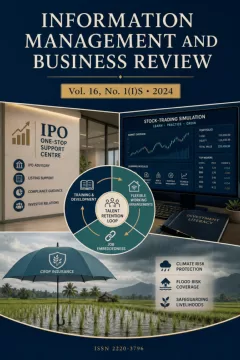 Vol. 16 No. 1(I)S (2024)
Investment Literacy, Talent Retention & Agricultural Risk
View issue contents
Published
Submissions
Have research to publish? Information Management and Business Review welcomes submissions.
Make a Submission