Abstract
This study investigates the impact of FDI, green technology innovation and GDP on CO2 emissions in the western region of China. This study applies the extended STIRPAT model, selects the relevant data of nine provinces in western China from 2000 to 2019, applies the static panel data analysis method, compares and analyses the estimation methods of Pooled OLS, fixed effect and random effect, and finally adopts the robust standard error estimation method of fixed effect. The results of the robust standard error estimation indicate that, in addition to the negative impact of green technology innovation on CO2 emissions, CO2 emissions are positively impacted by FDI, GDP, population, and the proportion of the secondary and tertiary industries. Therefore, reasonable introduction of FDI and improving green technology innovation levels are crucial in reducing CO2 emissions in the western region of China.
Keywords
- Foreign Direct Investment Search this journal for Foreign Direct Investment (opens in a new tab)
- Greem Technology Innovation Search this journal for Greem Technology Innovation (opens in a new tab)
- GDP Search this journal for GDP (opens in a new tab)
- CO2 Emissions Search this journal for CO2 Emissions (opens in a new tab)
- Western China Search this journal for Western China (opens in a new tab)
References
- Abdo, A.-B., Li, B., Zhang, X., Lu, J., & Rasheed, A. (2020). Influence of FDI on environmental pollution in selected Arab countries: a spatial econometric analysis perspective. Environmental Science and Pollution Research, 27(22), 28222–28246. https://doi.org/10.1007/s11356-020-08810-4
- Agrawal, G., & Khan, M. A. (2011). Impact of FDI on GDP: A comparative study of China and India. International Journal of Business and Management, 6(10), 71.
- Agya, A. A., & Wunuji, E. A. (2014). Effect of foreign direct investment on China economic growth: a Granger Causality approach. IOSR Journal of Economics and Finance, 2(4), 56-63.
- Ahmed, Z., Wang, Z., & Ali, S. (2019). Investigating the non-linear relationship between urbanization and CO2 emissions: An empirical analysis. Air Quality, Atmosphere and Health, 12(8), 945–953. https://doi.org/10.1007/s11869-019-00711-x
- Baumol, W. J., & Oates, W. E. (1988). The Theory of Environmental Policy. In Cambridge University Press. https://doi.org/10.2307/3145303
- Blundell, R., & Bond, S. (1998). Initial conditions and moment restrictions in dynamic panel data models. Journal of Econometrics, 87(1), 115-143.
- Braun, E., and Wield, D. (1994). Regulation as a Means for the Social Control of Technology. Technology Analysis & Strategic Management, 6 (3), 259–272. doi: 10.1080/09537329408524171
- Cai, W. H., & Ye, A. Z. (2017). Interactive Relationship among Transportation, Economic Growth and Carbon Emissions Based on PVAR Model. Journal of Transportation Systems Engineering and Information Technology, 17(03), 26–31. https://doi.org/10.16097/j.cnki.1009-6744.2017.03.005
- Cao, C., Wu, Q., Li, R., & Xu, B. (2020). The Impact of FDI and Trade Opening on Carbon Dioxide Emissions--A Case Study of Zhejiang Province. Northern Economy and Trade, 05, 16–20. https://kns.cnki.net/kcms/detail/detail.aspx?FileName=GFJM202005005&DbName=CJFQ2020
- Dang, Y. (2018). The Impact of FDI and International Trade on CO2 Emissions in China——Panel ARDL Approach. China Business And Market, 32(6), 113–121. https://doi.org/10.14089/j.cnki.cn11-3664/f.2018.06.012
- Dietz, T., & Rosa, E. A. (1994). Rethinking the environmental impacts of population, affluence and technology. Human Ecology Review, 1(2), 277–300. https://www.jstor.org/stable/24706840
- Do, T. V. T., & Dinh, H. L. (2020). Short-and long-term effects of GDP, energy consumption, FDI, and trade openness on CO2 emissions. Accounting, 6(3), 365–372. https://doi.org/10.5267/j.ac.2020.1.002
- Doytch, N. (2020). The impact of foreign direct investment on the ecological footprints of nations. Environmental and Sustainability Indicators, 8, 100085. https://doi.org/10.1016/j.indic.2020.100085
- Du, J. (2020). Forecast and analysis of the impact of urbanization evolution on cultivated land in Shaanxi province based on the Logistic Model. Journal of Qingyuan Polytechnic, 13(3), 27–32.
- Ehrlich, P. R., & Holdren, J. P. (1971). Impact of population growth: Complacency concerning this component of man’s predicament is unjustified and counterproductive. Science, 171, 1212–1217. https://doi.org/10.1126/science.171.3977.1212
- Ek, A. (2007). The impact of FDI on economic growth: The case of China.
- Elliott, R. J. R., Sun, P., & Chen, S. (2013). Energy intensity and foreign direct investment: A Chinese city-level study. Energy Economics, 40, 484–494. https://doi.org/10.1016/j.eneco.2013.08.004
- Gan, X., & Yin, B. (2016). A Study on the Impact of Foreign Direct Investment on China’s Economic Growth -- Based on the Dynamic Distribution Lag Model. Hubei Social Sciences, 03, 83–88. https://doi.org/10.13660/j.cnki.42-1112/c.013533
- Ghazali, A., & Ali, G. (2019). Investigation of key contributors of CO 2 emissions in extended STIRPAT model for newly industrialized countries: A dynamic common correlated estimator (DCCE) approach. Energy Reports, 5, 242–252. https://doi.org/10.1016/j.egyr.2019.02.006
- Grossman, G. M., & Krueger, A. B. (1995). Economic growth and the environment. In The Quarterly Journal of Economics (pp. 353–377). https://doi.org/10.2307/2118443
- Gu, H., Yang, W., & Chen, W. (2022). Effect of Green Technology Innovation on Urban Carbon Emission. Academic Exploration, 03, 120–132.
- Guo, J., & Yang, L. (2020). Impact of environmental regulations and government R&D funding on green technology innovation empirical analysis based on provincial level data in Mainland China. Science & Technology Progress and Policy, 37(10), 37–44. https://doi.org/10.6049/kjjbydc.Q201908707
- Guo, L., & Zhao, Y. (2022). Research on factors of carbon emissions from urban residents’ consumption under different levels of demand: Evidence from Northern China. Urban Development Studies, 29(4), 110–117.
- Hao, Y., & Cao, H. (2021). Relationship between energy consumption? CO2 emission and economic growth in Yangtze River Delta. Science ? Technology and Economy, 34(01), 101–105. https://doi.org/10.14059/j.cnki.cn32-1276n.2021.01.021
- Hausman, J. A. (1978). Specification tests in econometrics. Econometrica: Journal of The Econometric Society, 1251-1271.
- Hu, D., You, K., & Esiyok, B. (2021). Foreign direct investment among developing markets and its technological impact on host: Evidence from spatial analysis of Chinese investment in Africa. Technological Forecasting and Social Change, 166, 120593. https://doi.org/10.1016/j.techfore.2021.120593
- Hu, G., Li, C., & Hui, S. (2016). Based on the improved STIRPAT model application in carbon intensity forecasts. Statistics and Decision, 03, 87–89. https://doi.org/10.13546/j.cnki.tjyjc.2016.03.023
- Hu, X., & Shi, X. (2022). Research on the influence of green technology innovation on carbon emission performance? Take Northeast China as an example. Hubei Agricultural Sciences, 61(17), 5–10. https://doi.org/10.14088/j.cnki.issn0439-8114.2022.17.001
- Huan, M., Hou, Y., Cao, D., & Wei, K. (2018). FDI, technological progress and regional economic growth in China: Based on the Inter-provincial Panel Data from 1979 to 2013. Modern Economic Science, 40(02).
- Huang, J. (2017). The Threshold Effect Test of FDI’s Impact on China’s Carbon Emission Intensity. Statistics & Decision, 21, 108–111. https://doi.org/10.13546/j.cnki.tjyjc.2017.21.026
- Huang, M. (2015). Relation among economic growth? foreign direct investment and environmental pollution based on provincial panel 2003—2012. Resources & Industries, 17(01), 92–97. https://doi.org/10.13776/j.cnki.resourcesindustries.20141203.009
- Huangfu, Z., Hu, H., Xie, N., Zhu, Y. Q., Chen, H., & Wang, Y. (2020). The heterogeneous influence of economic growth on environmental pollution: evidence from municipal data of China. Petroleum Science, 17(4), 1180–1193. https://doi.org/10.1007/s12182-020-00459-5
- Jakada, A. H., Mahmood, S., Ahmad, A. U., Sani, A. I., & Yola, A. T. (2022). The effect of economic factors on the quality of the environment in African countries: An application of panel quantile regressions. Environmental Health Engineering and Management, 9(2), 85–95. https://doi.org/10.34172/EHEM.2022.10
- Jiang, B., & Ma, S. (2020). A study on the influencing factors of regional economic growth and carbon emission -- A case study of three Northeast Provinces. Enterprise Economy, 39(11), 122–131. https://doi.org/10.13529/j.cnki.enterprise.economy.2020.11.015
- Kong, Y., Feng, C., & Guo, L. (2022). Peaking Global and G20 Countries’ CO2 Emissions under the Shared Socio-Economic Pathways. International Journal of Environmental Research and Public Health, 19(17). https://doi.org/10.3390/ijerph191711076
- Lian, L., & Ma, H. (2013). FDI and economic growth in the Western region of China and dynamic mechanism: based on time-series data from 1986 to 2010. International Business Research, 6(4), 180.
- Liu, F., Huang, Q., & Liu, W. (2018). Regional Economic Growth and Regional Carbon Emissions ——Research Based on Environmental Kuznets Model. Journal of Central South University of Forestry & Technology (Social Sciences), 12(04), 20-26+35. https://doi.org/10.14067/j.cnki.1673-9272.2018.04.004
- Liu, Y., & Han, Y. (2021). Impacts of urbanization and technology on carbon dioxide emissions of Yangtze River economic belt at two stages: Based on an extended stirpat model. Sustainability, 13(13). https://doi.org/10.3390/su13137022
- Long, R., Gan, X., Chen, H., Wang, J., & Li, Q. (2020). Spatial econometric analysis of foreign direct investment and carbon productivity in China: Two-tier moderating roles of industrialization development. Resources, Conservation & Recycling, 155, 104677. https://doi.org/10.1016/j.resconrec.2019.104677
- Long, X., Chen, Y., Du, J., Oh, K., Han, I., and Yan, J. (2017). The Effect of Environmental Innovation Behavior on Economic and Environmental Performance of 182 Chinese Firms. Journal of Cleaner Production, 166, 1274–1282. doi: 10.1016/j.jclepro.2017.08.070
- Lucas, R. E., Wheeler, D., & Hettige, H. (1992). Economic development, environmental regulation, and the international migration of toxic industrial pollution, 1960-88 (Vol. 1062). World Bank Publications.
- Nadeem, A. M., Ali, T., Khan, M. T. I., & Guo, Z. (2020). Relationship between inward FDI and environmental degradation for Pakistan: an exploration of Pollution Haven Hypothesis through ARDL approach. Environmental Science and Pollution Research, 27(13), 15407–15425. https://doi.org/10.1007/s11356-020-08083-x
- Oladunni, O. J., Mpofu, K., & Olanrewaju, O. A. (2022). Greenhouse gas emissions and their driving forces in the transport sector of South Africa. Energy Reports, 8, 2052–2061. https://doi.org/10.1016/j.egyr.2022.01.123
- Pazienza, P. (2019). The impact of FDI in the OECD manufacturing sector on CO2 emission: Evidence and policy issues. Environmental Impact Assessment Review, 77, 60–68. https://doi.org/10.1016/j.eiar.2019.04.002
- Qi, P., & Vilaiphorn, C. (2019). The Impact of Foreign Direct Investment on Laos’ Economic Development. Co-Operative Economy & Science, 24, 68–70. https://doi.org/10.13665/j.cnki.hzjjykj.2019.24.026
- Qian, J., & Li, J. (2017). Performance of Energy Saving and Emission Reduction of Different Types of Technology Progress and Its Dynamic Change. Journal of Technology Economics, 36(04), 63-71+92.
- Sapkota, P., & Bastola, U. (2017). Foreign direct investment, income, and environmental pollution in developing countries: Panel data analysis of Latin America. Energy Economics, 64, 206–212. https://doi.org/10.1016/j.eneco.2017.04.001
- Sellitto, M. A., Camfield, C. G., and Buzuku, S. (2020). Green innovation and competitive advantages in a furniture industrial cluster: A survey and structural model. Sustainable Production Consumption, 23, 94–104. doi: 10.1016/j.spc.2020.04.007
- Song, L., & Xu, F. (2021). Research on carbon emission calculation and influencing factors of rural human settlement environment under the background of rural revitalization. Journal of Human Settlements in West China, 36(2), 36–45. https://doi.org/10.13791/j.cnki.hsfwest.20210205
- Su, Y., Jiang, Q., Khattak, S. I., Ahmad, M., & Li, H. (2021). Do higher education research and development expenditures affect environmental sustainability? New evidence from Chinese provinces. Environmental Science and Pollution Research, 28(47), 66656–66676. https://doi.org/10.1007/s11356-021-14685-w
- Tang, M., & Hu, F. (2021). How Does Land Urbanization Promote CO2 Emissions Reduction? Evidence From Chinese Prefectural-Level Cities. Frontiers in Environmental Science, 9, 1–16. https://doi.org/10.3389/fenvs.2021.766839
- Udeagha, M. C., & Ngepah, N. (2022). Dynamic ARDL Simulations Effects of fiscal decentralization, green technological innovation, trade openness, and institutional quality on environmental sustainability: Evidence from South Africa. Sustainability, 14(16), 10268. https://doi.org/10.3390/su141610268
- Wang, J., & Zhen, Q. (2018). A study on the relationship between economic growth and CO2 emissions -- Taking the Yangtze River Economic Belt as an example. Finance and Economy, 04, 36–45. https://doi.org/10.19622/j.cnki.cn36-1005/f.2018.04.005
- Wang, M. Y., Li, Y. M., Li, J., and Wang, Z. (2021). Green process innovation, green product innovation and its economic performance improvement paths: A survey and structural model. Journal of Environmental Management, 297, 113282. doi: 10.1016/j.jenvman.2021.113282
- Wang, S., Huang, Y., & Yuquan, Z. (2019). Spatial spillover effect and driving forces of carbon emission intensity at city level in China. Journal of Geographical Sciences, 29, 231–252. https://doi.org/10.1007/s11442-019-1594-1
- Wang, S., Zhou, C., Wang, Z., Feng, K., & Hubacek, K. (2017). The characteristics and drivers of fine particulate matter (PM2.5) distribution in China. Journal of Cleaner Production, 142, 1800–1809. https://doi.org/10.1016/j.jclepro.2016.11.104
- Wang, X. (2019). Financial development, two-way FDI and carbon emissions: Empirical analysis of Threshold Model based on China’s Province-level panel data. Value Engineering, 38(26), 110–112. https://doi.org/10.14018/j.cnki.cn13-1085/n.2019.26.046
- Walter, I. and Ugelow, J. (1979). Environmental Policies in Developing Countries. AMBIO, 8, 102-109.
- Wei, H. (2003). The location change of foreign investment in China after China enters into WTO and the prospect of attracting foreign investment in Central and Western China. Journal of Management World, 07, 67–75. https://doi.org/10.19744/j.cnki.11-1235/f.2003.07.009
- Wen, Y. (2021). Influence research on FDI and industrial structure optimization for carbon emission reduction. Shanghai Energy Saving, 03, 253–265. https://doi.org/10.13770/j.cnki.issn2095-705x.2021.03.005
- Wen, Y., Shabbir, M. S., Haseeb, M., Kamal, M., Anwar, A., Khan, M. F., & Malik, S. (2022). The dynamic effect of information and communication technology and renewable energy on CO2 emission: Fresh evidence from panel quantile regression. Frontiers in Environmental Science, 10(August), 1–12. https://doi.org/10.3389/fenvs.2022.953035
- Wu, W., & Liu, P. (2021). Interaction between FDI and carbon emissions -- Empirical analysis based on panel data of 281 prefecture-level cities. Business & Economy, 02, 117-120+134. https://doi.org/10.19905/j.cnki.syjj1982.2021.02.042
- Wu, Y., & Zhao, G. (2021). Does green technology innovation improve energy conservation and emission reduction? Future and Development, 45(06), 34–42.
- Xu, G., & Ren, X. (2018). A Study on the correlation between urbanization and the water resource load of Bijie City using the STRIPAT Model. China Rural Water and Hydropower, 01, 40–45. https://kns.cnki.net/kcms/detail/detail.aspx?FileName=ZNSD201801010&DbName=CJFQ2018
- Xu, J., Tong, B., & Wang, M. (2022). Research on the impact of green technology innovation on CO2 emissions from a spatial perspective. Studies in Science of Science, 1–20. https://doi.org/10.16192/j.cnki.1003-2053.20220301.001
- Yang L, Liang Z, Yao W, Zhu H, Zeng L, & Zhao Z. (2023). What are the impacts of urbanization on carbon emissions efficiency? Evidence from Western China. Land, 12(9), 1707. https://doi.org/10.3390/land12091707
- Yang, X., & Wang, D. (2022). Heterogeneous environmental regulation, foreign direct investment, and regional carbon dioxide emissions: Evidence from China. Sustainability, 14(11). https://doi.org/10.3390/su14116386
- York, R., Rosa, E. A., & Dietz, T. (2003). STIRPAT, IPAT and IMPACT: Analytic tools for unpacking the driving forces of environmental impacts. Ecological Economics, 46(3), 351–365. https://doi.org/10.1016/S0921-8009(03)00188-5
- Yuan, B., Li, C., Yin, H., & Zeng, M. (2022). Green innovation and China’s CO2 emissions–the moderating effect of institutional quality. Journal of Environmental Planning and Management, 65(5), 877–906. https://doi.org/10.1080/09640568.2021.1915260
- Yuan, Y., & Sun, X. (2020). Exploring the relationship between urbanization, industrial structure, energy consumption, economic growth and CO2 emissions: an empirical study based on the heterogeneity of inter-provincial income levels in China. Climate Change Research, 16(6), 738–747. https://doi.org/10.12006/j.issn.1673-1719.2019.192
- Zhang, K. (2019). Does FDI exacerbate CO2 Emissions in China’s manufacturing industry? Journal of Finance and Economics Theory, 06, 88–102. https://doi.org/10.13894/j.cnki.jfet.2019.06.009
- Zhao, X., & Xi, Y. (2022). Threshold effects of urban population size and industrial structure on CO2 emissions in China. Frontiers in Environmental Science, 10(April), 1–10.
- Zhou, B., & Shao, H. (2020). FDI, financial development and regional economic growth--A study of Spatial Econometrics based on China’s 31 provincial panel data. Reform of Economic System, 04, 150–157. https://kns.cnki.net/kcms/detail/detail.aspx?FileName=JJTG202004022&DbName=DKFX2020
- Zhou, S., Zhao, M., & Su, L. (2015). An empirical study of the carbon emissions Kuznets Curve for China--Based on Gregory-Hansen Cointegration Test. Resources and Environment in the Yangtze Basin, 24(09), 1471–1476. https://doi.org/10.11870/cjlyzyyhj201509005
- Zhu, C., Yang, S., Liu, P., & Wang, M. (2022). Study on carbon dioxide peak of transportation industry in China. Journal of Transportation Systems Engineering and Information Technology. https://kns.cnki.net/kcms/detail/detail.aspx?FileName=YSXT20220704002&DbName=CAPJ2022
- Zhu, M., & Wei, J. (2018). Research on the impact of intra-industry trade and FDI on CO2 emission of three economic circles in China. Technology and Innovation Management, 39(05), 606-610+628.
- Zhu, Y., Gao, H., & Xu, Y. (2022). How does coordinated development of two-way FDI Reduce Regional CO2 Emission Intensity? ——Based on the Mediating Effect of Enterprise Green Technology Innovation and the Moderating Effect of Government Quality. Soft Science, 02, 86–94.
- Zubair, A. O., Abdul Samad, A. R., & Dankumo, A. M. (2020). Does gross domestic income, trade integration, FDI inflows, GDP, and capital reduce CO2 emissions? Empirical evidence from Nigeria. Current Research in Environmental Sustainability, 2, 100009. https://doi.org/10.1016/j.crsust.2020.100009
Downloads
No downloads have been recorded for this article yet. Figures appear here once readers begin downloading the full text.
How to Cite
Share this article
License
Copyright (c) 2024 Yunxiu Qiu, Soo-Cheng Chuah, Ruhaini Muda, Theng-Huey Goh (Author)

This work is licensed under a Creative Commons Attribution 4.0 International License.
Author (s) should affirm that the material has not been published previously. It has not been submitted and it is not under consideration by any other journal. At the same time author (s) need to execute a publication permission agreement to assume the responsibility of the submitted content and any omissions and errors therein. After submission of revised paper in the light of suggestions of the reviewers, the editorial team edits and formats manuscripts to bring uniformity and standardization in published material.
This work will be licensed under Creative Commons Attribution 4.0 International (CC BY 4.0) and under condition of the license, users are free to read, copy, remix, transform, redistribute, download, print, search or link to the full texts of articles and even build upon their work as long as they credit the author for the original work. Moreover, as per journal policy author (s) hold and retain copyrights without any restrictions.
Keywords
- Foreign Direct Investment Search this journal for Foreign Direct Investment (opens in a new tab)
- Greem Technology Innovation Search this journal for Greem Technology Innovation (opens in a new tab)
- GDP Search this journal for GDP (opens in a new tab)
- CO2 Emissions Search this journal for CO2 Emissions (opens in a new tab)
- Western China Search this journal for Western China (opens in a new tab)
Section
Published in
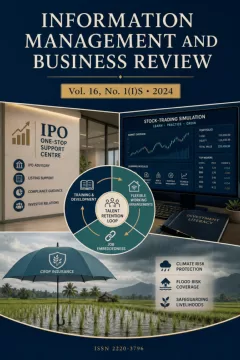 Vol. 16 No. 1(I)S (2024)
Investment Literacy, Talent Retention & Agricultural Risk
View issue contents
Published
Submissions
Have research to publish? Information Management and Business Review welcomes submissions.
Make a Submission