Abstract
Different students have different preferences for learning methods. Some of the students might prefer visual or audio reading or kinesthetic learning. It is believed that the student’s preferences of learning methods might help the students understand more about the subject and hence contribute to their academic performance. Therefore, this study investigates whether the students’ preferences for learning methods are influenced by the courses they registered for and the gender, and age of the students. A sample of 341 students from different backgrounds was selected in this study comprised of students from the Faculty of Business and Management, Faculty of Accountancy, Faculty of Graphic Design, and Faculty of Nursing in Universiti Teknologi MARA (UiTM) Puncak Alam. The findings show that course and gender play an important role in student’s preferences for learning methods while age is not the significant variable. There is a very high positive correlation between courses and preferences of learning methods, while age and gender have a high positive correlation toward preferences of learning methods. This study might help educators in tailoring their lectures to the students’ preferences of learning methods, thus contributing to the academic performance of the students.
Keywords
- Learning Method Search this journal for Learning Method (opens in a new tab)
- Courses Search this journal for Courses (opens in a new tab)
- Age Search this journal for Age (opens in a new tab)
- Gender Search this journal for Gender (opens in a new tab)
- VARK Search this journal for VARK (opens in a new tab)
- Academic Performance Search this journal for Academic Performance (opens in a new tab)
References
- Alkooheji, L., & Al-Hattami, A. (2018). Learning Style Preferences among College Students. International Education Studies, 11(10), 50. https://doi.org/10.5539/ies.v11n10p50
- Awang, H., Abd Samad, N., Mohd Faiz, N. S., Roddin, R., & Kankia, J. D. (2017). Relationship between the Learning Styles Preferences and Academic Achievement. IOP Conference Series: Materials Science and Engineering, 226(1), 1–6. https://doi.org/10.1088/1757-899X/226/1/012193
- Barman, A., Aziz, R. A., & Yusoff, Y. M. (2014). Learning style awareness and academic performance of students. South-East Asian Journal of Medical Education, 8(1), 47. https://doi.org/10.4038/seajme.v8i1.124
- Benitez, V. O. E. (2023). Students’ Learning Style and Their Preference to Teaching Method. Investing on Lifelong Education for the Future of Southeast Asians, February, 19. https://www.researchgate.net/publication/367969086
- Cabual, R. A. (2021). Learning Styles and Preferred Learning Modalities in the New Normal. OALib, 08(04), 1–14. https://doi.org/10.4236/oalib.1107305
- Chen, C. (2023). AI Will Transform Teaching and Learning. Let’s Get it Right. Stanford University. https://hai.stanford.edu/news/ai-will-transform-teaching-and-learning-lets-get-it-right
- Fahim, A., Rehman, S., Fayyaz, F., Javed, M., Alam, M. A., Rana, S., Jafari, F. H., & Alam, M. K. (2021). Identification of Preferred Learning Style of Medical and Dental Students Using VARK Questionnaire. BioMed Research International, 2021, 7. https://doi.org/10.1155/2021/4355158
- Hair, J. F. (2010). Multivariate Data Analysis (7th ed.). Prentice Hall Regents. https://books.google.com.my/books?id=JlRaAAAAYAAJ&source=gbs_book_other_versions
- Hamidon, N. A. (2015). Study on Students Learning Style According to Gender Factor. Journal of Culture, Society and Development, 8(2002), 20–22.
- Haryana, L. (2020). The Vark Learning Styles of Junior Islamic High School Students. 22nd ISTANBUL International Conference on “Literature, Humanities, and Social Science,” March, 8. https://doi.org/10.17758/dirpub8.dir0320417
- Hu, J., Peng, Y., Chen, X., & Yu, H. (2021). Differentiating the learning styles of college students in different disciplines in a college English blended learning setting. PLoS ONE, 16(5 May), 1–26. https://doi.org/10.1371/journal.pone.0251545
- Hussain, I. (2019). Pedagogical implications of VARK Model of Learning. Journal of Literature, Languages and Linguistics, 38(11), 33–37. www.iiste.org
- Liew, S. C., Sidhu, J., & Barua, A. (2015). The relationship between learning preferences (styles and approaches) and learning outcomes among pre-clinical undergraduate medical students Approaches to teaching and learning. BMC Medical Education, 15(1), 1–7. https://doi.org/10.1186/s12909-015-0327-0
- Magulod, G. C. (2019). Learning styles, study habits and academic performance of Filipino university students in applied science courses: Implications for instruction. Journal of Technology and Science Education, 9(2), 184–198. https://doi.org/10.3926/jotse.504
- Mahmud, A. F., Muin, S., & Hamia, N. (2019). Female Perspective on Learning Styles: English Department Students Universitas Muhammadiyah Maluku Utara. Advances in Social Science, Education, and Humanities Research, 306, 181–184. https://doi.org/10.2991/isseh-18.2019.41
- Melo, G., Monteza, D., Colson, G., & Zhang, Y. Y. (2022). How to assess? Student preferences for methods to assess experiential learning: A best-worst scaling approach. PLoS ONE, 17(10 October), 1–20. https://doi.org/10.1371/journal.pone.0276745
- Mkonto, N. (2015). Students ’ learning preferences. Journal of Studies in Education, 5(3), 212–235. https://doi.org/10.5296/jse.v5i3.8125
- Morin, D. (2019). Understanding Online Learning Based on Different Age Categories. Proceedings of the 2019 InSITE Conference, 16, 295. https://doi.org/10.28945/4253
- Rukmana, D. (2014). Quota Sampling. In: Michalos, A.C. (eds) Encyclopedia of Quality of Life and Well-Being Research. Springer, Dordrecht. https://doi.org/10.1007/978-94-007-0753-5_2393
- Salkind, N. J. (2015). Encyclopedia of Measurement and Statistics (3rd ed.). SAGE Publications. https://us.sagepub.com/en-us/nam/encyclopedia-of-measurement-and-statistics/book227214
- Tong, D. H., Uyen, B. P., & Ngan, L. K. (2022). The effectiveness of blended learning on students’ academic achievement, self-study skills, and learning attitudes: A quasi-experiment study in teaching the conventions for coordinates in the plane. Heliyon, 8(12), e12657. https://doi.org/10.1016/j.heliyon.2022.e12657
Downloads
No downloads have been recorded for this article yet. Figures appear here once readers begin downloading the full text.
How to Cite
Share this article
License
Copyright (c) 2024 Natasha Dzulkalnine, Nur Athirah Sumardi, Mohamed Nor Azhari Azman, Ihfasuziella Ibrahim, Nur Qudus, Syarifah Mastura Syed Abu Bakar (Author)

This work is licensed under a Creative Commons Attribution 4.0 International License.
Author (s) should affirm that the material has not been published previously. It has not been submitted and it is not under consideration by any other journal. At the same time author (s) need to execute a publication permission agreement to assume the responsibility of the submitted content and any omissions and errors therein. After submission of revised paper in the light of suggestions of the reviewers, the editorial team edits and formats manuscripts to bring uniformity and standardization in published material.
This work will be licensed under Creative Commons Attribution 4.0 International (CC BY 4.0) and under condition of the license, users are free to read, copy, remix, transform, redistribute, download, print, search or link to the full texts of articles and even build upon their work as long as they credit the author for the original work. Moreover, as per journal policy author (s) hold and retain copyrights without any restrictions.
Keywords
- Learning Method Search this journal for Learning Method (opens in a new tab)
- Courses Search this journal for Courses (opens in a new tab)
- Age Search this journal for Age (opens in a new tab)
- Gender Search this journal for Gender (opens in a new tab)
- VARK Search this journal for VARK (opens in a new tab)
- Academic Performance Search this journal for Academic Performance (opens in a new tab)
Section
Published in
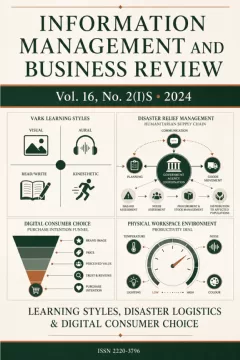 Vol. 16 No. 2(I)S (2024)
Learning Styles, Disaster Logistics & Digital Consumer Choice
View issue contents
Published
Submissions
Have research to publish? Information Management and Business Review welcomes submissions.
Make a Submission