Abstract
The objective of this study is to outline the issue of government-provided disaster relief management (JKMM) for flood victims during a disaster. Additionally, it examines communication and the planning of goods movement as key elements in determining the efficacy of Humanitarian Supply Chain Management (HSCM). This study focuses on the staff of the Social Welfare Department (JKMM), namely those from the Disaster Management Department and other agencies. The analysis of this research relies on a distinct dataset acquired from a survey conducted among the staff members. Researchers can more easily get quantitative measurements to analyze data on respondent variables. The operational sample comprises 137 participants. The study reveals that enhancing aspects related to the movement of goods and communication is crucial for improving the efficacy of HSCM. JKKM should ensure sufficient vehicle availability while simultaneously striving to minimize communication obstacles, such as limited network coverage. This paper stands out because of its unusual approach since it examines the challenges faced by the government agency (JKMM) in managing products for flood victims. This perspective sets it apart from earlier studies, which primarily focused on the experiences of flood victims and evacuation centers in Malaysia.
Keywords
- Disaster Relief Management Search this journal for Disaster Relief Management (opens in a new tab)
- Communication Search this journal for Communication (opens in a new tab)
- Planning Movement of Good Search this journal for Planning Movement of Good (opens in a new tab)
- Government Agency Search this journal for Government Agency (opens in a new tab)
References
- Choy, L. T. (2014). The strengths and weaknesses of research methodology: Comparison and complimentary between qualitative and quantitative approaches. IOSR Journal of Humanities and Social Science, 19(4), 99–104.
- Jaafar, J. B., Ishak, A. N. B., Hassan, S. B., Bin, K. F., & Adrutdin, M. I. Q. (2020). A Study of Customer Satisfaction with Planning Movement of Goods during Disaster Aid
- John, L., Ramesh, A. and Sridharan, R. (2012). 'Humanitarian supply chain management: a critical review', Int. Journal Services and Operations Management, 13(4), 498– 524.
- Khalid, M. S. B., & Shafiai, S. B. (2015). Flood disaster management in Malaysia: An evaluation of the effectiveness of the flood delivery system. International Journal of Social Science and Humanity, 5(4), 398.
- Martin, E., Nolte, I. & Vitolo, E. (2016). The Four Cs of disaster partnering: communication, cooperation, coordination and collaboration. Disasters.
- Mohd, S., Fathi, M. S., Harun, A. N., & Chong, N. O. (2018). Key Issues In The Management Of The Humanitarian Aid Distribution Process During And Post-Disaster In Malaysia. Planning Malaysia, 16(5).
- Mohd, S., Fathi, M. S., & Harun, A. N. (2019, April). Information Management For Humanitarian Aid Distribution System In Malaysia. In IOP Conference Series: Materials Science And Engineering, 513(1), 012012). IOP Publishing.
- Musa, S.M.S Weng, C.N and Shafi , H (2015) Pengurusan Banjir di Malaysia Melalui Kaedah Struktur, Bukan Struktur dan Bersepadu. In Jabil Mapjabil, Tuan Pah Rokian Syed Hussein and Chan Ngai Weng (Editors) Ekosistem Lembangan Saliran Malaysia: Bencana dan Pengurusannya. Sintok: Universiti Utara Malaysia Press, 50-69.
- NADMA Malaysia: Disaster Management Reference Handbook (June 2019)NADMA- Center for Excellence in Disaster Management and Humanitarian Assistance. Originally published: 7 Aug 2019, https://reliefweb.int/report/malaysia/malaysia-disaster-management-reference-handbook-June- 2019
- Shafiq, M., & Soratana, K. (2019). Humanitarian Logistics And Supply Chain Management Qualitative Study. Logforum, 15(1).
- Shafiai, S. (2016). Flood Disaster Management in Malaysia: A Review of Issues of Flood Disaster Relief during and Post-Disaster,(1983), 163–170.
- Shafiai, S., & Khalid, M. S. (2016). Examining of issues on flood disaster management in Malaysia. International Review of Management and Marketing, 6(7S), pp. 51–56.
- Tamyez, P. F., Gerth, N. C. I., & bin Anuar, K. F. (2019). Flood-Related Disaster Communication and Humanitarian Logistics. KnE Social Sciences, 15-39.
- Terap, D. P. (2013). Konflik di Pusat Pemindahan Banjir: Kajian Kes di Daerah Padang Terap, Kedah.
- Thiruchelvam, S., Ismail, M. F., Ghazali, A., Mustapha, K. N., Norkhair, F. F., Yahya, N., ... & Muda, Z. C. (2018). Development of humanitarian supply chain performance conceptual framework in creating a resilient logistics network. Malaysian Journal of Geosciences (MJG), 2(1), 30-33.
- Zakaria, N., & Mustaffa, C. S. (2014). Source credibility, risk communication and well-being: A conceptual framework. Procedia-Social and Behavioral Sciences, 155, 178-183.
Downloads
No downloads have been recorded for this article yet. Figures appear here once readers begin downloading the full text.
How to Cite
Share this article
License
Copyright (c) 2024 Jumailah Mohd Ali, Zarina Abdul Munir, Shereen Noranee, Norliana Jailani, Norfadzilah Abdul Razak (Author)

This work is licensed under a Creative Commons Attribution 4.0 International License.
Author (s) should affirm that the material has not been published previously. It has not been submitted and it is not under consideration by any other journal. At the same time author (s) need to execute a publication permission agreement to assume the responsibility of the submitted content and any omissions and errors therein. After submission of revised paper in the light of suggestions of the reviewers, the editorial team edits and formats manuscripts to bring uniformity and standardization in published material.
This work will be licensed under Creative Commons Attribution 4.0 International (CC BY 4.0) and under condition of the license, users are free to read, copy, remix, transform, redistribute, download, print, search or link to the full texts of articles and even build upon their work as long as they credit the author for the original work. Moreover, as per journal policy author (s) hold and retain copyrights without any restrictions.
Keywords
- Disaster Relief Management Search this journal for Disaster Relief Management (opens in a new tab)
- Communication Search this journal for Communication (opens in a new tab)
- Planning Movement of Good Search this journal for Planning Movement of Good (opens in a new tab)
- Government Agency Search this journal for Government Agency (opens in a new tab)
Section
Published in
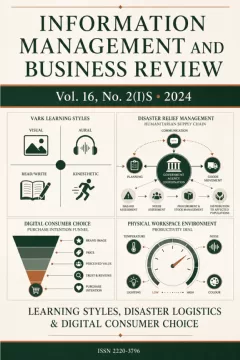 Vol. 16 No. 2(I)S (2024)
Learning Styles, Disaster Logistics & Digital Consumer Choice
View issue contents
Published
Submissions
Have research to publish? Information Management and Business Review welcomes submissions.
Make a Submission