Abstract
This research aims to review the expansion of gig work enabled by digital platforms, providing individuals with flexibility and opportunities to diversify their income. This research emphasizes the difficulties experienced by gig workers, such as social isolation, absence of benefits, financial instability, and the necessity for protective policies. It highlights the significance of acquiring new skills and proposes policy suggestions to establish a conducive atmosphere for gig workers. It contends that the gig economy in Malaysia's future necessitates thorough data and precise regulations to guarantee equitable treatment and advantages for gig workers amid worries about job displacement and the continuation of disparities.
Keywords
References
- Abd Samad, K., Abd Rahman, N. H., Ismail, S., & Marmaya, N. H. (2023). Is the well-being of gig workers in Malaysia better? The reality of pain and gain. International Review of Applied Economics, 37(4), 518–531. https://doi.org/10.1080/02692171.2023.2240243
- Abdull Rahman, R. H., Abd Hamid, M. A., Abdul Patah, S., Zaini, F., & Mahidi Mohyedin, A. S. (2022). Driving Factors and Career Prospects of Food Delivery Gig Workers. International Journal of Academic Research in Business and Social Sciences, 12(10). https://doi.org/10.6007/ijarbss/v12-i10/14656
- Abkhezr, P., & McMahon, M. (2022). The intersections of migration, app-based gig work, and career development: implications for career practice and research. International Journal for Educational and Vocational Guidance, 24(1), 39–57. https://doi.org/10.1007/s10775-022-09556-w
- Ahmad, N. (2020). Gig economy: The future of working. International Journal of Communication, Management and Humanities, 1(2), 45-52.
- Balakrishnan, J. (2022). Building Capabilities for the Future of Work in the Gig Economy. NHRD Network Journal, 15(1), 56–70. https://doi.org/10.1177/26314541211064726
- Bonvin, J. M., Cianferoni, N., & Mexi, M. (2023). Introduction. Social Dialogue in the Gig Economy, 1–17.
- Chen, T., Song, W., Song, J., Ren, Y., Dong, Y., Yang, J., & Zhang, S. (2022). Measuring Well-Being of Migrant Gig Workers: Exampled as Hangzhou City in China. Behavioral Sciences, 12(10), 365.
- Fauzi, N., Shamsul Harumain, Y. A., & Md Dali, M. (2022). GIG WORKERS AMONG WOMEN, A BETTER CHOICE OF WORK? A CASE STUDY OF MAKCIK TRAVELS. PLANNING MALAYSIA, 20.
- Horan, T., & Bullen-Smith, I. (2023). Online Ranking System Effects on Perceived Fairness: Gender, Income and Education. https://doi.org/10.31235/osf.io/2u3y5
- Huang, K., Yao, J., & Yin, M. (2019). Understanding the Skill Provision in Gig Economy from A Network Perspective. Proceedings of the ACM on Human-Computer Interaction, 3(CSCW), 1–23.
- Linthorst, J., & De Waal, A. (2020). Megatrends and Disruptors and Their Postulated Impact on Organizations. Sustainability, 12(20), 8740. https://doi.org/10.3390/su12208740
- Liu, W., He, C., Jiang, Y., Ji, R., & Zhai, X. (2020). Effect of Gig Workers’ Psychological Contract Fulfillment on Their Task Performance in a Sharing Economy—A Perspective from the Mediation of Organizational Identification and the Moderation of Length of Service. International Journal of Environmental Research and Public Health, 17(7), 2208. https://doi.org/10.3390/ijerph17072208
- Malik, R., Visvizi, A., & Skrzek-Lubasi?ska, M. (2021). The Gig Economy: Current Issues, the Debate, and the New Avenues of Research. Sustainability, 13(9), 5023. https://doi.org/10.3390/su13095023
- Md Yusof, A. B., Arshad, M. M., & Ismail, I. A. (2022). Positive Youth Development through Gig Economy among Food Panda Delivery Services in Malacca, Malaysia. International Journal of Academic Research in Business and Social Sciences, 12(14). https://doi.org/10.6007/ijarbss/v12-i14/15979
- Mehta, B. S. (2020). Changing Nature of Work and the Gig Economy: Theory and Debate. FIIB Business Review, 12(3), 227–237. https://doi.org/10.1177/2319714520968294
- Petkovski, I., Fedajev, A., & Bazen, J. (2022). Modeling Complex Relationships Between Sustainable Competitiveness and Digitalization. Journal of Competitiveness, 14(2), 79–96.
- Ostoj, I. (2021). The structure of gig workers in the global online gig economy by country of origin and its institutional foundations. Ekonomia I Prawo, 20(2), 337–351. https://doi.org/10.12775/eip.2021.020
- Pillai, R., & Paul, B. (2023). Industry 4.0 and the Changing Employment Relations: A Case of the Indian Information Technology Industry. NHRD Network Journal, 16(1), 92–110.
- Ran, X., & Zhao, Y. (2023). Behind the flexibility: insufficient occupational injury protection of gig workers in China. Frontiers in Public Health, 11. https://doi.org/10.3389/fpubh.2023.1117180
- Uchiyama, Y., Furuoka, F., & Akhir, M N M. (2022). Gig Workers, Social Protection and Labour Market Inequality: Lessons from Malaysia. , 56(3), 165-184. https://doi.org/10.17576/jem-2022-5603-09
Downloads
No downloads have been recorded for this article yet. Figures appear here once readers begin downloading the full text.
How to Cite
Share this article
License
Copyright (c) 2024 Nurul Syifaa Mohd Shakil (Author)

This work is licensed under a Creative Commons Attribution 4.0 International License.
Author (s) should affirm that the material has not been published previously. It has not been submitted and it is not under consideration by any other journal. At the same time author (s) need to execute a publication permission agreement to assume the responsibility of the submitted content and any omissions and errors therein. After submission of revised paper in the light of suggestions of the reviewers, the editorial team edits and formats manuscripts to bring uniformity and standardization in published material.
This work will be licensed under Creative Commons Attribution 4.0 International (CC BY 4.0) and under condition of the license, users are free to read, copy, remix, transform, redistribute, download, print, search or link to the full texts of articles and even build upon their work as long as they credit the author for the original work. Moreover, as per journal policy author (s) hold and retain copyrights without any restrictions.
Keywords
Section
Published in
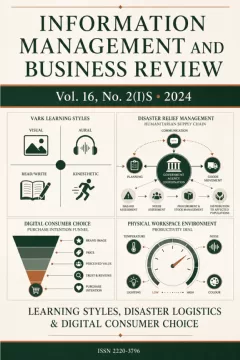 Vol. 16 No. 2(I)S (2024)
Learning Styles, Disaster Logistics & Digital Consumer Choice
View issue contents
Published
Submissions
Have research to publish? Information Management and Business Review welcomes submissions.
Make a Submission