Abstract
Employee turnover has long been acknowledged as a silent threat to any organization. The turnover phenomenon has been a highly pressing concern for private universities’ faculties. Despite the attentiveness and responsiveness of high rates of turnover around the globe, research on the area of turnover or turnover intention, as well as succession planning, career attitude and job security is limited. Past studies have not assessed the scale and nature of the association between these three variables. Thus, this study aims to explore the relationship between succession planning, career attitude and job security toward turnover intention. The study specifically focused on a private university in Malaysia and data was gathered through 148 questionnaire surveys. The conceptual framework developed consisted of dimensions of succession planning, career attitude, job security and turnover intention. A set of three hypotheses was developed that assessed whether there existed a positive or negative relationship between these three variables. For data analysis, the study utilized various numbers of statistical techniques such as exploratory factor analysis, confirmatory factor analysis, and cross-case analysis. The study results indicated that the research model developed was a good predictor of turnover intention and provided general support for all three hypotheses. The study also found that there was a positive relationship between succession planning, career attitude, and job security toward turnover intention. The empirical relationships between variables further proposed that it would be favorable and advantageous to the private university management to recuperate university turnover situations. Further discussions included the research contributions and implications.
Keywords
- Turnover Intention Search this journal for Turnover Intention (opens in a new tab)
- Succession Planning Search this journal for Succession Planning (opens in a new tab)
- Career Attitude Search this journal for Career Attitude (opens in a new tab)
- Job Security Search this journal for Job Security (opens in a new tab)
References
- Ali, Z., & Mehreen, A. (2019). Understanding succession planning as a combating strategy for turnover intentions. Journal of Advances in Management Research, 16(2), 216–233.
- Ali, Z., Mahmood, B., & Mehreen, A. (2019). Linking succession planning to employee performance: The mediating roles of career development and performance appraisal. Australian Journal of Career Development, 28(2), 112-121.
- Altinay, L., Dai, Y. De, Chang, J., Lee, C. H., Zhuang, W. L., & Liu, Y. C. (2019). How to facilitate hotel employees’ work engagement: The roles of leader-member exchange, role overload, and job security. International Journal of Contemporary Hospitality Management, 31(3), 1525–1542.
- Arijanto, A., Marlita, D., Suroso, A., & Purnomo, R. (2020). How is the Effect of Job Insecurity, Work Stress, and the Work Environment on Turnover Intention: A Case Study at the Company of Supplier Security System in Indonesia. 120(Icmeb 2019), 114–119.
- Bano, Y., Omar, S. S., & Ismail, F. (2022). Succession Planning Best Practices for Organizations: A Systematic Literature Review Approach. International Journal of Global Optimization and Its Application, 1(1), 39–48.
- De Winne, S., Marescaux, E., Sels, L., Van Beveren, I., & Vanormelingen, S. (2019). The impact of employee turnover and turnover volatility on labor productivity: a flexible non-linear approach. International Journal of Human Resource Management, 30(21), 3049–3079.
- Ghazali, M. T., Abdul Rahman, S. A., & Abd. Ghani, M. (2021). A Review on Competency-Based Succession Planning at Higher Education Institutions in Malaysia. International Journal of Academic Research in Business and Social Sciences, 11(9).
- Guo, L., & Baruch, Y. (2021). The moderating role of a city’s institutional capital and people’s migration status on career success in China. Human Relations, 74(5), 678–704.
- Gusanto, A., Rochmiati, I. N., Sintiara, M. F., & Sibarani, R. M. (2023). Understanding the Relationship Between Turnover Intention And Retention Drivers in a Pharmaceutical Company. 61–76.
- Hassan, S. N. U., & Siddiqui, D. A. (2020). Impact of Effective Succession Planning Practices on Employee Retention: Exploring the Mediating Roles. International Journal of Human Resource Studies, 10(2), 21.
- Hossain, M. M. (2019). Understanding turnover intention: Country of the job as a moderator. International Journal of Innovation, Creativity and Change, 9(9), 9-23.
- Lalin, A. S., Mazumder, M. H., & Chowdhury, S. (2021). Effects of Job Stress on Banker's Turnover Intention. Jalalabad Papers, 2(1), 65-87.
- Lin, Y. C., & Chen, A. S. (2020). Experiencing career plateau on a committed career journey: a boundary condition of career stages. Personnel Review, 50(9), 1797–1819.
- Obeng, A. F., Quansah, P. E., & Boakye, E. (2020). The Relationship between Job Insecurity and Turnover Intention: The Mediating Role of Employee Morale and Psychological Strain. Management, 10(2), 35–45.
- Odim, V. I., Orishede, F., & Clinton, N. E. (2017). The effect of de-recruitment on organizational succession planning. a review of extant literature. International Journal of Economics, 11, 1–19. http://ijeponline.org/index.php/journal/article/view/5
- Offergelt, F., Spörrle, M., Moser, K., & Shaw, J. D. (2019). Leader-signalled knowledge hiding: Effects on employees’ job attitudes and empowerment. Journal of Organizational Behavior, 40(7), 819–833.
- Ramlawati, R., Trisnawati, E., Yasin, N. A., & Kurniawaty, K. (2021). External alternatives, job stress on job satisfaction and employee turnover intention. Management Science Letters, 11, 511–518.
- Rangrez, S. N., Amin, F., & Dixit, S. (2022). Influence of Role Stressors and Job Insecurity on Turnover Intentions in Start-ups: Mediating Role of Job Stress. Management and Labour Studies, 47(2), 199–215.
- Raz, A. (2017). Leadership Strategies for Employee Retention in Small Lodging Establishments.
- Ullah, H. (2018). A Study of the Relationship between Reward and Recognition and Employees Job Satisfaction: A Literature Review A Study ……. Abasyn Journal of Social Sciences. 7(2
- Von Hippel, C., Kalokerinos, E. K., & Henry, J. D. (2013). Stereotype threat among older employees: Relationship with job attitude and turnover intentions. Psychology and Aging, 28(1), 17–27. https://doi.org/10.1037/a0029825.
Downloads
No downloads have been recorded for this article yet. Figures appear here once readers begin downloading the full text.
How to Cite
Share this article
License
Copyright (c) 2024 Nurul Irdina Fahmi, Idaya Husna Mohd, Nursaadatun Nisak Ahmad, Shereen Noranee, Syarifah Mastura Syed Abu Bakar, Wong Chee Hoo (Author)

This work is licensed under a Creative Commons Attribution 4.0 International License.
Author (s) should affirm that the material has not been published previously. It has not been submitted and it is not under consideration by any other journal. At the same time author (s) need to execute a publication permission agreement to assume the responsibility of the submitted content and any omissions and errors therein. After submission of revised paper in the light of suggestions of the reviewers, the editorial team edits and formats manuscripts to bring uniformity and standardization in published material.
This work will be licensed under Creative Commons Attribution 4.0 International (CC BY 4.0) and under condition of the license, users are free to read, copy, remix, transform, redistribute, download, print, search or link to the full texts of articles and even build upon their work as long as they credit the author for the original work. Moreover, as per journal policy author (s) hold and retain copyrights without any restrictions.
Keywords
- Turnover Intention Search this journal for Turnover Intention (opens in a new tab)
- Succession Planning Search this journal for Succession Planning (opens in a new tab)
- Career Attitude Search this journal for Career Attitude (opens in a new tab)
- Job Security Search this journal for Job Security (opens in a new tab)
Section
Published in
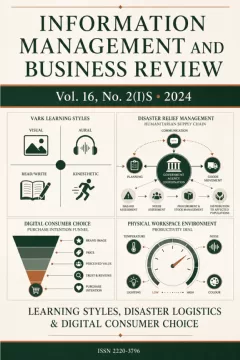 Vol. 16 No. 2(I)S (2024)
Learning Styles, Disaster Logistics & Digital Consumer Choice
View issue contents
Published
Submissions
Have research to publish? Information Management and Business Review welcomes submissions.
Make a Submission