Abstract
The burgeoning manufacturing sector has been the primary driver of Malaysia's substantial and notable economic expansion. Notwithstanding these, the Malaysian manufacturing sector remains afflicted by concerning safety concerns. To enhance the situation, the Malaysian government has proposed the use of selfregulatory safety management systems (SMS). However, there are doubts about the employees' preparedness to adopt this measure. Implementing SMS has numerous complexities. Despite progress made in the SMS technique, failures continue to be prevalent. There is a lack of literature regarding the perspectives of the manufacturing industry regarding their concerns regarding the implementation of SMS. This study aimed to ascertain the presence of safety practices derived from SMS elements and identify the characteristics associated with the successful application of SMS. The anticipation is that the outcomes of this study will contribute to the successful implementation of SMS. The findings of this research will be of significant importance to the stakeholders and policymakers.
Keywords
- Conceptual Model Search this journal for Conceptual Model (opens in a new tab)
- Safety Management Systems (SMS) Search this journal for Safety Management Systems (SMS) (opens in a new tab)
- Employees Search this journal for Employees (opens in a new tab)
- Manufacturing Industry Search this journal for Manufacturing Industry (opens in a new tab)
References
- Ajmal, M., Isha, A. S. N., Nordin, S. M., Kanwal, N., Al-Mekhlafi, A. B. A. & Naji, G. M. A. (2020). A conceptual framework for the determinants of organizational agility: does safety commitment matter? Solid State Technol, 63(6), 4112-4119.
- Department of Occupational Safety and Health. (2023). Occupational accidents and fatalities statistics. DOSM Website. https://www.dosh.gov.my/index.php/statistic-v/occupational-accident-statistics/occupational-accident-statistic-2023
- Duncan, R. B. (1972). Characteristics of organizational environments and perceived environmental uncertainty. Administrative Science Quarterly, 313-327.
- Dyjack, D. T., Levine, S. P., Holtshouser, J. L. & Schork, M. A. (1998). Comparison of AIHA ISO 9001-based occupational health and safety management system guidance document with a manufacturer's occupational health and safety assessment instrument. American Industrial Hygiene Association Journal, 59(6), 419-429.
- Fruhen, L. S., Griffin, M. A. & Andrei, D. M. (2019). What does safety commitment mean to leaders? A multi-method investigation. Journal of safety research, 68, 203-214.
- Gilkey, D. P., Keefe, T. J., Hautaluoma, J. E., Bigelow, P. L., Herron, R. E. & Stanley, S. A. (2003). Management commitment to safety and health in residential construction: HomeSafe spending trends 1991–1999. Work, 20(1), 35-44.
- Hale, A. & Borys, D. (2013). Working to rule or working safely? Part 2: The management of safety rules and procedures. Safety Science, 55, 222-231.
- Hale, B., Van Bossuyt, D. L., Papakonstantinou, N. & O’Halloran, B. (2021, August). A zero-trust methodology for the security of complex systems with machine learning components. In International design engineering technical conferences and computers and information in engineering conference (Vol. 85376, p. V002T02A067). American Society of Mechanical Engineers.
- Haslinda, A., Saharudin, S., Roslan, N. H. & Mohamed, R. (2016). Safety training, company policy and communication for effective accident management. International Journal of Academic Research in Business and Social Sciences, 6(9), 141-158.
- Jiang, L. & Yu, X. (2023). Safety management systems and their influence on employee safety behavior in manufacturing industries: A meta-analysis. Safety Science, 145, 105493.
- Khan, S. A. R., Tabish, M. & Zhang, Y. (2023). Embracement of industry 4.0 and sustainable supply chain practices under the shadow of practice-based view theory: Ensuring environmental sustainability in the corporate sector. Journal of Cleaner Production, 398, 136609.
- Kim, H. & Scott, C. (2019). Change communication and the use of anonymous social media at work: Implications for employee engagement. Corporate Communications: An International Journal, 24(3), 410-424.
- Ladewski, B. J. & Al-Bayati, A. J. (2019). Quality and safety management practices: The theory of quality management approach. Journal of safety research, 69, 193-200.
- Lee, D. (2018). The effect of safety management and sustainable activities on sustainable performance: Focusing on suppliers. Sustainability, 10(12), 4796.
- Lim, S. L. (2022). The contribution of the manufacturing sector to Malaysia's economic growth. Malaysian Journal of Economic Studies, 59(1), 25-39.
- Mason, M. (2007). Critical thinking and learning. Educational philosophy and theory, 39(4), 339-349.
- Mazzetti, G., Valente, E., Guglielmi, D. & Vignoli, M. (2020). Safety doesn’t happen by accident: a longitudinal investigation on the antecedents of safety behavior. International journal of environmental research and public health, 17(12), 4332.
- Mearns, K., Whitaker, S. M. & Flin, R. (2003). Safety climate, safety management practice and safety performance in offshore environments. Safety Science, 41(8), 641-680.
- Mintzberg, H. (1994). Rethinking strategic planning part I: Pitfalls and fallacies. Long range planning, 27(3), 12-21.
- Mukherji, S. & Arora, N. (2017). Digital communication: easing operational outcomes in the workplace. Procedia computer science, 122, 1084-1091.
- Okumus, F. (2003). A framework to implement strategies in organizations. Management decision, 41(9), 871-882.
- Razali, N. A., Redzuan, N. I. N., Kamaruddin, A. N., Dahlan, A. D., Hanafi, S. N. M., Nobli, F. N. A. & Syahira Azlin Atan, N. (2018). A study on safety management practices and safety performance. European Proceedings of Social and Behavioral Sciences, 44.
- Reason, J., Parker, D. & Lawton, R. (1998). Organizational controls and safety: The varieties of rule?related behavior. Journal of occupational and organizational psychology, 71(4), 289-304.
- Ros, A. & Gustafson, P. (2015). Patient safety requires rules and procedures that are both followed and disregarded. Lakartidningen, 112, DFI4-DFI4.
- Santos-Reyes, J. & Beard, A. N. (2008). A systemic approach to managing safety. Journal of Loss Prevention in the Process Industries, 21(1), 15-28.
- Tawse, A. & Tabesh, P. (2021). Strategy implementation: A review and an introductory framework. European Management Journal, 39(1), 22-33.
- Tenhiälä, A. (2009). Contingency theories of order management, capacity planning, and exception processing in complex manufacturing environments [Doctoral dissertation, Helsinki University of Technology]. https://chromeextension://efaidnbmnnnibpcajpcglclefindmkaj/https://aaltodoc.aalto.fi/server/api/core/bitstreams/7a668e5e-9ebb-4e90-98c4-4b72949d280e/content
- Teo, S. T., Bentley, T. & Nguyen, D. (2020). Psychosocial work environment, work engagement, and employee commitment: A moderated, mediation model. International Journal of Hospitality Management, 88, 102415.
- Tewari, A. & Paiva, A. R. (2022). Modeling and mitigation of occupational safety risks in dynamic industrial environments. arXiv preprint arXiv, 2205.00894, 1-32.
- Vinodkumar, M. N. & Bhasi, M. (2010). Safety management practices and safety behavior: Assessing the mediating role of safety knowledge and motivation. Accident Analysis & Prevention, 42(6), 2082-2093.
- Vinodkumar, M. N. & Bhasi, M. (2011). A study on the impact of management system certification on safety management. Safety science, 49(3), 498-507.
- Vogel, W. & Lasch, R. (2016). Complexity drivers in manufacturing companies: a literature review. Logistics Research, 9(1), 25.
Downloads
No downloads have been recorded for this article yet. Figures appear here once readers begin downloading the full text.
How to Cite
Share this article
License
Copyright (c) 2024 Suzana Ab Rahman, Roszi Naszariah Nasni Naseri, Nadiah Ishak (Author)

This work is licensed under a Creative Commons Attribution 4.0 International License.
Author (s) should affirm that the material has not been published previously. It has not been submitted and it is not under consideration by any other journal. At the same time author (s) need to execute a publication permission agreement to assume the responsibility of the submitted content and any omissions and errors therein. After submission of revised paper in the light of suggestions of the reviewers, the editorial team edits and formats manuscripts to bring uniformity and standardization in published material.
This work will be licensed under Creative Commons Attribution 4.0 International (CC BY 4.0) and under condition of the license, users are free to read, copy, remix, transform, redistribute, download, print, search or link to the full texts of articles and even build upon their work as long as they credit the author for the original work. Moreover, as per journal policy author (s) hold and retain copyrights without any restrictions.
Keywords
- Conceptual Model Search this journal for Conceptual Model (opens in a new tab)
- Safety Management Systems (SMS) Search this journal for Safety Management Systems (SMS) (opens in a new tab)
- Employees Search this journal for Employees (opens in a new tab)
- Manufacturing Industry Search this journal for Manufacturing Industry (opens in a new tab)
Section
Published in
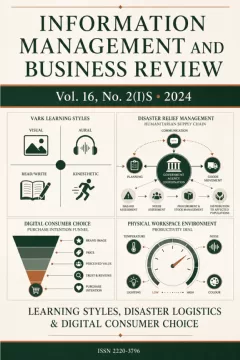 Vol. 16 No. 2(I)S (2024)
Learning Styles, Disaster Logistics & Digital Consumer Choice
View issue contents
Published
Submissions
Have research to publish? Information Management and Business Review welcomes submissions.
Make a Submission