Abstract
As moving businesses from face-to-face trading, mail order and telephone order to electronic commerce over open networks such as the Internet, there be an exponentially growth in electronic payment transactions. Therefore, monitoring and evaluating the current electronic payment systems greatly affects the efficiency of money transactions, trades and, finally, the overall economy of the countries. In this paper, the Iranian e-payment systems are examined as a special case. The aim is to examine and evaluate the current epayment systems, and rank they based on the experts opinions. Considering the nature of the gathered data, the analytic hierarchy process (AHP), as a decision-making method, is used to evaluate the data. The findings of this research are intended to be useful for both academic researchers and companies planning to adopt or to improve an electronic payment system.
Keywords
- Electronic Payment System Search this journal for Electronic Payment System (opens in a new tab)
- Internet Search this journal for Internet (opens in a new tab)
- E-Commerce Search this journal for E-Commerce (opens in a new tab)
- Analytic Hierarchy Process Search this journal for Analytic Hierarchy Process (opens in a new tab)
References
- Bryson, N. & Joseph, A. (1999). Generating consensus priority point vectors: a logarithmic goal programming approach. Computers & Operations Research , 26, 637-43.
- Crawford, G. & Williams, C. (1985). A note on the analysis of subjective judgment matrices. Journal of Mathematical Psychology , 29, 387-405.
- Crede, A. (1998). Electronic Payment Systems, Electronic Money & the Internet: The United Kingdom Experience to Date. TA-Datenbank-Nachrichten , 2, 29-39.
- Hung, S. Y., Chang, C. M. & Yu, T. J. (2006). Determinants of user acceptance of the e-Government services: The case of online tax filing and payment system. Government Information Quarterly , 23, 97-122.
- Jing, Y. (2009). On-line Payment and Security of E-commerce. Proceedings of the 2009 International Symposium on Web Information Systems and Applications , 46-50.
- Johnson, O. E. G. (1998). Payment systems, monetary policy, and the role of the central bank. Washington, DC. International Monetary Fund.
- Khiaonarong, T. (2000). Electronic payment systems development in Thailand. International Journal of Information Management , 20, 59-72.
- Lootsma, F. A. (1999). Multi-criteria decision analysis via ratio and difference judgment. Socio Economic Planning Sciences , 42, 192-197.
- Saaty, T. L. (1980). The analytic hierarchy process: planning, priority setting and resource allocation. New York: McGraw-Hill.
- Shim, J. P. (1989). Bibliographical research on the analytic hierarchy process (AHP). Socio Economic Planning Sciences, 23, 161-167.
- Tsiakis, T. & Sthephanides, G. (2005). The concept of security and trust in electronic payments. Computers and Security , 24, 10-15.
- World Bank Report. (1990). Financial systems and development. World Bank Policy and Research Series. Washington, D.C.
- Yu, H. C., His, K. H. & Kou, P. J. (2002). Electronic Payment Systems: an analysis and comparison of types. Technology in Society , 24, 331-347.
Downloads
No downloads have been recorded for this article yet. Figures appear here once readers begin downloading the full text.
How to Cite
Share this article
License
Copyright (c) 2026 Shiva Zokaee, Seyed Babak Ebrahimi, Mostafa Ghazizadeh (Author)

This work is licensed under a Creative Commons Attribution 4.0 International License.
Author (s) should affirm that the material has not been published previously. It has not been submitted and it is not under consideration by any other journal. At the same time author (s) need to execute a publication permission agreement to assume the responsibility of the submitted content and any omissions and errors therein. After submission of revised paper in the light of suggestions of the reviewers, the editorial team edits and formats manuscripts to bring uniformity and standardization in published material.
This work will be licensed under Creative Commons Attribution 4.0 International (CC BY 4.0) and under condition of the license, users are free to read, copy, remix, transform, redistribute, download, print, search or link to the full texts of articles and even build upon their work as long as they credit the author for the original work. Moreover, as per journal policy author (s) hold and retain copyrights without any restrictions.
Keywords
- Electronic Payment System Search this journal for Electronic Payment System (opens in a new tab)
- Internet Search this journal for Internet (opens in a new tab)
- E-Commerce Search this journal for E-Commerce (opens in a new tab)
- Analytic Hierarchy Process Search this journal for Analytic Hierarchy Process (opens in a new tab)
Section
Published in
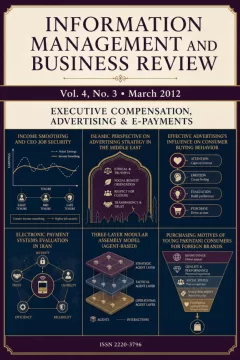 Vol. 4 No. 3 (2012)
Executive Compensation, Advertising & E-Payments
View issue contents
Published
Submissions
Have research to publish? Information Management and Business Review welcomes submissions.
Make a Submission