Abstract
This research investigates health risk perception and vaccine valence as factors that affect Malaysian intention to engage in domestic vacations. An online survey was created with Google Forms and distributed to a sample of 265 domestic travellers at least 18 years of age in May and June 2021; this is when the nationwide vaccine program started in Malaysia. The result indicates that vaccine valence risk perception was a significant factor in affecting domestic vacation intention. Only perceived behavioural control and subjective norms mediated the relationship between health risk perception and domestic vacation intention. Overall, vaccine valence risk perception tested significantly with all constructs in this study due to the various factors, especially the timing of data collection where the data collection was carried out amid the national vaccination program. Hence, the vaccine is now perceived as a hope for many as the solution to the current pandemic problem. It indicates that domestic vacationers will return once vaccinated and when tourism sectors are open for business and resume their regular operation. These findings extend the body of knowledge for the theory of health belief and theory of planned behaviour in predicting tourist intention to travel during a pandemic. Findings also indicate the positive impact of vaccine valence on the tourist's intention to travel, which provides a glimpse of future tourist behaviour when facing similar uncertainties.
Keywords
- COVID-19 Search this journal for COVID-19 (opens in a new tab)
- Health Risk Perception Search this journal for Health Risk Perception (opens in a new tab)
- Domestic Vacation Intention Search this journal for Domestic Vacation Intention (opens in a new tab)
- Vaccine Valence Search this journal for Vaccine Valence (opens in a new tab)
References
- Ajzen, I. and Fishbein, M. (1980) Understanding Attitudes and Predicting Social Behaviour. Prentice-Hall, Englewood Cliffs.
- Ajzen, I. (1991). The theory of planned behaviour. Organizational behaviour and human decision processes, 50(2), 179-211.
- Ajzen, I., & Madden, T. J. (1986). Prediction of goal-directed behaviour: Attitudes, intentions, and perceived behavioural control. Journal of Experimental Social Psychology, 22(5), 453-474.
- Akarsu, B., Canbay Özdemir, D., Ayhan Baser, D., Aksoy, H., Fidanc?, ?., & Cankurtaran, M. (2020). While studies on the COVID-19 vaccine are ongoing, the public’s thoughts and attitudes to the future COVID-19 vaccine. International Journal of Clinical Practice, August, 1–10. https://doi.org/10.1111/ijcp.13891
- Albattat, A. R., Ala’a, A., Martinez Faller, E., & Tadros, S. (2018). Current Issue in Tourism: Diseases Transformation As a Potential Risks for Travellers. Global and Stochastic Analysis, 5(7), 341–350. https://www.researchgate.net/publication/321713009
- Altinay Özdemir, M. (2020). How Covid-19 Outbreak Affects Tourists’ Travel Intentions? A Case Study In Turkey. Social Mentality And Researcher Thinkers Journal, 6(32), 1101–1113. https://doi.org/10.31576/smryj.562
- Bae, S. Y., & Chang, P. J. (2020). The effect of coronavirus disease-19 (COVID-19) risk perception on behavioural intention towards ‘untact’ tourism in South Korea during the first wave of the pandemic (March 2020). Current Issues in Tourism, 0(0), 1–19. https://doi.org/10.1080/13683500.2020.1798895
- Cancino-Montecinos, S., Björklund, F., & Lindholm, T. (2018). Dissonance reduction as emotion regulation: Attitude change is related to positive emotions in the induced compliance paradigm. PLoS ONE, 13(12), 1–15. https://doi.org/10.1371/journal.pone.0209012
- Chaulagain, S., Pizam, A., & Wang, Y. (2020). An Integrated Behavioral Model for Medical Tourism: An American Perspective. Journal of Travel Research. https://doi.org/10.1177/0047287520907681
- Chien, P. M., Sharifpour, M., Ritchie, B. W., & Watson, B. (2017). Travelers’ health risk perceptions and protective behaviour: A psychological approach. Journal of Travel Research, 56(6), 744-759.
- Chin.W. (1998). The partial least squares approach to structural equation modelling. In Journal of the Academy of Marketing Science.
- Clark, L. A., & Watson, D. (2019). Constructing validity: New developments in creating objective measuring instruments. Psychological assessment, 31(12), 1412.
- Department of Statistics Malaysia. (2020). Department of Statistics Malaysia: Press release domestic tourism survey 2018. Department of Statistics Malaysia, June, 1–3.
- Ekinci, Y., Gursoy, D., Can, A. S., & Williams, N. L. (2022). Does travel desire influence COVID-19 vaccination intentions? Journal of Hospitality Marketing and Management, 31(4), 413–430. https://doi.org/10.1080/19368623.2022.2020701
- Essam Janahi, M. (2011). Public knowledge, risk perception, attitudes and practices about the swine flu pandemic: A cross-sectional questionnaire-based survey in Bahrain. International Journal of Collaborative Research on Internal Medicine & Public Health, June.
- Fan, X., Lu, J., Qiu, M., & Xiao, X. (2023). Changes in travel behaviours and intentions during the COVID-19 pandemic and recovery period: A case study of China. Journal of Outdoor Recreation and Tourism, 41. https://doi.org/10.1016/j.jort.2022.100522
- Falk, R. F., & Miller, N. B. (1992). A Primer for Soft Modeling. The University of Akron Press, April, 80. http://books.google.com/books/about/A_Primer_for_Soft_Modeling.html?id=3CFrQgAACAAJ
- Fishbein, M., & Azjen, I. (1975). Belief, Attitude, Intention, and Behavior: An Introduction to Theory and Research. Reading, MA: Addison-Wesley. Contemporary Sociology, 6(2), 244–245
- Foo, L. P., Chin, M. Y., Tan, K. L., & Phuah, K. T. (2020). The impact of COVID-19 on the tourism industry in Malaysia. Current Issues in Tourism. https://doi.org/10.1080/13683500.2020.1777951
- Fornell, C., & Larcker, D. F. (2016). Evaluating structural equation models with unobservable variables and measurement error. Journal of Marketing Research This, 18(1), 39–50.
- Fornell, C., & Larcker, D. F. (1981). Fornell, C. and Larcker, D.F. (1981), “Evaluating structural equation models with unobservable variables and.pdf. Journal of Marketing Research, XVIII(February), 39–50.
- Girish, V. G., & Lee, C. K. (2020). Authenticity and its relationship with theory of planned behaviour: Case of Camino de Santiago walk in Spain. Current Issues in Tourism, 23(13), 1593-1597.
- Gold, A. H., Malhotra, A., & Segars, A. H. (2001). Knowledge management: An organizational capabilities perspective. Journal of Management Information Systems, 18(1), 185–214. https://doi.org/10.1080/07421222.2001.11045669
- Golets, A., Farias, J., Pilati, R., & Costa, H. (2023). COVID-19 pandemic and tourism: The impact of health risk perception and intolerance of uncertainty on travel intentions. Current Psychology, 42, 2500–2513. https://doi.org/10.1007/s12144-021-02282-6/Published
- Golets, A., Farias, J., Pilati, R., & Costa, H. (2020). COVID-19 pandemic and tourism: The impact of health risk perception and intolerance of uncertainty on travel intentions. Preprints, October, 1–30. https://doi.org/10.20944/preprints202010.0432.v1
- Gstaettner, A. M., Rodger, K., & Lee, D. (2017). Visitor perspectives of risk management in a natural tourism setting: An application of the Theory of Planned Behaviour. Journal of Outdoor Recreation and Tourism, 19, 1-10.
- Grégoire, Y., & Fisher, R. J. (2006). The effects of relationship quality on customer retaliation. Marketing Letters, 17(1), 31–46. https://doi.org/10.1007/s11002-006-3796-4
- Hanafiah, M. H., Md Zain, N. A., Azinuddin, M., & Mior Shariffuddin, N. S. (2022). I’m afraid to travel! Investigating the effect of perceived health risk on Malaysian travellers’ post-pandemic perception and future travel intention. Journal of Tourism Futures. https://doi.org/10.1108/JTF-10-2021-0235
- Hair, Joseph F., Hault, G. T. M., Christian Ringle, & Sarstedt, M. (2014). A Primer on Partial Least Squares Structural Equation Modeling (PLS-SEM). SAGE Publications.
- Han, H., Al-Ansi, A., Chua, B. L., Tariq, B., Radic, A., & Park, S. H. (2020). The post-coronavirus world in the international tourism industry: Application of the theory of planned behaviour to safer destination choices in the case of US outbound tourism. International journal of environmental research and public health, 17(18), 6485.
- Henseler, J., Hubona, G., & Ray, P. A. (2016). Using PLS path modelling in new technology research: Updated guidelines. Industrial Management and Data Systems, 116(1), 2–20. https://doi.org/10.1108/IMDS-09-2015-0382
- Henseler, J., Ringle, C. M., & Sarstedt, M. (2015). A new criterion for assessing discriminant validity in variance-based structural equation modelling. Journal of the Academy of Marketing Science, 43(1), 115–135. https://doi.org/10.1007/s11747-014-0403-8
- Henseler, J., Ringle, C. M., & Sinkovics, R. R. (2009). The use of partial least squares path modelling in international marketing. Advances in International Marketing, 20, 277–319. https://doi.org/10.1108/S1474-7979(2009)0000020014
- Henseler, J., & Sarstedt, M. (2013). Goodness-of-fit indices for partial least squares path modelling. Computational Statistics, 28(2), 565–580. https://doi.org/10.1007/s00180-012-0317-1
- Huang, X., Dai, S., & Xu, H. (2020). Predicting tourists’ health risk preventative behaviour and travelling satisfaction in Tibet: Combining the theory of planned behaviour and health belief model. Tourism Management Perspectives, 33(February 2019), 100589. https://doi.org/10.1016/j.tmp.2019.100589
- Hussain, S., Fangwei, Z., Siddiqi, A. F., Ali, Z., & Shabbir, M. S. (2018). Structural Equation Model for evaluating factors affecting the quality of social infrastructure projects. Sustainability (Switzerland), 10(5), 1–25. https://doi.org/10.3390/su10051415
- Janmaimool, P., & Watanabe, T. (2014). Evaluating determinants of environmental risk perception for risk management in contaminated sites. International Journal of Environmental Research and Public Health, 11(6), 6291–6313. https://doi.org/10.3390/ijerph110606291
- J?czmyk, A., Uglis, J., Zawadka, J., Pietrzak-Zawadka, J., Wojcieszak-Zbierska, M. M., & Kozera-Kowalska, M. (2023). Impact of COVID-19 Pandemic on Tourist Travel Risk Perception and Travel Behaviour: A Case Study of Poland. International Journal of Environmental Research and Public Health, 20(8). https://doi.org/10.3390/ijerph20085545
- Khan, M. A. A., & Hashim, H. (2020). the Effect of Covid-19 on Tourism and Hospitality Industry in Malaysia, Resurgence in the Post-Pandemic Era: a Conceptual Criterion. International Journal of Tourism & Hospitality Reviews, 7(2), 54–62. https://doi.org/10.18510/ijthr.2020.726
- Kline, P. (2015). A handbook of test construction (psychology revivals): introduction to psychometric design. Routledge.
- Li, J., Nguyen, T. H. H., & Coca-Stefaniak, J. A. (2020). Coronavirus impacts on post-pandemic planned travel behaviours. Annals of Tourism Research, March, 102964. https://doi.org/10.1016/j.annals.2020.102964
- Liu, Y., Shi, H., Li, Y., & Amin, A. (2021). Factors influencing Chinese residents’ post-pandemic outbound travel intentions: an extended theory of planned behaviour model based on the perception of COVID-19. Tourism Review, 76(4), 871–891. https://doi.org/10.1108/TR-09-2020-0458
- Maulana, N., Astuti, R. D., Sukamdani, H. B., & Tjiptoherijanto, P. (2022). Risk Perception in the Post COVID-19 Pandemic Era: An Analysis of Tourist Accommodation and Travel Behavior in the New Normal Era. Sustainability (Switzerland), 14(22). https://doi.org/10.3390/su142214758
- Mohamed M., N. M., Jahari, N. A., Abdul Rauf, R. K., & Daut, A. Z. (2023). To travel or not: Travel intention during post-pandemic times. Quantum Journal of Social Sciences and Humanities, 4(5), 153–163. https://doi.org/10.55197/qjssh.v4i5.285
- Nguyen, M., Pham, M., Chi, H., Nguyen, N. M., Pham, M. Q., & Journal, /. (2021). Public’s Travel Intention Following COVID-19 Pandemic Constrained: A Case Study in Vietnam. Economics and Business, 8(8), 181–0189. https://doi.org/10.13106/jafeb.2021.vol8.no8.0181
- Nie, Z., Xu, L., Zhang, H., Cao, Y., Zhang, C., Pan, J., & Zhang, J. (2022). Crowding and vaccination: Tourist’s two-sided perception on crowding and the moderating effect of vaccination status during COVID-19 pandemic. Journal of Destination Marketing and Management, 24. https://doi.org/10.1016/j.jdmm.2022.100705
- Qezelbash, A. H., Makian, S., & Shahabi Sorman Abadi, R. (2024). Effectiveness of the COVID-19 vaccination on travel intentions: the case of Iran. Journal of Tourism Futures, 10(2), 237–254. https://doi.org/10.1108/JTF-05-2022-0147
- Radic, A., Koo, B., Gil-Cordero, E., Cabrera-Sánchez, J. P., & Han, H. (2021). Intention to take COVID-19 vaccine as a precondition for international travel: Application of extended norm-activation model. International Journal of Environmental Research and Public Health, 18(6), 1–15. https://doi.org/10.3390/ijerph18063104
- Sánchez-Cañizares, S. M., Cabeza-Ramírez, L. J., Muñoz-Fernández, G., & Fuentes-García, F. J. (2020a). Impact of the perceived risk from COVID-19 on intention to travel. Current Issues in Tourism. https://doi.org/10.1080/13683500.2020.182957
- Sarstedt, M., Ringle, C. M., & Hair, J. F. (2020). Handbook of Market Research. In Handbook of Market Research (Issue September). https://doi.org/10.1007/978-3-319-05542-8
- Susanto, A., Amelia, A., Amadea, C., & Hendriana, E. (2021). The impact of the COVID-19 outbreak towards the post-pandemic leisure travel intention. Journal of Tourism, Hospitality & Culinary Arts (JTHCA) 2021, 13(2), 54–71.
- Schwarzer, R., Mueller, J., & Greenglass, E. (1999). Assessment of perceived general self-efficacy on the Internet: data collection in cyberspace. Anxiety, stress and coping, 12(2), 145-161.
- Tay, K. X., & Chan, J. K. L. (2023). Travel Confidence Reviving Tourism Industry: Is the Vaccination a Solution? Sustainability (Switzerland), 15(5). https://doi.org/10.3390/su15054539
- Wasiul Karim, Haque, A., Zohurul Anis, & Mohammad Arije Ulfy. (2020). The Movement Control Order (MCO) for the COVID-19 Crisis and its Impact on the Tourism and Hospitality Sector in Malaysia. International Tourism and Hospitality Journal. https://doi.org/10.37227/ithj-2020-02-09
- Watson and Clark. (1985). The Future of Positive Psychology. The Oxford Handbook of Positive Psychology, 3rd Edition, 54(6), 1063–1070. https://doi.org/10.1093/oxfordhb/9780199396511.013.69
- World Health Organisation Regional Office for Europe. (2017). Vaccination and trust. In World Health Organization Regional Office for Europe. http://www.euro.who.int/en/health-topics/disease-prevention/vaccines-and-immunization/publications/2017/vaccination-and-trust-2017
- Quintal, V. A., Lee, J. A., & Soutar, G. N. (2010). Tourists' information search: the differential impact of risk and uncertainty avoidance. International Journal of Tourism Research, 12(4), 321-333.
- Xuefeng, Y., Zhenggang, G., Li, M., Qiang, W., Xusheng, L., & Shuo, X. (2021). The Influence of Travel Expectation Theory on RV Travel Consumption Decision. E3S Web of Conferences, 251, 1–4. https://doi.org/10.1051/e3sconf/202125101094
- Zheng, D., Luo, Q., & Ritchie, B. W. (2021). Afraid to travel after COVID-19? Self-protection, coping and resilience against pandemic ‘travel fear.’ Tourism Management, 83(October 2020), 104261. https://doi.org/10.1016/j.tourman.2020.104261
- Zhou, B., Wang, L., Wang, L., Chris, R., Liu, S., Xiong, Q., & Wang, Y. (2024). The Effect of Perceived Susceptibility of COVID-19 on Health Risk Perception, Risk Aversion and Travel Intentions: The Moderating Effects of Trust in Government. Journal of Resources and Ecology, 15(3), 733–744. https://doi.org/10.5814/j.issn.1674-764x.2024.03.019
- Zhu, H., & Deng, F. (2020). How to influence rural tourism intention by risk knowledge during COVID-19 containment in China: Mediating role of risk perception and attitude. International Journal of Environmental Research and Public Health, 17(10). https://doi.org/10.3390/ijerph17103514
Downloads
No downloads have been recorded for this article yet. Figures appear here once readers begin downloading the full text.
How to Cite
Share this article
License
Copyright (c) 2024 Rozilawati Shaari, Wan Rusni Wan Ismail, Nor Hafizah Mazlan, Wan Ilinajwa Wan Mustaffa, Norliana Hashim (Author)

This work is licensed under a Creative Commons Attribution 4.0 International License.
Author (s) should affirm that the material has not been published previously. It has not been submitted and it is not under consideration by any other journal. At the same time author (s) need to execute a publication permission agreement to assume the responsibility of the submitted content and any omissions and errors therein. After submission of revised paper in the light of suggestions of the reviewers, the editorial team edits and formats manuscripts to bring uniformity and standardization in published material.
This work will be licensed under Creative Commons Attribution 4.0 International (CC BY 4.0) and under condition of the license, users are free to read, copy, remix, transform, redistribute, download, print, search or link to the full texts of articles and even build upon their work as long as they credit the author for the original work. Moreover, as per journal policy author (s) hold and retain copyrights without any restrictions.
Keywords
- COVID-19 Search this journal for COVID-19 (opens in a new tab)
- Health Risk Perception Search this journal for Health Risk Perception (opens in a new tab)
- Domestic Vacation Intention Search this journal for Domestic Vacation Intention (opens in a new tab)
- Vaccine Valence Search this journal for Vaccine Valence (opens in a new tab)
Section
Published in
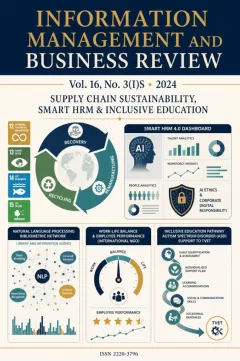 Vol. 16 No. 3(I)S (2024)
Supply Chain Sustainability, Smart HRM & Inclusive Education
View issue contents
Published
Submissions
Have research to publish? Information Management and Business Review welcomes submissions.
Make a Submission