Abstract
Cross-border service relationships are considerable issues in Pakistan, which tend researchers to work in this area of research. The core purpose of this study was to explore the impact of quality, satisfaction, and value on purchase intentions for foreign brands among young Pakistani customers. The data was collected from a random sample of 500 university students through questionnaire designed by the researchers. The findings suggest that providing quality and satisfaction to Pakistani ethnocentric customers does not guarantee the brand to earn loyalty in return. Foreign brands can succeed in creating brand value through creating a convinced link with some tangible benefits and by creating means of self-presentation for the customers. The student’s responses can be assumed as a limitation of this study, which can be justified by considering the fact that the study is first of its type in the Pakistani environment.
Keywords
- Loyalty Search this journal for Loyalty (opens in a new tab)
- Consumer Ethnocentrism Search this journal for Consumer Ethnocentrism (opens in a new tab)
- Consumer Behavior Search this journal for Consumer Behavior (opens in a new tab)
- Cross-Border Products Search this journal for Cross-Border Products (opens in a new tab)
References
- Adorno, T. W., Frenkel-Brunswik, E., Levinson, D. J. & Sanford, R. N. (1982). The Authoritarian Personality, New York: Norton.
- Anderson, P. M. & He, X. (1998). Price influence and age segments of Beijing consumers. Journal of Consumer Marketing, 15(2), 152-169.
- Ahmed, S. & d'Astous, A. 91999). Product-country images in Canada and in the People's Republic of China. Journal of International Consumer Marketing, 11(1), 5-22.
- Balabanis, D. & George, A. (2004). Domestic Country Bias, Country-of-Origin Effects, and Consumer Ethnocentrism: A Multidimensional Unfolding Approach. Journal of the Academy of Marketing Science , 32 (1), 80–95.
- Bearden, W. O., Netemeyer, R. G. & Teel, J. E. (1989). Measurement of consumer susceptibility to interpersonal Influence. Journal of Consumer Research, 15, 473-481.
- Caruana, A. & Chircop, S. (2002). The Dark Side of Globalization and Liberalization: Helplessness, Alienation and Ethnocentrism among Small Business Owners and Managers. Journal of Nonprofit and Public Sector Marketing , 9(4), 63–75.
- European Union. (2007). EU Consumer Policy Strategy 2007–2013: Empowering Consumers, Enhancing Their Welfare, Effectively Protecting Them. Brussels: Commission of the European Communities.
- Gong, W., Li, Z. G. & Li, T. (2004). Marketing to China's youth: a cultural transformation perspective. Business Horizon, 47(6), 41-50.
- Hammond, R. A. & Axelrod, R. (2006). The Evolution of Ethnocentrism. Journal of Conflict Resolution , 50, 926– 36.
- Hung, K. H., Gu, F. F. & Yim, C. K. (2007). A social institutional approach to identifying generation cohorts in China with a comparison with American consumers. Journal of International Business Studies, 38, 836-853.
- Hui, M. K. & Zhou, L. (2002). Linking product evaluations and purchasing intention for country-of-origin effects. Journal of Global Marketing, 15(3/4), 95-101.
- Jacoby, J. & Olson, J. C. (19850. Perceived Quality. Lexington Books: Lexington, MA.
- John, A. & Brady, M. (2009). The Impact of Consumer Ethnocentrism Tendencies on Buyers’ Evaluations of the Quality of South African Packaged and Non-Packaged Consumables in Mozambique. International Journal of Business Research , 9(3), 105–114.
- Jones, T. O. & Sasser, W. E. Jr. (1995). Why Satisfied Customers Defect. Harvard Business Review , 73(6), 88–99. Jin, Z., Chansarkar, B. & Kondap, N. M. (2006). Brand origin in an emerging market: perceptions of Indian consumers. Asia Pacific journal of Marketing and Logistics, 18(4), 283-302.
- Kwok, S., Uncles, M. & Huang, Y. (2006). Brand preferences and brand choices among urban Chinese consumers: an investigation of country-of-origin effects. Asia Pacific journal of Marketing and Logistics, 18(3), 163-172.
- Kirmani, A. & Baumgartner, H. (2000). Reference points used in quality and value judgments. Marketing Letters, 11(4), 299-310.
- LeVine, R. A. & Campbell, D. T. (1972). Ethnocentrism: Theories of Conflict, Ethnic Attitudes, and Group Behavior. London: John Wiley & Sons.
- Levine, R. A. (2001). Ethnocentrism, in Smelser, Neil J and Bates, Paul B (eds.). International Encyclopedia of the Social and Behavioral Sciences, Vol 7, New York: Elsevier.
- Liu, S. S. & Johnson, K. F. (2005). The automatic country-of origin effect on brand judgments. journal of Advertising, 34(1), 87-98.
- Marshall, S. R. & David, M. B. (2001). Dynamic Decision-Making: A Cross-Cultural Comparison of U.S. and Peruvian Export Managers. Journal of International Business Studies , 32(4), 873–93.
- McDougall, G. H. G. & Levesque, T. (2000). Customer satisfaction with services: putting perceived value into the equation. Journal of Services Marketing, 14(5), 392-410.
- Mogab, J. W., Michael, J., Pisani, K., McGlashan, N., Sharon, W. & Wuest, B. E. (2005). Manifesto: The Texas Sales Tax Rebate and Cross-Border Mexican Shoppers. Texas Business Review , 2, 1–6.
- Netemeyer, R. G., Durvasula, S. & Lichtenstein, D. R. (1991). A Cross-National Assessment of the Reliability and Validity of the CETSCALE. Journal of Marketing Research , 28, 320–27.
- Nijssen, E. J. & Douglas, S. P. (2004). Examining the Animosity Model in a Country with a High Level of Foreign Trade. International Journal of Research in Marketing , 21(1), 23–38.
- Nijssen, E. J. & Douglas, P. (2008). Consumer World-Mindedness, Social- Mindedness, and Store Image. Journal of International Marketing , 16(3), 84–107.
- Piron, F. (2002). International Out shopping and Ethnocentrism. European Journal of Marketing , 36(1/2), 189–210.
- Sweeney, J. C., Soutar, G. N. & Johnson, L. W. (1999). The role of perceived risk in the quality-value relationship: a study in a retail environment. Journal of Retailing, 75(1), 77-105.
- Sumner, W. G. (2002). Folkways: A Study of Mores, Manners, Customs and Morals, Newton Abbot: David & Charles Publishing.
- Schewe, C. D. & Meredith, G. (2004). Segmenting global markets by generational cohorts: determining motivations by age. journal of Consumer Behavior, 4(1): 51-63.
- Solomon, M. (1983). The role of products as social stimuli: a symbolic inter actionism perspective. journal of Consumer Research, 10, 319-329.
- Shimp, T. A. & Sharma, S. (1987). Consumer Ethnocentrism: Construction and Validation of the CETSCALE’. Journal of Marketing Research , 24, 280–89.
- Shimp, T. A. (1984). Consumer Ethnocentrism: The Concept and a Preliminary Empirical Test. Advances in Consumer Research , 11, 285–90.
- Steenkamp, J. B. E. M., Batra, R. & Alden, D. L. (2003). How perceived brand globalness creates brand value. journal of International Business Studies, 34(1), 1-13.
- Sharma, S., Shimp, T. A. & Shin, J. (1995). Consumer Ethnocentrism: A Test of Antecedents and Moderators. Journal of the Academy of Marketing Science , 23, 26–37.
- Garbarino, E. & Johnson, S. M. (1999). The Different Roles of Satisfaction, Trust, and Commitment in Customer Relationships. Journal of Marketing , 63, 70–87.
- The Economist. (2007). Cross-Border Shopping. You’d Be a Loonie Not To, (August 2), (accessed February 14, 2008), [available at http:// www.economist.com].
- Tropp, L. R. & Thomas, F. P. (2005). Differential Relationships Between Intergroup Contact and Affective and Cognitive Dimensions of Prejudice. Personality and Social Psychology Bulletin , 31(8), 1145–58.
- Verhallen, T. M. (1982). Scarcity and consumer choice behavior. Journal of Economic Psychology, 2(2), 299321.
- Wu, J. & Fu, G. (2007). The effects of brand origin country and made-in country on consumers' product evaluations and purchase intention. Frontiers of Business Research in China, 1(3), 1673-7326.
- Zeithaml, V. A. (1988). Consumer perceptions of price, quality and value: a means-end model and synthesis of evidence. Journal of Marketing , 52, 2-22.
- Zhang, Y. (1996). Chinese consumers' evaluation of foreign products: the influence of culture, product types and product presentation format. European Journal of Marketing, 30(12), 50-68.
- Zhao, L. & Hui, M. K. (2003). Symbolic value of foreign products in the People's Republic of China. Journal of International Marketing, 11(2), 36- 58.
- Zhao, N. & Belk, R. W. (2004). Chinese consumer readings of global and local advertising appeals. Jour nal of Advertising 33(3), 63-76.
- Zhao, L. & Wong, A. (2008). Exploring the influence of product conspicuousness and social compliance on purchasing motives of young Chinese consumers for foreign brands. Journal of Consumer Behavior , 7, 470-483.
Downloads
No downloads have been recorded for this article yet. Figures appear here once readers begin downloading the full text.
How to Cite
Share this article
License
Copyright (c) 2026 Arslan Rafi, Arslan Ali, Sharjeel Saqib, Ali Iftikhar Choudhary, Syed Azeem Akhtar (Author)

This work is licensed under a Creative Commons Attribution 4.0 International License.
Author (s) should affirm that the material has not been published previously. It has not been submitted and it is not under consideration by any other journal. At the same time author (s) need to execute a publication permission agreement to assume the responsibility of the submitted content and any omissions and errors therein. After submission of revised paper in the light of suggestions of the reviewers, the editorial team edits and formats manuscripts to bring uniformity and standardization in published material.
This work will be licensed under Creative Commons Attribution 4.0 International (CC BY 4.0) and under condition of the license, users are free to read, copy, remix, transform, redistribute, download, print, search or link to the full texts of articles and even build upon their work as long as they credit the author for the original work. Moreover, as per journal policy author (s) hold and retain copyrights without any restrictions.
Keywords
- Loyalty Search this journal for Loyalty (opens in a new tab)
- Consumer Ethnocentrism Search this journal for Consumer Ethnocentrism (opens in a new tab)
- Consumer Behavior Search this journal for Consumer Behavior (opens in a new tab)
- Cross-Border Products Search this journal for Cross-Border Products (opens in a new tab)
Section
Published in
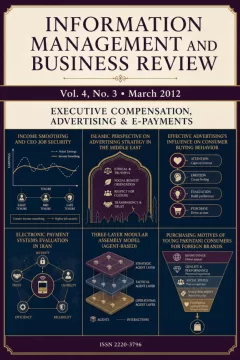 Vol. 4 No. 3 (2012)
Executive Compensation, Advertising & E-Payments
View issue contents
Published
Submissions
Have research to publish? Information Management and Business Review welcomes submissions.
Make a Submission