Abstract
Job satisfaction is among the most difficult issues for many business leaders to address. Researchers have widely discussed this problem, yet statistics still show an alarming increase, and various factors cause it to happen often. This study aims to examine the relationship between job satisfaction and turnover intention and investigate the moderating effect of employee gender and years of experience on the relationship. The four workplace satisfaction determinants—career advancement, employee empowerment, pay level, and nature of the work—that affect employee turnover intention are covered in this study. This study involved respondents among the travel agencies’ employees within the state of Selangor, regardless of their working position. A set of questionnaires was distributed to 130 employees from 26 travel agency companies that participated in the study. T he results show employee empowerment has a significant negative relationship with turnover intention. I t has been also found that the relationship between job satisfaction and turnover intention is significantly moderated by gender and years of experience. This study recommends that further research should use a larger sample size and qualitative methods to gain comprehensive knowledge regarding the phenomenon.
Keywords
- Job Satisfaction Search this journal for Job Satisfaction (opens in a new tab)
- Turnover Intention Search this journal for Turnover Intention (opens in a new tab)
- Travel Agency Search this journal for Travel Agency (opens in a new tab)
- Employees Search this journal for Employees (opens in a new tab)
- Selangor Search this journal for Selangor (opens in a new tab)
References
- Abou-Shouk, M., Elbaz, A. M., & Maher, A. (2021). Breaking the silence of travel agency employees: The moderating role of gender. Tourism and Hospitality Research, 21(4), 487–500. https://doi.org/10.1177/1467358420988048
- Abubakar, R. A., & Maitama Kura, K. (2015). Does Gender Moderate The Relationship Between Job Satisfaction and Employee-Turnover Intention? A Proposed Model. International Journal of Accounting and Business Management, 4(2), 254-259. 9
- Al Sabei, S. D., Labrague, L. J., Miner Ross, A., Karkada, S., Albashayreh, A., Al Masroori, F., & Al Hashmi, N. (2020). Nursing Work Environment, Turnover Intention, Job Burnout, and Quality of Care: The Moderating Role of Job Satisfaction. J Nurs Scholarsh, 52(1), 95-104. doi: 10.1111/jnu.12528
- Chin, C. L. (2018). The Influence of Job Satisfaction on Employee Turnover Intention in the Manufacturing Industry of Malaysia. 1(2), 53–63.
- Clark, A. E. (1997). Job Satisfaction and Gender: Why Are Women So Happy at Work? Labor Economics, 4, 341-372. http://dx.doi.org/10.1016/S0927-5371(97)00010-9
- Crookston, B. T., West, J. H., Davis, S. F., Hall, P. C., Seymour, G., & Gray, B. L. (2021). Understanding female and male empowerment in Burkina Faso using the project-level Women's Empowerment in Agriculture Index (pro-WEAI): a longitudinal study. BMC Womens Health, 21(1), 230. doi: 10.1186/s12905-02101371-9
- DOSM (2019a) Department of Statistics Malaysia. Labor Force Survey Report Malaysia 2019. Retrieved 29 April 2020.
- DOSM, (2019b) Department of Statistics Malaysia. Quarterly Bulletin Report Malaysia, Foreign Direct Investment (FDI) & Malaysia’s Direct Investment Abroad (DIA) 2019: Quarter 4. Retrieved 29 April 2020.
- DOSM, (2019c) Department of Statistics Malaysia. Employment Statistic Fourth Quater Report 2019, Retrieved 13 February 2020.
- Dwesini, N. F. (2019). Causes and prevention of high employee turnover within the hospitality industry: A literature review. African Journal of Hospitality, Tourism and Leisure, 8(3), 1.
- Eagly, A. H., & Wood, W. (2012). Social Role Theory. In Handbook of Theories of Social Psychology (pp. 458-476).
- Ghazi, S. R., Shahzada, G., & Khan, M. S. (2013). Resurrecting Herzberg’s Two Factor Theory: an Implication to the University Teachers. Journal of Educational and Social Research, 3(2), 445.
- Guha, S., & Chakrabarti, S. (2014). Employee Turnover: A Study on Information Technology Sector. Journal of Business and Management – Vol. 20, No. 2,2014.
- Gupta, M., & Shaheen, M. (2017). The Relationship between Psychological Capital and Turnover Intention: Work Engagement as Mediator and Work Experience as Moderator. Jurnal Pengurusan, 49, 117-126. doi: 10.17576/pengurusan-201749-10
- Herzberg, F., Mausner, B., & Snyderman, B. (1959). The motivation to work. Hoboken, NJ: John Wiley and Sons Inc. 34.
- Ho, S. (2018). Employee Job Happiness Index 2017 by Jobstreet.com. Retrieved 10 January 2021.
- Hossain, M. S., Kannan, S. N., & Raman Nair, S. K. K. (2021). Factors Influencing Sustainable Competitive Advantage in the Hospitality Industry. Journal of Quality Assurance in Hospitality and Tourism, 22(6), 679–710. https://doi.org/10.1080/1528008X.2020.1837049
- Ibrahim, S., Suan, C., & Karatepe, O. (2019). The effects of supervisor support and self-efficacy on call center employees’ work engagement and quitting intentions. International Journal of Manpower, 40(4), 688-703. https://doi.org/10.1108/ijm-12-2017-0320
- JOLTS (2020). Bureau of Labor Statistics Job Openings and Labor Turnover Survey reports. https://www.bls.gov/jlt/joltsbmart2020.htm
- Kim, S. Y., & Fernandez, S. (2016). Employee Empowerment and Turnover Intention in the U.S. Federal Bureaucracy. The American Review of Public Administration, 47(1), 4-22.
- Lambert, E., Hogan, N., & Barton, S. (2001). The Impact of Job Satisfaction on Turnover Intent: a Test of a Structural Measurement Model Using a National Sample Workers. The Social Science Journal, 233-250.
- Lei, K. Y., Basit, A., & Hassan, Z. (2018). The Impact of Talent Management on Job Satisfaction: A Study among the Employees of a Travel Agency in Malaysia. Indonesian Journal of Applied Business and Economic Research, 1(1), 1–19. http://econbiz.org/index.php/ijaber/article/view/6
- Nointin, A. A. (2018). Hierarchical model of internal marketing to predict employee satisfaction and turnover intention. Journal of Applied Structural Equation Modeling, 2(1), 44–58. https://doi.org/10.47263/jasem 2(1), 05.
- Obi, G.-V. (2021). Gender Perceptions of Psychological Empowerment in The Workplace: A Comparative Analysis of Two Cultures. International Journal of Business and Social Science Research, 1-7. doi: 10.47742/ijbssr.v2n7p1
- Page, M. (2015). Malaysia Employee Intentions Report. Retrieved 23 March 2020.
- Pang, L., Kucukusta, D., & Chan, X. (2015). Employee Turnover Intention in Travel Agencies: Analysis of Controllable and Uncontrollable Factors. International Journal of Tourism Research, 17(6), 577-590. doi: 10.1002/jtr.2025
- Phang, C-K., Keng, S-L. & Chiang, K-C. (2014). Mindful-S.T.O.P.: Mindfulness Made Easy for Stress Reduction in Medical Students. Education in Medicine Journal. 6, 48-56. 10.5959/eimj.v6i2.230.
- Rana, S., & Singh, V. (2016). Employee empowerment and job satisfaction. International Journal of Humanities and Social Science, 21(10 12):23-29
- Raziq, A., & Maulabakhsh, R. (2015). Impact of Working Environment on Job Satisfaction. Procedia Economics and Finance, 23, 717–725.
- Rigther, D. (2017). A study Towards the Relationship Between Perceived Organizational Support and Turnover Intentions: The Mediating Role of Job Satisfaction. Human Resource Studies.
- Rigther, D. (2017). A study towards the relationship between Perceived Organizational Support and Turnover Intentions: the mediating role of Job Satisfaction. Human Resource Studies.
- Richardsen, A. M., Mikkelsen, A. & Burke, R. J. (1997). Work experiences and career and job satisfaction among professional and managerial women in Norway. Scandinavian journal of management. 13(2), 209-218
- Romeo, M., Yepes-Baldo, M., & Lins, C. (2020). Job Satisfaction and Turnover Intention Among People with Disabilities Working in Special Employment Centers: The Moderation Effect of Organizational Commitment. Front Psychol, 11, 1035.
- Sergio, R. P., & Rylova, M. (2018). Employee engagement and empowerment as a gateway towards retention: The case of Volkswagen group. Journal of Eastern European and Central Asian Research, 5(2).
- Spector, P. (1997). Job satisfaction: Application, assessment, causes, and consequences. Thousand Oaks: CA: Sage Publication.
- Sukriket, P., & Business, U. S. (2014). The Relationship Between Job Sustainable Competitive Advantage in the Hospitality Industry. Journal of Quality Assurance in Hospitality and Tourism, 22(6), 679–710. https://doi.org/10.1080/1528008X.2020.1837049
- Tnay, E., Othman, A. E. A., Siong, H. C., & Lim, S. L. O. (2013). The Influences of Job Satisfaction and Organizational Commitment on Turnover Intention. Procedia - Social and Behavioral Sciences, 97, 201-208.
- Wexler, J. (2001). Opportunity buys loyalty. Computerworld, 2-40.
- Willie, E. D. (2021). Hospitality Industry Employee Turnover. Walden University Scholar Works. College Management and Technology.
- Zhang, Y. (2016). A Review of Employee Turnover Influence Factor and Countermeasure. Journal of Human Resource and Sustainability Studies, 04(02), 85-91.
Downloads
No downloads have been recorded for this article yet. Figures appear here once readers begin downloading the full text.
How to Cite
Share this article
License
Copyright (c) 2024 Siti Noraini Mohd Tobi, Juliana Norizan, Mohamad Shahril Mohamad Besir, Nor Intan Shamimi Abdul Aziz, Hendrikus Kadang (Author)

This work is licensed under a Creative Commons Attribution 4.0 International License.
Author (s) should affirm that the material has not been published previously. It has not been submitted and it is not under consideration by any other journal. At the same time author (s) need to execute a publication permission agreement to assume the responsibility of the submitted content and any omissions and errors therein. After submission of revised paper in the light of suggestions of the reviewers, the editorial team edits and formats manuscripts to bring uniformity and standardization in published material.
This work will be licensed under Creative Commons Attribution 4.0 International (CC BY 4.0) and under condition of the license, users are free to read, copy, remix, transform, redistribute, download, print, search or link to the full texts of articles and even build upon their work as long as they credit the author for the original work. Moreover, as per journal policy author (s) hold and retain copyrights without any restrictions.
Keywords
- Job Satisfaction Search this journal for Job Satisfaction (opens in a new tab)
- Turnover Intention Search this journal for Turnover Intention (opens in a new tab)
- Travel Agency Search this journal for Travel Agency (opens in a new tab)
- Employees Search this journal for Employees (opens in a new tab)
- Selangor Search this journal for Selangor (opens in a new tab)
Section
Published in
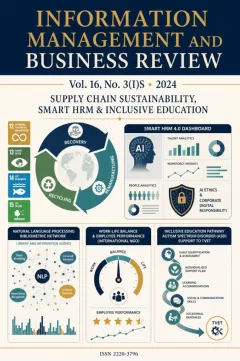 Vol. 16 No. 3(I)S (2024)
Supply Chain Sustainability, Smart HRM & Inclusive Education
View issue contents
Published
Submissions
Have research to publish? Information Management and Business Review welcomes submissions.
Make a Submission