Abstract
The integration of progressive 4.0 technology into human resource management (HRM) represents a significant shift in how organizations optimize and enhance workforce capabilities. This review explores the origins, applications, benefits, challenges and future prospects surrounding smart HRM 4.0. By reviewing existing literature, this paper examines the utilization of Artificial Intelligence (AI), Big Data analytics, machine learning (ML) and the Internet of Things (IoT) in HRM, specifically in talent acquisition, training, performance management, and rewards. Additionally, it addresses the implementation challenges including data quality assurance, skill shortages, and cultural resistance. The paper also emphasizes the importance of ethical considerations. In terms of future research, it highlights the necessity for ethically deploying Industry 4.0 and establishing robust AI governance frameworks. By combining technological innovation with ethical values, organizations can navigate the complexities of this integration, leading to a future characterized by workplace efficiency, accountability, and fairness.
Keywords
- Industry 4.0 Search this journal for Industry 4.0 (opens in a new tab)
- 4.0 Technologies Search this journal for 4.0 Technologies (opens in a new tab)
- Smart HRM 4.0 Search this journal for Smart HRM 4.0 (opens in a new tab)
- Ethical Implications Search this journal for Ethical Implications (opens in a new tab)
- Corporate Digital Responsibility Search this journal for Corporate Digital Responsibility (opens in a new tab)
References
- Abdeldayem, M. M., & Aldulaimi, S. H. (2020). Trends and opportunities of artificial intelligence in human resource management: Aspirations for the public sector in Bahrain. International Journal of Scientific and Technology Research, 9(1), 3867–3871
- Abdussamad, Z., Agyei, I. T., Dongul E. S., Abdussamad, J., Raj, R. & Effendy, F. (2022). Impact of Internet of Things (IoT) on Human Resource Management: A review. Materials Today: Proceedings, 56, 3534–3543
- Abellan-Sevilla, A.J. & de-Urbina-Criad, M. O. (2023). Smart human resource analytics for happiness management. Journal of Management Development, 42(6), 514-525.
- Agarwal, A. (2023). AI adoption by human resource management: a study of its antecedents and impact on HR system effectiveness. Foresight, 25(1), 67-81.
- Agrawal, P., Narain, R. & Ullah, I. (2020). Analysis of barriers in the implementation of digital transformation of supply chain using an interpretive structural modelling approach. Journal of Modelling in Management, 15(1), 297-317.
- Albaroudi, E., Mansouri, T. & Alameer, A. (2024). A Comprehensive Review of AI Techniques for Addressing Algorithmic Bias in Job Hiring. AI, 5(1), 383-404.
- Al-Harazneh, Y.M. & Sila, I. (2021), The impact of E-HRM usage on HRM effectiveness: highlighting the roles of top management support, HR professionals, and line managers. Journal of Global Information Management, 29(2), 118-147.
- Al-Khatib, A.W., Al-Fawaeer, M.A., Alajlouni, M.I. & Rifai, F.A. (2022). Conservative culture, innovative culture, and innovative performance: a multi-group analysis of the moderating role of the job type. International Journal of Innovation Science, 14(3/4), 675-692.
- Angrave, D., Charlwood, A., Kirkpatrick, I., Lawrence, M., & Stuart, M. (2016). HR and analytics: Why HR is set to fail the big data challenge. Human Resource Management Journal, 26(1), 1-11.
- Artar, M., Balcioglu, Y. S. & Erdil, O. (2024). Improving the quality of hires via the use of machine learning and an expansion of the person-environment fit theory. Management Decision, 0025-1747, doi 10.1108/MD-12-2023-2295.
- Bankins, S. 2021. The ethical use of artificial intelligence in human resource management: a decision-making framework. Ethics and Information Technology, 23(4), 841-854.
- Bohmer, N. & Schinnenburg, H. (2023). Critical exploration of AI-driven HRM to build up organizational capabilities. Employee Relations: The International Journal, 45(5), 1057-1082.
- Bockius, H. & Gatzert, N. (2023). Organizational risk culture: a literature review on dimensions, assessment, value relevance, and improvement levers. European Management Journal, doi: 10. 1016/J.EMJ.2023.02.002.
- Bujold, A., Roberge Maltais, I., Parent Rocheleau, X., Boasen J., Senecall, S. & Leger, P. M. (2023). Responsible artificial intelligence in human resources management: a review of the empirical literature. AI and Ethics, https://doi.org/10.1007/s43681-023-00325-1.
- Bozkus, K. (2024). Organizational Culture Change and Technology: Navigating the Digital Transformation. IntechOpen. doi: 10.5772/intechopen.112903.
- Calabrese, A., Levialdi Ghiron, N. & Tiburzi, L. (2021), ‘Evolutions’ and ‘revolutions’ in manufacturers’ implementation of industry 4.0: a literature review, a multiple case study, and a conceptual framework. Production, Planning and Control, 32(3), 213-227.
- Calabrese, A., Dora, M., Ghiron, N.L. & Tiburzi, L. (2022). Industry’s 4.0 transformation process: how to start, where to aim, what to be aware of. Production, Planning and Control. 33(5), 492-512.
- Charlwood, A. & Guenole, N. (2022). Can HR adapt to the paradoxes of artificial intelligence? Human Resource Management Journal, 32(4), 729-742.
- Chatterjee, S., Chaudhuri, R., Vrontis, D., & Siachou, E. (2021). Examining the dark side of human resource analytics: An empirical investigation using the privacy calculus approach. International Journal of Manpower, 43(1), 52–74.
- Cheng, M. M., & Hackett, R. D. (2021). A critical review of algorithms in HRM: Definition, theory, and practice. Human Resource Management Review, 31(1), 100698. https://doi.org/10.1016/j.hrmr.2019.100698
- Chen, Z. (2022). Artificial intelligence-virtual trainer: Innovative didactics aimed at personalized training needs. Journal of the Knowledge Economy, 14, 2007–2025. https://doi.org/10.1007/s13132-022 00985-0
- Chowdhury, S., Dey, P., Joel-Edgar, S., Bhattacharya, S., Rodriguez-Espindola, O., Abadie, A. & Truong, L. (2023). Unlocking the value of artificial intelligence in human resource management through AI capability framework. Human Resource Management Review, 33(1), 100899
- Culot, G., Nassimbeni, G., Orzes, G., & Sartor, M. (2020). Behind the definition of Industry 4.0: Analysis and open questions. International Journal of Production Economics, 226, 107617.
- Duman, M. & Akdemir, B. (2021). A study to determine the effects of Industry 4.0 technology components on organizational performance. Technological Forecasting and Social Change, 167, 0-3.
- Flores, E., Xu, X., & Lu, Y. (2020). Human Capital 4.0: A workforce competence typology for Industry 4.0. Journal of Manufacturing Technology Management, 31(4), 687–703.
- Gal, U., Jensen, T. B., & Stein, M.K. (2020). Breaking the vicious cycle of algorithmic management: A Virtue ethics approach to people analytics. Information and Organization, 30(2), 100301. https://doi.org/10.1016/j.infoandorg.2020.100301
- Ganatra, N. J. & Pandaya, J. D. (2023). The transformative impact of artificial intelligence on hr practices and employee experience: A review. Journal of Management Research and Analysis, 10(2), 106-111.
- Ghobakhloo, M., Vilkas, M., Stefanini, A., Grybauskas, Marcinkevicius, G., Petraite, M. & Sarvari, P. A. (2023). Developing capabilities underlying Industry 4.0 design principles within the manufacturing context. Journal of Manufacturing Technology Management, 34(7), 1183-1207.
- Goretzko, D. & Israel, L.S.F. (2022). Pitfalls of machine learning-based personnel selection: fairness, transparency, and data quality. Journal of Personnel Psychology, 21(1), 37-47, doi: 10.1027/1866-5888/a000287.
- Hamilton, R. H. & Sodeman, W.A. (2020). The questions we ask: Opportunities and challenges for using big data analytics to strategically manage human capital resources. Business Horizons, 63, 85-95.
- Hartley, N., Kunz, W. & Tabit, J. (2024). The corporate digital responsibility (CDR) calculus: How and why organizations reconcile digital and ethical trade-offs for growth. Organizational Dynamics, 53(2), 101056. https://doi.org/10.1016/j.orgdyn.2024.101056.
- Heidemann, A., Hulter, S. M. & Tekieli, M. (2024). Machine learning with real-world HR data: mitigating the trade-off between predictive performance and transparency. The International Journal of Human Resource Management, 35(14), 2343-2366
- Hickman, L., Saef, R., Ng, V., Woo, S. E., Tay, L., & Bosch, N. (2021). Developing and evaluating language-based machine learning algorithms for inferring applicant personality in video interviews. Human Resource Management Journal, 34(2), 255-274. https://doi. org/10.1111/1748-8583.12356
- Hmoud, B. (2021). Assessing HR Leader’s attitude toward the adoption of artificial intelligence in recruitment. Journal of EcoAgriTourism, 17(1), 20-32
- Hoffmann Souza, M.L., da Costa, C.A., de Oliveira R. G. & da Rosa R. R. (2020). A survey on decision-making based on system reliability in the context of Industry 4.0. Journal of Manufacturing Systems, 56, 133-156.
- Hunkenschroer, A.L. & Luetge, C. (2022). Ethics of AI-enabled recruiting and selection: a review and research agenda. Journal of Business Ethics, 178(4), 977-1007
- James, A.T., Kumar, G., Tayal, P., Chauhan, A., Wadhawa, C. & Panchal, J. (2022). Analysis of human resource management challenges in the implementation of Industry 4.0 in the Indian automobile industry. Technological Forecasting and Social Change, 176, 121483
- Kamble, S. S., Gunasekaran, A., & Sharma, R. (2018). Analysis of the driving and dependence power of barriers to adopt Industry 4.0 in the Indian manufacturing industry. Computers in Industry, 101, 107-119. https://doi.org/10.1016/j. compind.2018.06.004
- Lobschat, L., Mueller, B., Eggers, F., Brandimarte, L., Diefenbach, S., Kroschke, M., & Wirtz, J. J. J. (2021). Corporate digital responsibility. Journal of Business Research, 122, 875–888.
- Maamari, B.E. & Osta, A. (2021). The effect of HRIS implementation success on job involvement, job satisfaction and work engagement in SMEs. International Journal of Organizational Analysis, 29(5), 1269-1286.
- Marcon, E., Soliman, M., Gerstlberger, W. & Frank, A.G. (2022). Sociotechnical factors and Industry 4.0: an integrative perspective for the adoption of smart manufacturing technologies. Journal of Manufacturing Technology Management, 33(2), 259-286.
- Marler, J.H. & Boudreau, J.W. (2017). An evidence-based review of HR Analytics. International Journal of Human Resource Management, 28(1), 3-26.
- Matt, D. T., Orzes, G., Rauch, E., & Dallasega, P. (2020). Urban production – A socially sustainable factory concept to overcome shortcomings of qualified workers in smart SMEs. Computers and Industrial Engineering, 139. https://doi.org/10.1016/j. cie.2018.08.035
- McIver, D., Lengnick-Hall, M. A., & Lengnick-Hall, C. A. (2018). A strategic approach to workforce analytics. Business Horizons, 61(3), 397-407.
- Meddour, H., Abdussalaam, I. I., & Abdul Majid, A. H. (2020). Withstanding the effect of Industry 4.0: The role of high-performance work system and management philosophy. International Journal of Supply Chain Management, 9(1), 511–519.
- Meijerink, J., Boons, M., Keegan, A., & Marler, J. (2021). Algorithmic human resource management: Synthesizing developments and cross-disciplinary insights on digital HRM. The International Journal of Human Resource Management, 32(12), 2545–2562.
- Mittelstadt, B. D., Allo, P., Taddeo, M., Wachter, S., & Floridi, L. (2016). The ethics of algorithms: Mapping the debate. Big Data & Society, 3(2). https://doi.org/10.1177/2053951716679679
- Mohanty, S., & Mishra, P. C. (2020). Framework for understanding the Internet of Things in human resource management. Espacios, 41(12), 3-15.
- Murugesan, U., Subramanian, P., Srivastava, S. & Dwivedi, A. (2023). A study of Artificial Intelligence impacts on Human Resource Digitalization in Industry 4.0. Decision Analytics Journal, 7, 100249. https://doi.org/10.1016/j.dajour.2023.100249
- Nayem, Z. & Uddin, M. A. (2024). Unbiased employee performance evaluation using machine learning. Journal of Open Innovation: Technology, Market, and Complexity 10(1), 100243. https://doi.org/10.1016/j.joitmc.2024.100243.
- Nicolas-Agust?n, A., Jimenez-Jimenez, D. & Maeso-Fernandez, F. (2022). The role of human resource practices in the implementation of digital transformation. International Journal of Manpower, 43(2), 395-410.
- Ogbeibu, S., Pereira, V., Emelifeonwu, J. & Gaskin, J. (2021). Bolstering creativity willingness through digital task interdependence, disruptive and smart HRM technologies. Journal of Business Research, 124, 422-436. doi: 10.1016/j.jbusres.2020.10.06
- Oswal, N., Ateeq, K., & Mathew, S. (2021). Trends in Recruitment Information and Communication System using Artificial Intelligence in Industry 4.0. International Conference on Finance, Economics, Management and IT Business. (pp.111-118). DOI: 10.5220/0010503201110118
- Pessach, D., Singer, G., Avrahami, D., Chalutz Ben-Gal, H., Shmueli, E., & Ben-Gal, I. (2020). Employee recruitment: A prescriptive analytics approach via machine learning and mathematical programming. Decision Support Systems, 134. https://doi.org/10.1016/j.dss.2020.1132
- Pillai, R. & Srivastava, K.B.L. (2024). Smart HRM 4.0 for achieving organizational performance: a dynamic capability view perspective. International Journal of Productivity and Performance Management, 73 (2), 476-496.
- Pillai, R. & Srivastava, K.B.L. (2023). Smart HRM 4.0 practices for organizational performance: the role of dynamic capabilities. Benchmarking: An International Journal, 13(1), 1-23.
- Pillai, R. & Sivathanu, B. (2020). Adoption of artificial intelligence (AI) for talent acquisition in IT/ ITeS organizations. Benchmarking, 27 (9), 2599-2629.
- Pillai, R., Yadav, S., Sivathanu, B., Kaushik, N. & Goel, P. (2021). Use of 4.0 (I4.0) technology in HRM: a pathway toward SHRM 4.0 and HR performance. Foresight, 24(6), 708-727.
- Rodgers, W., Murray, J. M., Stefanidis, A., Degbey, W. Y. & Tarba, S. Y. (2023). An artificial intelligence algorithmic approach to ethical decision-making in human resource management processes. Human Resource Management Review, 33. https://doi.org/10.1016/j.hrmr.2022.100925
- Sahin, F., Karadag, H. & Tuncer, B. (2019). Big five personality traits, entrepreneurial self-efficacy and entrepreneurial intention: a configurational approach. International Journal of Entrepreneurial Behaviour and Research, 25(6), 1118-1211.
- Sakurada, L., Geraldes, C. A. S., Fernandes, F. P., Pontes, J., & Leitao, P. (2020). Analysis of new job profiles for the factory of the future. International Workshop on Service Orientation in Holonic and Multi-Agent Manufacturing, 262–273
- Sarbu, M. (2022). The impact of Industry 4.0 on innovation performance: Insights from German manufacturing and service firms. Technovation, 113, 102415.
- Samarasinghe, K.R. & Medis, A. (2020). Artificial intelligence-based strategic human management (AISHRM) for industry 4.0. Global Journal of Management and Business Research, 20(2), 1-4.
- Shahreki, J., Ganesan, J., Raman, K., Chin, A.L.L. & Chin, T.S. (2019). The effect of human resource information system application on employee satisfaction and turnover intention. Entrepreneurship and Sustainability Issues, 7(2), 1462-1479.
- Shahreki, J. & Lee, J. Y. (2024). Adopting human resource information system and work-related outcomes in emerging market SMEs: a unified theory of acceptance and use of technology. Cross Cultural & Strategic Management, 31(1), 116-142.
- Shet, S. V. & Pereira, V. (2021). Proposed managerial competencies for Industry 4.0 – Implications for social sustainability. Technological Forecasting & Social Change, 173, 121080. https://doi.org/10.1016/j.techfore.2021.121080
- Sivakumar, S., Mohan, U., Chankarachan, P., & Bhaduri, N. (2020). HR4.0: How Should HR Gear Up for Industry 4.0? NHRD Network Journal, 13(2), 190-196. https://doi.org/10.1177/2631454120931604
- Soltani, P. & Morice, A.H.P. (2020). Augmented reality tools for sports education and training. Computers & Educations, 155. https://doi.org/10.1016/j.compedu.2020.103923.
- Strohmeier, S. (2020). Smart HRM–a Delphi study on the application and consequences of the Internet of things in human resource management. The International Journal of Human Resource Management, 31(18), 2289-2318. doi: 10.1080/09585192.2018.1443963.
- Talukdar, A. & Anirban, G. (2022), A dark side of e-HRM: mediating role of HR service delivery and HR socialization on HR effectiveness. International Journal of Manpower, 43(1), 116-147.
- Tang, G., Park, K., Agarwal, A. & Liu, F. (2020). Impact of innovation culture, organization size and technological capability on the performance of SMEs: the case of China. Sustainability, 12(4), 1355. https://doi.org/10.3390/su12041355.
- Toth, Z. & Blut, M. (2024). Ethical compass: The need for Corporate Digital Responsibility in the use of Artificial Intelligence in financial services. Organizational Dynamics, 53(2). https://doi.org/10.1016/j.orgyn.2024.10104.
- van Dun, D.H. & Kumar, M. 2023. Social enablers of Industry 4.0 technology adoption: transformational leadership and emotional intelligence. International Journal of Operations & Production Management, 43(13), 152-182.
- Verma, A., Bansal, M. & Verma, J. (2020). Industry 4.0: reshaping the future of HR. Strategic Direction, 36(5), 9-11.
- Wirtz, J., Kunz, W. H., Hartley, N., & Tarbit, J. (2023). Corporate Digital Responsibility in Service Firms and their Ecosystems. Journal of Service Research, 26(2), 173-190.
- Weiskopf, R., & Hansen, H. K. (2022). Algorithmic governmentality and the space of ethics: Examples from People Analytics. Human Relations, 76, 483–506.
- Zhou, Y., Cheng, Y., Zou, Y. and Liu, G. (2022). e-HRM: a meta-analysis of the antecedents, consequences, and cross-national moderators. Human Resource Management Review, 32(4), 1-21.
Downloads
No downloads have been recorded for this article yet. Figures appear here once readers begin downloading the full text.
How to Cite
Share this article
License
Copyright (c) 2024 Syezreen Dalina Rusdi, Ida Rosnita Ismail, Rosmah Mat Isa (Author)

This work is licensed under a Creative Commons Attribution 4.0 International License.
Author (s) should affirm that the material has not been published previously. It has not been submitted and it is not under consideration by any other journal. At the same time author (s) need to execute a publication permission agreement to assume the responsibility of the submitted content and any omissions and errors therein. After submission of revised paper in the light of suggestions of the reviewers, the editorial team edits and formats manuscripts to bring uniformity and standardization in published material.
This work will be licensed under Creative Commons Attribution 4.0 International (CC BY 4.0) and under condition of the license, users are free to read, copy, remix, transform, redistribute, download, print, search or link to the full texts of articles and even build upon their work as long as they credit the author for the original work. Moreover, as per journal policy author (s) hold and retain copyrights without any restrictions.
Keywords
- Industry 4.0 Search this journal for Industry 4.0 (opens in a new tab)
- 4.0 Technologies Search this journal for 4.0 Technologies (opens in a new tab)
- Smart HRM 4.0 Search this journal for Smart HRM 4.0 (opens in a new tab)
- Ethical Implications Search this journal for Ethical Implications (opens in a new tab)
- Corporate Digital Responsibility Search this journal for Corporate Digital Responsibility (opens in a new tab)
Section
Published in
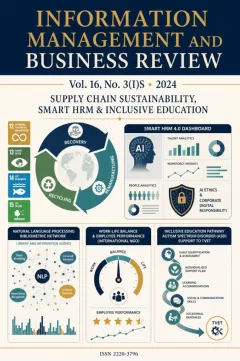 Vol. 16 No. 3(I)S (2024)
Supply Chain Sustainability, Smart HRM & Inclusive Education
View issue contents
Published
Submissions
Have research to publish? Information Management and Business Review welcomes submissions.
Make a Submission