Abstract
Participation in the stock market is crucial for financial engagement and wealth creation. However, specific population segments, such as students from higher learning institutions, may exhibit lower stock market participation levels. Addressing this issue, this study uses the behavioral finance theory to examine how financial literacy, financial well-being, herding behavior, overconfidence bias, risk tolerance, social interaction, and investment intention influence stock market participation. Data was collected through a self-administered questionnaire distributed to 669 university students in Malaysia aged 17-30 years old. The findings reveal that financial literacy, herding behavior, risk tolerance, and social interaction positively influenced investment intention. The study also discovered that investment intention positively influences stock market participation. This study has made significant contributions to both theory and practice. Theoretically, this study contributes to the literature by confirming the positive relationship between financial literacy and investment intention. This study contributes to the development of more effective interventions and policies that not only educate students about an essential aspect of financial literacy but also prepare them for a financially secure future.
Keywords
- Stock Market Participation Search this journal for Stock Market Participation (opens in a new tab)
- Investment Intention Search this journal for Investment Intention (opens in a new tab)
- Higher Education Institution Search this journal for Higher Education Institution (opens in a new tab)
- Behavioral Intention Search this journal for Behavioral Intention (opens in a new tab)
References
- Ahmad, M., & Shah, S. Z. A. (2022). Overconfidence heuristic-driven bias in investment decision-making and performance: Mediating effects of risk perception and moderating effects of financial literacy. Journal of Economic and Administrative Sciences, 38(1), 60–90. https://doi.org/10.1108/JEAS-07-2020-0116
- Ahmaed, Z., & Noreen, U. (2021). Role of behavioral determinants for investment decision making. Asia-Pacific Social Science Revie, 21(2), 48–62.
- Akter, S., D’Ambra, J., & Ray, P. (2013). Development and validation of an instrument to measure user-perceived service quality of mHealth. Information and Management, 50(4), 181–195. https://doi.org/10.1016/j.im.2013.03.001
- Bakar, S., & Yi, A. N. C. (2016). The impact of psychological factors on investors’ decision making in Malaysian stock market: A case of Klang Valley and Pahang. Procedia Economics and Finance, 35, 319–328. https://doi.org/10.1016/S2212-5671(16)00040-X
- Bayar, Y., Sezgin, H. F., Öztürk, Ö. F., & ?a?maz, M. Ü. (2020). Financial literacy and financial risk tolerance of individual investors: Multinomial logistic regression approach. SAGE Open, 10(3). https://doi.org/10.1177/2158244020945717/ASSET/IMAGES/LARGE/10.1177_2158244020945717-FIG1.JPEG
- Bhatia, S., & Singh, S. (2023). Exploring financial well-being of working professionals in the Indian context. Journal of Financial Services Marketing. https://doi.org/10.1057/s41264-023-00215-x
- Brailovskaia, J., Lin, M., Scholten, S., Zhu, M., Fu, Y., Shao, M., Hu, S., Li, X., Guo, W., Cai, D., Lu, S., & Margraf, J. (2022). A qualitative cross-cultural comparison of well-being constructs: the meaning of happiness, life satisfaction, and social support for German and Chinese students. Journal of Happiness Studies, 23(4), 1379–1402. https://doi.org/10.1007/s10902-021-00454-6
- Cossa, A., Madaleno, M., & Mota, J. (2022). Financial literacy environment scan in Mozambique. Asia Pacific Management Review, 27(4), 229–244. https://doi.org/https://doi.org/10.1016/j.apmrv.2021.09.004
- Diener, E., & Biswas-Diener, R. (2008). Health and happiness. In Happiness: unlocking the mysteries of Psychological Wealth (pp. 27–46). Wiley Library. https://doi.org/https://doi.org/10.1002/9781444305159.ch3
- Dorina Clichici, & Moag?r-Poladian, S. (2022). Financial literacy, economic development and financial development: A cross-country analysis. Romanian Journal of European Affairs, 22(1). http://rjea.ier.ro/sites/rjea.ier.ro/files/revista/RJEA_2015_vol16_no1_site.pdf
- Fagerström, S. (2008). Behavioral finance: The psychological impact and overconfidence in financial markets.
- Ghosh, U. (2022). A study on the impact of COVID-19 on investor behavior of individuals towards the mutual fund. Journal of Positive School Psychology, 6(8).
- Gold, A. H., Malhotra, A., & Segars, A. H. (2001). Knowledge management: An organizational capabilities perspective. Journal of Management Information Systems, 18(1), 185–214. https://doi.org/10.1080/07421222.2001.11045669
- Goodboy, A. K., & Kline, R. B. (2017). Statistical and practical concerns with published communication research featuring structural equation modelling. Communication Research Reports, 34(1), 68–77. https://doi.org/10.1080/08824096.2016.1214121
- Hair, J. F., Hollingsworth, C. L., Randolph, A. B., & Chong, A. Y. Loong. (2017). An updated and expanded assessment of PLS-SEM in information systems research. Industrial Management and Data Systems, 117(3), 442–458. https://doi.org/10.1108/IMDS-04-2016-0130
- Henseler, J., Ringle, C. M., & Sinkovics, R. R. (2009). The use of partial least squares path modelling in international marketing. Advances in International Marketing, 20(2009), 277–319. https://doi.org/10.1108/S1474-7979(2009)0000020014
- Hulland, J., Baumgartner, H., & Smith, K. M. (2018). Marketing survey research best practices: evidence and recommendations from a review of JAMS articles. Journal of the Academy of Marketing Science, 46(1), 92–108. https://doi.org/10.1007/s11747-017-0532-y
- Jain, R., Sharma, D., Behl, A., & Tiwari, A. K. (2022). Investor personality as a predictor of investment intention – the mediating role of overconfidence bias and financial literacy. International Journal of Emerging Markets. https://doi.org/10.1108/IJOEM-12-2021-1885
- Jaiyeoba, H. B., Abdullah, M. A., & Ibrahim, K. (2020). Institutional investors vs retail investors Are psychological biases equally applicable to investor divides in Malaysia? International Journal of Bank Marketing, 38(3), 671–691. https://doi.org/10.1108/IJBM-07-2019-0242
- Kafayat, A. (2014). Interrelationship of biases: Effect investment decisions ultimately. Theoretical and Applied Economics, 21(6), 85–110.
- Kumar, P., Pillai, R., Kumar, N., & Tabash, M. I. (2023). The interplay of skills, digital financial literacy, capability, and autonomy in financial decision-making and well-being. Borsa Istanbul Review, 23(1), 169–183. https://doi.org/https://doi.org/10.1016/j.bir.2022.09.012
- Lin, C. A., & Bates, T. C. (2022). Smart people know how the economy works: Cognitive ability, economic knowledge and financial literacy. Intelligence, 93, 101667. https://doi.org/10.1016/j.intell.2022.101667
- Mehra, R. and Prescott, C. E. (1985). The equity premium: A puzzle, Journal of Monetary Economics, 15(2), 145-161.
- Mishra, R. (2018). Financial literacy, risk tolerance and stock market participation. Asian Economic and Financial Review, 8(12), 1457–1471. https://doi.org/10.18488/journal.aefr.2018.812.1457.1471
- Mousavi, S. J., & Rasaeimanesh, D. (2023). Investigating the direct effect of financial knowledge, financial stress, financial risk tolerance and financial socialization on the financial behavior and financial well-being of individuals in Iran. International Journal of Innovative Science and Research Technology, 8(5).
- Murthy, U., Anthony, P., & Vighnesvaran, R. (2016). Factors affecting Kuala Lumpur Composite Index (KLCI) stock market return in Malaysia. International Journal of Business and Management, 12(1), 122. https://doi.org/10.5539/ijbm.v12n1p122
- Pahlevi, R. W., & Oktaviani, I. I. (2018). Determinants of individual investor behavior in stock investment decisions. Accounting and Financial Review, 1(2), 53–61. http://jurnal.unmer.ac.id/index.php/afre
- Sabiran, M., Mohamed, N., & Yusoff, N. (2023). Factors influencing stock market participation intentions among millennials. Journal of Advanced Research in Business and Management Studies, 30(1), 58–73. https://www.akademiabaru.com/submit/index.php/arbms
- Shanmugham, R., & Ramya, K. (2012). Impact of social factors on individual investors’ trading behavior. Procedia Economics and Finance, 2, 237–246. https://doi.org/10.1016/S2212-5671(12)00084-6
- Thaler, H. R. (1999). Mental accounting matters. Journal of Behavioral Decision Making, 12(3), 183-206.
- Van Nguyen, H., Ha, G. H., Nguyen, D. N., Doan, A. H., & Phan, H. T. (2022). Understanding financial literacy and associated factors among adult population in a low-middle income country. Heliyon, 8(6), e09638. https://doi.org/https://doi.org/10.1016/j.heliyon.2022.e09638
- Wu, W., Huang, V., Chen, X., Davison, R. M., & Hua, Z. (2018). Social value and online social shopping intention: The moderating role of experience. Information Technology & People, 31(3), 688–711. https://doi.org/10.1108/ITP-10-2016-0236
- Yang, M., Al-Mamun, A., Mohiuddin, M., Al-Shami, S. S. A., & Zainol, N. R. (2021). Predicting stock market investment intention and behavior among Malaysian working adults using PLS-SEM. Mathematics, 9(873), 1–16. https://doi.org/10.3390/math9080873
- Yoopetch, C., & Chaithanapat, P. (2021). The effect of financial attitude, financial behavior and subjective norm on stock investment intention. Kasetsart Journal of Social Sciences, 42(3), 501–508. https://doi.org/10.34044/J.KJSS.2021.42.3.08
Downloads
No downloads have been recorded for this article yet. Figures appear here once readers begin downloading the full text.
How to Cite
Share this article
License
Copyright (c) 2024 Suhaily Maizan Abdul Manaf, Mohd Talmizie Amron, Zalinawati Abdullah, Zuraida Mohamad, Sahaida Laily Md Hashim (Author)

This work is licensed under a Creative Commons Attribution 4.0 International License.
Author (s) should affirm that the material has not been published previously. It has not been submitted and it is not under consideration by any other journal. At the same time author (s) need to execute a publication permission agreement to assume the responsibility of the submitted content and any omissions and errors therein. After submission of revised paper in the light of suggestions of the reviewers, the editorial team edits and formats manuscripts to bring uniformity and standardization in published material.
This work will be licensed under Creative Commons Attribution 4.0 International (CC BY 4.0) and under condition of the license, users are free to read, copy, remix, transform, redistribute, download, print, search or link to the full texts of articles and even build upon their work as long as they credit the author for the original work. Moreover, as per journal policy author (s) hold and retain copyrights without any restrictions.
Keywords
- Stock Market Participation Search this journal for Stock Market Participation (opens in a new tab)
- Investment Intention Search this journal for Investment Intention (opens in a new tab)
- Higher Education Institution Search this journal for Higher Education Institution (opens in a new tab)
- Behavioral Intention Search this journal for Behavioral Intention (opens in a new tab)
Section
Published in
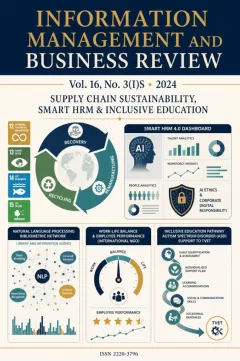 Vol. 16 No. 3(I)S (2024)
Supply Chain Sustainability, Smart HRM & Inclusive Education
View issue contents
Published
Submissions
Have research to publish? Information Management and Business Review welcomes submissions.
Make a Submission