Abstract
This research delves into the hotly contested topic of residency requirements in our country, which is now receiving a lot of attention from the media. Students at public colleges, especially those from low-income families who already face many obstacles, should pay special attention to this issue. Students who must manage the challenges of university life in addition to having to repay student loans are even more disadvantaged. Thus, the purpose of this study is to investigate the social, psychological, and financial aspects that impact the need for living on campus. 200 questionnaires in all were disseminated using Google Forms and then analyzed. The study utilized multiple regression analysis to evaluate the predictor factors that influence kids' fundamental survival needs. According to the findings, societal factors (b = -.455) had the biggest impact on the fundamental requirements of UiTM Melaka degree and diploma holders. The kids' basic needs were also strongly impacted by psychological (b = -.310) and economic (b = -.357) aspects. These results highlight the vital role that social, economic, and psychological interventions have in improving people's quality of life—not just in college settings, but also in general. The study's high R Square value (.978) indicates that these factors together account for almost all variances in quality of life. As a result, this research supports all-encompassing approaches that target these important factors to enhance people's general well-being, especially those of those who are vulnerable.
Keywords
- Psychology Search this journal for Psychology (opens in a new tab)
- Social Search this journal for Social (opens in a new tab)
- Financial Search this journal for Financial (opens in a new tab)
- Students Search this journal for Students (opens in a new tab)
- Necessities of Life Search this journal for Necessities of Life (opens in a new tab)
References
- Baumeister, R. F., & Heatherton, T. F. (1996). Self-regulation failure: An overview. Psychological Inquiry, 7(1), 1-15.
- Bayram, N., & Bilgel, N. (2008). The prevalence and socio-demographic correlations of depression, anxiety, and stress among a group of university students. Social Psychiatry and Psychiatric Epidemiology, 43(8), 667-672
- Bilgel, N., and Bayram, N. (2008). The frequency and sociodemographic relationships between stress, anxiety, and depression in a sample of college students. Social Psychiatry and Psychiatric Epidemiology. 43(8), 667–672.
- Biswas-Diener, R., and Diener, E. (2002). Does having money make you feel better subjectively? Research on Social Indicators, 57(2), 119–169.
- Brigham, E. F., Ehrhardt, M. C., Gessaroli, J., & Nason, R. (2014). Financial Management: Theory and practice (3rd Canadian ed.). Nelson Education.
- Cohen, S., & Wills, T. A. (1985). Stress, social support, and the buffering hypothesis. Psychological Bulletin, 98(2), 310-357. https://doi.org/10.1037/0033-2909.98.2.310
- Dyrbye, L. N., Thomas, M. R., & Shanafelt, T. D. (2010). Medical student distress: Causes, consequences, and proposed solutions. Mayo Clinic Proceedings, 80(12), 1613-1622.
- Erdogan, B., Ozdogan, A., & Erdogan, A. (2015) University Students’ Resilience Level: The Effect of Gender and Faculty. Procedia - Social and Behavioral Sciences, 186, 1262-1267
- Hair, J.F., Black, W.C., Babin, B.J. & Anderson, R.E. (2010). Multivariate Data Analysis. Upper Saddle River, NJ: Prentice-Hall.
- Heatherton, T. F., and Baumeister, R. F. (1996). A Resource-Depleting Approach to Self-Regulation Failure. Psychological Bulletin, 124(2), 247–259.
- Heller, D. E. (2001). The Function of Financial Assistance in Maintaining College Students. Journal of Student Financial Aid, 31(2), 16–25,
- Ilhan, T., and Rahat, E. (2016). Resilience, relational self-construal, social support, and coping strategies are factors that indicate how well students will transition to college life. Theory & Practice in Educational Sciences, 16(1), 187-208.
- Jacob, S. (2011). Higher education's financial management issues are addressed with an emphasis on students' budgeting and financial literacy. Journal of Educational and Developmental Psychology. 1(1), 94–104.
- Lee, A., Daley, M., Crawford, J., Clark, S., Brooks, R., & Maxis, R. 2007). A focus on the psychological, social, and economic obstacles is one of the factors that contribute to academic achievement in higher education. Journal of Higher Education Research, 28(3), 225–240
- Lee, S. H., and Jang, S. J. (2022). Social Affects on Academic Achievement and Student Well-Being. Journal of Higher Education Research, 15(1), 45–60.
- Markus, H. R., & Kitayama, S. (1991). Culture and the self: Implications for cognition, emotion, and motivation. Psychological Review, 98(2), 224-253. https://doi.org/10.1037/0033-295X.98.2.224
- Maslow, A.H. (1943). An explanation of human motivation. 370–396 in Psychological Review, 50(4).
- Majlis Keselamatan Malaysia. (2024) Malaysia's Mental Health Is Growing Worse. Putrajaya. retrieved from https://www.mkn.gov.my/web/ms/2023/04/13/kesihatan-mental-di-Malaysia-semakin-membimbangkan/.
- Pallant, J. (2020) SPSS: Survival Manual 7th Edition. Allen and Unwin.
- Putnam, R. D. (2000). Bowling alone: The collapse and revival of American community. Simon & Schuster.
- Rahat, E., & Ilhan, T. (2016). Coping styles, social support, relational self-construal, and resilience in predicting students' adjustment to university life. Educational Sciences: Theory and Practice, 16(1), 187-208.
- Reis, H. T., & Gable, S. L. (2003). Toward a positive psychology of relationships. In C. L. M. Keyes & J. Haidt (Eds.), Flourishing: Positive psychology and the life well-lived (pp. 129-159). American Psychological Association.
- Roberts, L. M., & Smith, J. D. (2021). Psychological support for university students: A review of mental resilience and stress management interventions. Journal of Educational Psychology, 113(5), 835-848.
- Ronnestad, M. H., and Skovholt, T. M. (2003). Challenges faced by a new counsellor or therapist. Career Development Journal, 30(1), 45–58. The doi: 10.1023/A:1025125624919
- Ryff and Singer, C. D. (1998). The characteristics of good human health. 1–28 in Psychological Inquiry, 9(1). 10.1207/s15327965pli0901_1
- Shanafelt, T. D., Thomas, M. R., and Dyrbye, L. N. (2010). An extensive analysis of psychological distress markers such as anxiety, depression, and other conditions among medical students in the United States and Canada. 354–373, Academic Medicine, 81(4). 3181d56d24 https://doi.org/10.1097/ACM.0b013e
- Smith, A., and Roberts, L. (2021). Academic performance and student well-being are influenced by psychological factors. 627–641 in Journal of Educational Psychology, 113(4).
- Schunk, D. H., and Pintrich, P. R. (2002). Theory, Research, and Applications of Motivation in Education. Pearson Training.
- Skovholt, T. M., & Ronnestad, M. H. (2003). The evolving professional self: Stages and themes in therapist and counsellor development. John Wiley & Sons.
- Turkey, A., Ozdogan, O., and B. Erdogan. (2015). Students' self-esteem and adjustment to university life. Journal of International Educational and Instructional Studies, 5(3), 35–40.
- Turner, M., Holdsworth, S., & Scott-Young, C. M. (2016). Resilience at University: the development and testing of a new measure. Higher Education Research & Development, 36(2), 386–400. https://doi.org/10.1080/07294360.2016.1185398
- Tyre, M., Simmons, D., and Griffin, L. (2016). The significance of adaptability for pupils' general well-being and academic achievement. Journal of Educational Psychology. 108(4), 593-610.
- Wan Ahmad, A. M., Mohd Ibrahim, M. S., Husein, A. and Khamis, F. M. (2018). Sample Size Calculations Made Easy Using G*Power. USM Press.
- Wang, J. 2009). an investigation into resilience traits in foreign graduate students' adjustment to US colleges. Journal of Studies in International Education. 13(1), 22–45
- World Health Organisation (WHO). (2001). New knowledge, new hope in mental health (World Health Report, 2001). World Health Organisation, Geneva. Taken from the website https://www.who.int/whr/2001/en
- Zhang, J., and Chen, H. (2021). College Students' Financial Behaviour and Financial Literacy. Journal of Financial Education, 47(1), 1-23.
Downloads
No downloads have been recorded for this article yet. Figures appear here once readers begin downloading the full text.
How to Cite
Share this article
License
Copyright (c) 2024 Ahmad Rosli Mohd Nor, Muhammad Saifullah Samsul, Khairunnisa Abd. Samad, Mohd Izwan Mahmud (Author)

This work is licensed under a Creative Commons Attribution 4.0 International License.
Author (s) should affirm that the material has not been published previously. It has not been submitted and it is not under consideration by any other journal. At the same time author (s) need to execute a publication permission agreement to assume the responsibility of the submitted content and any omissions and errors therein. After submission of revised paper in the light of suggestions of the reviewers, the editorial team edits and formats manuscripts to bring uniformity and standardization in published material.
This work will be licensed under Creative Commons Attribution 4.0 International (CC BY 4.0) and under condition of the license, users are free to read, copy, remix, transform, redistribute, download, print, search or link to the full texts of articles and even build upon their work as long as they credit the author for the original work. Moreover, as per journal policy author (s) hold and retain copyrights without any restrictions.
Keywords
- Psychology Search this journal for Psychology (opens in a new tab)
- Social Search this journal for Social (opens in a new tab)
- Financial Search this journal for Financial (opens in a new tab)
- Students Search this journal for Students (opens in a new tab)
- Necessities of Life Search this journal for Necessities of Life (opens in a new tab)
Section
Published in
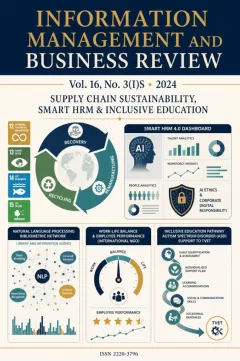 Vol. 16 No. 3(I)S (2024)
Supply Chain Sustainability, Smart HRM & Inclusive Education
View issue contents
Published
Submissions
Have research to publish? Information Management and Business Review welcomes submissions.
Make a Submission