Abstract
The increasing complexity and globalization of supply chains necessitate robust risk management strategies to ensure safety and resilience. Traditional risk assessment methods often fall short in dynamically adapting to the rapidly changing conditions and voluminous data inherent in modern supply chains. This study explores the potential of Artificial Intelligence (AI)-powered risk assessment to address these limitations in the context of Malaysia's supply chain industry. By employing AI technologies such as machine learning, IoT, and predictive analytics, organizations can significantly enhance their risk management capabilities, improving predictive accuracy, real-time monitoring, and overall operational efficiency. Through a qualitative analysis involving in-depth interviews with supply chain managers, AI experts, and technology vendors, the study identifies the strategies employed for AI integration, the perceived effectiveness of these technologies, and the challenges faced in implementation. The findings highlight the importance of robust data governance, the development of explainable AI models, and continuous skill development to overcome barriers related to data quality, model interpretability, and high implementation costs. The study concludes with recommendations for fostering a safer and more resilient logistics environment in Malaysia, emphasizing the need for comprehensive AI adoption frameworks and scalable solutions for small and medium-sized enterprises.
Keywords
References
- Al Doghan, M. A., & Sundram, V. P. K. (2023). Organization operational efficiency and Innovativeness: Exploring the role of employees’ task-based training, operational task commitment, operational engagement, and supervisor support. International Journal of Operations and Quantitative Management, 29(1), 108-127.
- Atika, S. B., Mokhtar, A. R. M., Muhamed, A. A., & Sundram, V. P. K. (2024). The mediating effect of eco-innovation on low-carbon supply chain practices toward manufacturing firm performance in Malaysia. Journal of International Logistics and Trade. DOI 10.1108/JILT-03-2023-0013
- Choi, T. Y., Rogers, D. S., & Vakil, B. (2018). Coronavirus is a wake-up call for supply chain management. Harvard Business Review. Retrieved from https://hbr.org/2020/03/coronavirus-is-a-wake-up-call-for-supply-chain-management
- Christopher, M., & Peck, H. (2004). Building the resilient supply chain. International Journal of Logistics Management, 15(2), 1-14. https://doi.org/10.1108/09574090410700275
- Guidotti, R., Monreale, A., Ruggieri, S., Turini, F., Giannotti, F., & Pedreschi, D. (2019). A survey of methods for explaining black box models. ACM Computing Surveys (CSUR), 51(5), 1-42. https://doi.org/10.1145/3236009
- Ivanov, D., Dolgui, A., & Sokolov, B. (2019). The impact of digital technology and Industry 4.0 on the ripple effect and supply chain risk analytics. International Journal of Production Research, 57(3), 829-846. https://doi.org/10.1080/00207543.2018.1488086
- Jobin, A., Ienca, M., & Vayena, E. (2019). The global landscape of AI ethics guidelines. Nature Machine Intelligence, 1(9), 389-399. https://doi.org/10.1038/s42256-019-0088-2
- Kamble, S. S., Gunasekaran, A., & Gawankar, S. A. (2020). Sustainable Industry 4.0 framework: A systematic literature review identifying the current trends and future perspectives. Process Safety and Environmental Protection, 135, 700-713. https://doi.org/10.1016/j.psep.2020.11.025
- Mkumbo, F. A. E., Ibrahim, A. R., Salleh, A. L., Sundram, V. P. K. & Atikah S. B. (2019). The Influence of Supply Chain Practices and Performance Measurement Practices towards Firm Performance, International Journal of Supply Chain Management, 8(3), 809-819.
- Narayanan, N. S. P., Ghapar, F., Chew, L. L., Sundram, V. P. K., Jayamani, U., & Muhammad, A. (2024a). Measuring the Unmeasured: Exploring the Concept of “Supply Chain Quotient”[SCQ]. Information Management and Business Review, 16(2 (I) S), 36-43.
- Narayanan, N. S. P., Ghapar, F., Chew, L. L., Sundram, V. P. K., Jayamani, U., & Muhammad, A. (2024b). Optimizing Working Capital Management in Supply Chain Finance: A Multi-Dimensional Approach. Information Management and Business Review, 16(2 (I) S), 44-52.
- Othman, N. A. F., Izhan, F. F. A., Sundram, V. P. K., Majid, M., Din, S. Z. M., Munir, Z. A., & Razali, M. Z. M. (2023). Modeling workplace ostracism among workforces amid pandemic outbreaks. Information Management and Business Review, 15(4 (SI) I), 86-93.
- Papadopoulos, T., Gunasekaran, A., Dubey, R., Fosso Wamba, S., & Childe, S. J. (2017). Big data and analytics in operations and supply chain management: Managerial aspects and practical challenges. Production Planning & Control, 28(11-12), 873-876. https://doi.org/10.1080/09537287.2017.1336795
- Riahi, Y., Saidi, M., & Jabbehdari, S. (2021). The challenges of AI in supply chain risk management: A case study. Procedia Computer Science, 181, 644-653. https://doi.org/10.1016/j.procs.2021.01.202
- Russell, S. J., & Norvig, P. (2020). Artificial intelligence: A modern approach (4th ed.). Pearson.
- Selvaraju, M., Beleya, P., & Sundram, V. P. K. (2017). Supply chain cost reduction using mitigation & resilient strategies in the hypermarket retail business. International Journal of Supply Chain Management, 6(2), 116-121.
- Sivan, S., Anuar, R., Krishnasamy, T., Bahrin, A. S., Narayanan, N. S. P., & Sundram, V. P. K. (2024a). Optimizing Safety Practices and Culture: A Comprehensive Examination through Perception Surveys in Malaysia's Logistics Industry. Information Management and Business Review, 16(1 (I) S), 33-38.
- Sivan, S., Anuar, R., Krishnasamy, T., Bahrin, A. S., Narayanan, N. S. P., & Sundram, V. P. K. (2024b). Integrating Safety Practices into the Supply Chain for Sustainable Development in Malaysia's Building Construction Sites. Information Management and Business Review, 16(1 (I) S), 24-32.
- Sivan, S., Ghadiri, S. M., Rajagopal, P., Bahrin, A. S., & Sundram, V. P. K. (2022). Adoption and benefit of industrial revolution 4.0 in the logistics industry: A conceptual paper. Journal of Entrepreneurship Business and Economics, 10(2S1), 79-94.
- Sundram, V. P. K., Chandran, V. G. R., Atikah, S. B., Rohani, M., Nazura, M. S., Akmal, A. O., & Krishnasamy, T. (2016). Research methodology: Tools, methods, and techniques. MLSCA, Selangor.
- Sundram, V. P. K., Rajagopal P., Atikah S. B. & Subramaniam, G. (2018). The Role of Supply Chain Integration on Green Practices and Performance in a Supply Chain Context: A Conceptual Approach to Future Research, International Journal of Supply Chain Management, 7(1), 95-104.
- Sundram, V. P. K., Rajagopal P., Nur Atiqah Z. A., Atikah S. B. & Appasamy, G. Zarina, A. M. (2018). Supply Chain Responsiveness in an Asian Global Electronic Manufacturing Firm: ABX Energy (M), International Journal of Supply Chain Management, 7(2), 23-31.
- Sundram, V. P. K., Rajagopal, P., Nur Atiqah, Z. A., Atikah, S. B., Appasamy, G., & Zarina, A. M. (2018). Supply chain responsiveness in an Asian global electronic manufacturing firm: ABX energy (M). International Journal of Supply Chain Management, 7(2), 23-31.
- Sundram, V.P.K., Ghapar, Chew, LL and Muhammad, A. (2023). Engaging Lean Six Sigma Approach Using DMAIC Methodology for Supply Chain Logistics Recruitment Improvement, Information Management and Business Review 15 (2), 46-53.
- Sundram, V.P.K., Ghapar, F. Osman, MF., Chew, LL and Muhammad, A. (2023). Lean Six-Sigma Approach for Sub-Contract Licensing and its Process Improvement across the Manufacturing Supply Chain using GUT Priority Matrix, Information Management and Business Review 15 (2), 1-8.
- Tang, C. S. (2006). Perspectives in supply chain risk management. International Journal of Production Economics, 103(2), 451-488. https://doi.org/10.1016/j.ijpe.2005.12.006
- Vatumalae, V., Rajagopal, P., & Sundram, V. P. K. (2020). Warehouse operations measurement in hypermarket retailers: A review of the literature. International Journal of Supply Chain Management, 9(5), 1276.
- Vatumalae, V., Rajagopal, P., Sundram, V. P. K., & Hua, Z. (2022). A study of retail hypermarket warehouse inventory management in Malaysia. SMART Journal of Business Management Studies, 18(1), 71-79.
- Wamba, S. F., & Akter, S. (2019). Understanding supply chain analytics capabilities and agility for data-rich environments. International Journal of Operations & Production Management, 39(6), 887-912. https://doi.org/10.1108/IJOPM-01-2019-0025
- Wang, G., Gunasekaran, A., Ngai, E. W., & Papadopoulos, T. (2020). Big data analytics in logistics and supply chain management: Certain investigations for research and applications. International Journal of Production Economics, 159, 193-210. https://doi.org/10.1016/j.ijpe.2014.04.021
- Zetty Zahureen, M. Y., Nur Zahidah, B., Ismadi I., Bujang, I. & Sundram, V.P.K. (2020), Quantitative Research Methods, Asian Academy, Petaling Jaya, Malaysia.
Downloads
No downloads have been recorded for this article yet. Figures appear here once readers begin downloading the full text.
How to Cite
Share this article
License
Copyright (c) 2024 N. Sureshkumar PP Narayanan, Farha Ghapar, Li Lian Chew, Veera Pandiyan Kaliani Sundram, Babudass M.Naidu, Mohd Hafiz Zulfakar, Azimah Daud (Author)

This work is licensed under a Creative Commons Attribution 4.0 International License.
Author (s) should affirm that the material has not been published previously. It has not been submitted and it is not under consideration by any other journal. At the same time author (s) need to execute a publication permission agreement to assume the responsibility of the submitted content and any omissions and errors therein. After submission of revised paper in the light of suggestions of the reviewers, the editorial team edits and formats manuscripts to bring uniformity and standardization in published material.
This work will be licensed under Creative Commons Attribution 4.0 International (CC BY 4.0) and under condition of the license, users are free to read, copy, remix, transform, redistribute, download, print, search or link to the full texts of articles and even build upon their work as long as they credit the author for the original work. Moreover, as per journal policy author (s) hold and retain copyrights without any restrictions.
Keywords
Section
Published in
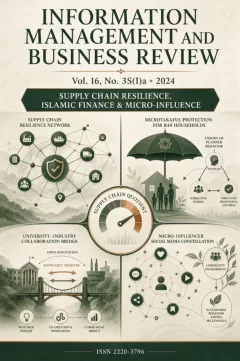 Vol. 16 No. 3S(I)a (2024)
Supply Chain Resilience, Islamic Finance & Micro-Influence
View issue contents
Published
Submissions
Have research to publish? Information Management and Business Review welcomes submissions.
Make a Submission