Abstract
Artificial intelligence (AI) has emerged as a powerful tool, enabling online retailers to offer highly personalized shopping experiences tailored to individual preferences and behaviors. As e-commerce continues to grow in Malaysia, understanding the influence of AI and personalization marketing on consumer purchase intentions has become increasingly important for businesses seeking to remain competitive. However, the rapid adoption of AI also raises concerns about data privacy, ethical AI usage, and compliance with emerging data protection regulations, such as Malaysia’s Personal Data Protection Act (PDPA). This study aims to explore the potential impact of artificial intelligence (AI) and personalization marketing on consumer purchase intention within the Malaysian e-commerce market. By reviewing previous literature and theoretical frameworks, the study explores how the use of AI tools including predictive analytics automation, and personalization experiences might influence consumer behavior in online shopping environments. The study adopts a quantitative approach, in which quota sampling will be used for the participant selection. A selfadministered questionnaire with a five-point Likert scale will be employed to gather data from e-commerce users in Malaysia. Partial Least Squares – Structural Equation Modelling (PLS-SEM) is proposed as the method for analyzing the anticipated relationships between predictive analytics, automation, personalization, and purchase intention. The findings from this study have important implications for both e-commerce businesses and policymakers in Malaysia. For businesses, understanding which aspects of AI and personalization most influence consumer purchase intentions can help them strategically implement these technologies to enhance customer engagement and drive sales. For policymakers, the study highlights the need to consider ethical and legal issues, such as data privacy and policy issues, in the growing use of AI in the e-commerce market.
Keywords
- Artificial Intelligence Search this journal for Artificial Intelligence (opens in a new tab)
- Predictive Analytics Search this journal for Predictive Analytics (opens in a new tab)
- Automation Search this journal for Automation (opens in a new tab)
- Personalization Marketing Search this journal for Personalization Marketing (opens in a new tab)
- Customer Purchase Intention Search this journal for Customer Purchase Intention (opens in a new tab)
References
- Ahmad, N., Ali, M., & Karim, A. (2023). The impact of e-commerce platforms on consumer purchase behavior in Malaysia. International Journal of E-commerce Studies, 15(2), 123-140.
- Ajzen, I. (1991). The theory of planned behavior. Organizational Behavior and Human Decision Processes, 50(2), 179-211.
- Ansari, A., Koenigsberg, O., & Stahl, F. (2022). The Role of Personalization in Customer Engagement and Purchase Decisions. Journal of Marketing Research, 59(4), 678-692.
- Arora, N., Lodish, L., & Rawal, V. (2021). Evaluating the effectiveness of personalization in digital marketing. Marketing Science, 40(3), 539-558.
- Bansal, R. and T. Bansal (2023). "Impact of Artificial Intelligence on Online Buying Behaviour in E-Commerce." 484-489. DOI 10.1109/ICACCTech61146.2023.00085
- Choi, J., Lee, K., & Kim, S. (2022). Predictive analytics in marketing: A review and future directions. Journal of Business Research, 145, 99-110.
- Choudhury, P., Ghosh, D., & Kadiyali, V. (2023). Data-driven personalization: Enhancing marketing effectiveness and customer loyalty. Journal of Interactive Marketing, 58, 72-88.
- Davis, F. D. (1989). Perceived usefulness, perceived ease of use, and user acceptance of information technology. MIS Quarterly, 13(3), 319-340.
- eMarketer. (2024). Social commerce sales in Malaysia. Retrieved from [eMarketer]( https://www.emarketer.com)
- Gefen, D., Karahanna, E., & Straub, D. W. (2003). Trust and TAM in online shopping: An integrated model. MIS Quarterly, 27(1), 51-90.
- Grewal, D., Roggeveen, A. L., & Nordfält, J. (2020). The future of retailing. Journal of Retailing, 96(1), 69-82.
- Huang, M. H., & Rust, R. T. (2020). Engaged with a robot? The role of AI in service. Journal of Service Research, 23(2), 155-176. https://doi.org/10.1177/1094670519846188
- Huang, M. H., & Rust, R. T. (2021). A framework for collaborative artificial intelligence in marketing. Journal of Retailing, 97(1), 81-96. https://doi.org/10.1016/j.jretai.2020.10.002
- Hwang, J., Kim, Y., & Yang, H. (2023). The Impact of AI-driven Personalization on Email Marketing Effectiveness. Journal of Marketing Analytics, 11(1), 45-59.
- Kapoor, K. K., Dwivedi, Y. K., & Piercy, N. C. (2021). The influence of social media on consumer behavior: An empirical study on factors influencing the decision-making process of consumers. Journal of Retailing and Consumer Services, 58, 102282.
- Kaplan, A., & Haenlein, M. (2019). Siri, Siri, in my hand: Who's the fairest in the land? On the interpretations, illustrations, and implications of artificial intelligence. Business Horizons, 62(1), 15-25. https://doi.org/10.1016/j.bushor.2018.08.004
- Kim, S., & Kim, J. (2022). The role of digital experience quality in shaping consumer purchase intentions. Journal of Interactive Marketing, 58, 45-60.
- Kordzadeh, N., & Gable, G. (2023). The impact of personalized digital experiences on user retention and conversion rates. International Journal of Information Management, 65, 187-200.
- Kotler, P., & Keller, K. L. (2016). Marketing Management (15th ed.). Pearson Education.
- Kumar, V., Aksoy, L., & Donkers, B. (2023). Automation in marketing: A review of recent developments and future research directions. Marketing Science, 42(3), 415-430.
- Kumar, V., Rajan, B., Gupta, S., & Pozza, I. D. (2021). Customer engagement in service. Journal of the Academy of Marketing Science, 49, 304-328.
- Lee, J., & Kim, H. (2022). Social influence and personalized marketing: Exploring the effects on consumer purchase intentions. Journal of Consumer Psychology, 32(4), 567-580.
- Lee, J., Park, J., & Han, J. (2023). The influence of social proof and user reviews on consumer purchase intentions. Journal of Consumer Research, 50(1), 112-127.
- Lim, S., & Lee, J. (2022). Social commerce in Malaysia: Integration of social media and e-commerce platforms. Journal of Digital Commerce, 9(3), 75-90.
- Lambrecht, A. and C. E. Tucker (2020). Apparent algorithmic discrimination and real-time algorithmic learning in digital search advertising. Available at SSRN 3570076.
- Lommatzsch, A., Düring, M., & Koehler, J. (2020). The impact of AI-driven personalization on consumer behavior. International Journal of Information Management, 54, 102197.
- Luo, X., Tong, S., Fang, Z., & Qu, Z. (2019). Frontiers: Machines vs. humans: The impact of artificial intelligence chatbot disclosure on customer purchases. Marketing Science, 38(6), 937-947. https://doi.org/10.1287/mksc.2019.1192
- Luo, X., Zhang, J., & Xu, H. (2021). The effectiveness of chatbots in enhancing customer engagement and satisfaction. Journal of Interactive Marketing, 55, 1-16.
- Malaysian Communications and Multimedia Commission (MCMC). (2023). Internet user survey report. Retrieved from [MCMC]( https://www.mcmc.gov.my)
- Nguyen, T. H., & Simkin, L. (2022). Artificial intelligence and personalized marketing: A review and research agenda. Journal of Business Research, 135, 463-472.
- Qin, Y., & Jiang, Z. (2021). The effect of artificial intelligence (AI) recommendation systems on consumer purchase intention: The moderating role of user innovativeness. Electronic Commerce Research and Applications, 47, 101037. https://doi.org/10.1016/j.elerap.2021.101037
- Rahman, Z., Ali, M., & Fong, W. K. (2021). AI in e-commerce: A study of Malaysian market dynamics. Journal of Retailing and Consumer Services, 62, 102614.
- Statista. (2023). E-commerce market value in Malaysia. Retrieved from [Statista]( https://www.statista.com)
- Sundar, S. S., Tamul, D. J., & Wu, M. (2019). Unlocking the potential of AI in advertising: Machine learning in online advertising. Journal of Advertising Research, 59(2), 119-134.
- Sun, Y., & Zhang, X. (2022). The impact of artificial intelligence on consumer decision-making: An integrated model of TAM and trust. Electronic Commerce Research and Applications, 53, 101118.
- Taylor, T. (2024). 20 artificial intelligence statistics that marketers need to know in 2023. HubSpot. Retrieved from [HubSpot]( https://blog.hubspot.com/marketing/artificial-intelligence-stats)
- Tan, B., Ng, S., & Tan, C. (2024). The rise of mobile commerce in Malaysia: Trends and implications. Asian Journal of E-commerce, 11(1), 45-60.
- Venkatesh, V., & Davis, F. D. (2000). A theoretical extension of the Technology Acceptance Model: Four longitudinal field studies. Management Science, 46(2), 186-204.
- Wang, Y., & Zhang, L. (2023). Enhancing customer purchase intentions through AI-driven personalization: An empirical study. International Journal of Information Management, 64, 102-114.
- Yadav, M. S., & Pavlou, P. A. (2020). Technology-enabled interactions in digital
- Environments: a conceptual foundation for current and future research. Journal of the
- Academy of Marketing Science, 48(1), 132-136.
- Zhang, X., Wang, M., & Zhou, L. (2023). The role of artificial intelligence in personalized marketing: A review and research agenda. Journal of Marketing Research, 60(1), 15-30.
- Zhang, Y., Wang, C., & Zhang, H. (2023). The impact of personalization on consumer purchase intentions in digital marketing. Journal of Digital Marketing, 12(2), 35-50.
Downloads
No downloads have been recorded for this article yet. Figures appear here once readers begin downloading the full text.
How to Cite
Share this article
License
Copyright (c) 2024 Mohamad Fariz Abdullah, Muhamad Azman Ibrahim, Azlin Zanariah Bahtar, Noor Rita Mohamad Khan (Author)

This work is licensed under a Creative Commons Attribution 4.0 International License.
Author (s) should affirm that the material has not been published previously. It has not been submitted and it is not under consideration by any other journal. At the same time author (s) need to execute a publication permission agreement to assume the responsibility of the submitted content and any omissions and errors therein. After submission of revised paper in the light of suggestions of the reviewers, the editorial team edits and formats manuscripts to bring uniformity and standardization in published material.
This work will be licensed under Creative Commons Attribution 4.0 International (CC BY 4.0) and under condition of the license, users are free to read, copy, remix, transform, redistribute, download, print, search or link to the full texts of articles and even build upon their work as long as they credit the author for the original work. Moreover, as per journal policy author (s) hold and retain copyrights without any restrictions.
Keywords
- Artificial Intelligence Search this journal for Artificial Intelligence (opens in a new tab)
- Predictive Analytics Search this journal for Predictive Analytics (opens in a new tab)
- Automation Search this journal for Automation (opens in a new tab)
- Personalization Marketing Search this journal for Personalization Marketing (opens in a new tab)
- Customer Purchase Intention Search this journal for Customer Purchase Intention (opens in a new tab)
Section
Published in
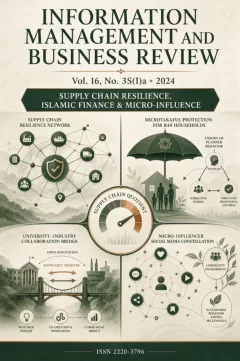 Vol. 16 No. 3S(I)a (2024)
Supply Chain Resilience, Islamic Finance & Micro-Influence
View issue contents
Published
Submissions
Have research to publish? Information Management and Business Review welcomes submissions.
Make a Submission