Abstract
Stress remains one of the most difficult challenges in responding to various situations. It elicits negative thoughts and feelings in the person. Counseling, training, exercise, and other methods effectively reduce stress. However, with the advancement of technology, different approaches to dealing with it have emerged. One of the types of digital health applications was stress relief applications. This application was starting to become famous as an alternative to help individuals manage their stress levels. Numerous stressmanagement or stress-relief applications are available for smartphones and tablets. These applications include a variety of stress-reduction techniques, including meditation, mindfulness breathing, cognitive behavioral therapy, and relaxation techniques . This review paper explores the psychological factors influencing the usage of stress relief applications. In this review paper, researchers focused on perceived stress, motivation for selfcare, and cognitive engagement. Understanding these psychological factors can help the individual experiencing high stress levels to utilize the stress relief application. Besides, for the application developers, it gives the idea to create compelling digital tools that cater to users' specific needs and preferences, ultimately promoting better stress management and overall well-being.
Keywords
- Stress-Relief Application Search this journal for Stress-Relief Application (opens in a new tab)
- Psychological Factors Search this journal for Psychological Factors (opens in a new tab)
- Perceived Stress Search this journal for Perceived Stress (opens in a new tab)
- Motivation for Self-Care Search this journal for Motivation for Self-Care (opens in a new tab)
- Cognitive Engagement Search this journal for Cognitive Engagement (opens in a new tab)
- Review Paper Search this journal for Review Paper (opens in a new tab)
References
- Albdour, M. M., Hong, J. S., & Jenuwine, E. S. (2024). Consequences of high school bullying on stress and health of Arab American college students. Journal of Child and Adolescent Psychiatric Nursing : Official Publication of the Association of Child and Adolescent Psychiatric Nurses, Inc, 37(1). https://doi.org/10.1111/jcap.12453
- Alhasani, M., Mulchandani, D., Oyebode, O., & Orji, R. (2020). A Systematic Review of Persuasive Strategies in Stress Management Applications. BCSS@ PERSUASIVE.
- Alhasani, M., Oyebode, O., Baghaei, N., Mulchandani, D., & Orji, R. (2022). A Systematic and Comparative Review of Behavior Change Strategies in Stress Management Applications: Opportunities for Improvement. Frontiers in Public Health, 10. https://doi.org/10.3389/fpubh.2022.777567
- Alkhawaldeh, J. M., Mukhtar, F., Anshasi, H. A., Alkhawaldeh, H. M., Peng, O. C., Al?Amer, R., & Soh, K. L. (2020). Stress management training program for stress reduction and coping improvement in public health nurses: A randomized controlled trial. Journal of Advanced Nursing, 76(11), 3123–3135. https://doi.org/10.1111/jan.14506
- Apolinário-Hagen, J., Fritsche, L., Breil, B., Drüge, M., & Hennemann, S. (2019). Determinant Factors of Public Acceptance of Stress Management Applications: Survey Study (Preprint). jmir. https://doi.org/10.2196/preprints.15373
- Bakker, D., Kazantzis, N., Rickwood, D., & Rickard, N. (2016). Mental health smartphone applications: Review and evidence-based recommendations for future developments. JMIR Mental Health, 3(1), e7.
- Balieva, F., Schut, C., Kupfer, J., Lien, L., Misery, L., Sampogna, F., von Euler, L., & Dalgard, F. J. (2022). Perceived stress in patients with inflammatory and non?inflammatory skin conditions. An observational controlled study among 255 Norwegian dermatological outpatients. Skin Health and Disease, 2(4). https://doi.org/10.1002/SKI2.162)
- Beck, A. T. (1976). Cognitive Therapy and the Emotional Disorders. New York: International Universities Press.
- Chan, B., Buckley, T., & Tofler, G. H. (2023). Emotional Stress and Physical Exertion as Triggers of Acute Myocardial Infarction. The American Journal of Cardiology, 203, 285–287. https://doi.org/10.1016/J.AMJCARD.2023.07.085)
- Danilo, M., Wolfgang, L., Nikolaos, K., Brian, S., Schwartz., D, B. (2023). 1. Symptom Reduction and Engagement in a Cognitive-Behavioral Mobile Phone App: A Study of User Profiling to Determine Prognostic Indicators. Behavior Therapy, doi: 10.1016/j.beth.2023.05.014
- Gurgevich, S., & Nicolai, J. P. (2014). Obesity and the Stress Connection: Mind-Body Therapies for Weight Control (pp. 413–421). Springer New York. https://doi.org/10.1007/978-1-4939-0548-5_28
- Hoffman, L., Kaluma, D., Benedetto, E., Mann, Z., Torous, J., Grossman, E., & Huang, H. (2019). Augmenting Mental Health in Primary Care: A 1-Year Study of Deploying Smartphone Applications in a Multi-site Primary Care/Behavioral Health Integration Program. Frontiers in Psychiatry, 10. https://doi.org/10.3389/fpsyt.2019.00094
- Holtz, B. E., Kanthawala, S., Martin, K., Nelson, V., & Parrott, S. (2023). Young adults' adoption and use of mental health applications: efficient, effective, but no replacement for in-person care. Journal of American College Health, ahead-of-print(ahead-of-print), 1–9. https://doi.org/10.1080/07448481.2023.2227727
- Hwang, H., Kim, S. M., Netterstrøm, B., & Han, D. H. (2022). The Efficacy of a Smartphone-Based App on Stress Reduction: Randomized Controlled Trial. Journal of Medical Internet Research, 24(2). https://doi.org/10.2196/28703
- Jaworski, B. K., Taylor, K., Senti, S., Ramsey, K. M., Pietrzak, R. H., Heinz, A. J., Mackintosh, M.-A., Rosen, C. S., & Owen, J. E. (2023). Mental health applications and U.S. military veterans: Perceived importance and utilization of the National Center for Posttraumatic Stress Disorder app portfolio. Psychological Services, 21(3). https://doi.org/10.1037/ser0000806
- Kashyap, S., Liddell, B. J., Keegan, D., Thomson, T., & Nickerson, A. (2020). An Interaction Model of Environmental and Psychological Factors Influencing Refugee Mental Health. Journal of Traumatic Stress, 34(1), 257–266. https://doi.org/10.1002/jts.22636
- Kosasih, E., Margaroli, F., Gelli, S., Aziz, A., Wildgoose, N., & Brintrup, A. (2022). Towards knowledge graph reasoning for supply chain risk management using graph neural networks. International Journal of Production Research. 62. 1-17. 10.1080/00207543.2022.2100841.
- Langer, K., Jentsch, L. V. & Wolf, T. O. (2023). Rapid effects of acute stress on cognitive emotion regulation, Psychoneuroendocrinology, 151, 106054,
- Lehman, K. A., Burns, M. N., Gagen, E. C., & Mohr, D. C. (2012). Development of the Brief Inventory of Perceived Stress. Journal of Clinical Psychology, 68(6), 631–644. https://doi.org/10.1002/JCLP.21843/ABSTRACT
- Linardon, J., Firth, J., Torous, J., Messer, M., & Fuller-Tyszkiewicz, M. (2024). Efficacy of mental health smartphone applications on stress levels: a meta-analysis of randomized controlled trials. In Health Psychology Review: Vol. ahead-of-print(Issue ahead-of-print). Routledge. https://doi.org/10.1080/17437199.2024.2379784
- Linardon, J., Firth, J., Torous, J., Messer, M., & Fuller-Tyszkiewicz, M. (2024). Efficacy of mental health smartphone applications on stress levels: a meta-analysis of randomized controlled trials. In Health Psychology Review: Vol. ahead-of-print(Issue ahead-of-print). Routledge. https://doi.org/10.1080/17437199.2024.2379784
- Mcgee-Vincent, P., Juhasz, K., Jamison, A. L., Avery, T. J., Owen, J. E., Jaworski, B. K., & Blonigen, D. M. (2021). Mobile Mental Health Applications from the National Center for PTSD: Digital Self-Management Tools for Co-Occurring Disorders. Journal of Dual Diagnosis, 17(3), 181–192. https://doi.org/10.1080/15504263.2021.1939919
- Melumad, S., & Pham, M. T. (2020). The smartphone is a pacifying technology. Journal of Consumer Research, 47(2), 237-255.
- Nazlin Kamaruzaman, K., Hussein, Z., & Fikry, A. (2023). Factors Affecting Behavioural Intention to Use Mobile Health Applications among Obese People in Malaysia. European Journal of Business Science and Technology, 9(1). https://doi.org/10.11118/ejobsat.2023.002
- Nogueira-Leite, D., Cruz-Correia, R., & Marques-Cruz, M. (2024). Individuals' attitudes toward digital mental health applications and implications for adoption in Portugal: web-based survey. BMC Medical Informatics and Decision Making, 24(1). https://doi.org/10.1186/s12911-024-02488-1
- Nogueira-Leite, D., Cruz-Correia, R., & Marques-Cruz, M. (2024). Individuals' attitudes toward digital mental health applications and implications for adoption in Portugal: web-based survey. BMC Medical Informatics and Decision Making, 24(1). https://doi.org/10.1186/s12911-024-02488-1
- Oyebode, O., Alqahtani, F., & Orji, R. (2020). Using machine learning and thematic analysis methods to evaluate mental health applications based on user reviews. IEEE Access, 8, 111141-111158.
- Paler, E. A., Claret, M. D., O Poblete, M.-L., C Alarde, G. F., & Mamauag, M. B. (2019). College Students' Stressors And Coping Techniques: A Precursor To Good Mental Health. The Malaysian Journal of Nursing, 11(01), 31–37. https://doi.org/10.31674/mjn.2019.v11i01.005
- Pop-Jordanova, N., Radojkova-Nikolovska, V., Markovska-Simoska, S., & Author, C. (2013). Perceived Stress In Dental Practice. Manu Contributions. Sec. Med. Sci., XXXIV, 2.
- Saini, S., Panjwani, D., & Saxena, N. (2022). Mobile Mental Health Applications: Alternative Intervention or Intrusion? Cornell University. https://doi.org/10.48550/arxiv.2206.10728
- Shamsi, S. G., & Chaube, A. (2024). CalmSense – Stress Monitoring & Stress Reducing Mobile Application. Gurukul International Multidisciplinary Research Journal, 3–12. https://doi.org/10.69758/fkuy1992
- Wasil, A. R., Gillespie, S., Patel, R., Petre, A., Venturo-Conerly, K. E., Shingleton, R. M., Weisz, J. R., & DeRubeis, R. J. (2020). Reassessing evidence-based content in popular smartphone applications for depression and anxiety: Developing and applying user-adjusted analyses. Journal of Consulting and Clinical Psychology, 88(11), 983.
- Wo?owska, A., & Górska, E. (2018). Experiencing stress by primary school students. Acta Universitatis Nicolai Copernici Pedagogika, 34, 205. https://doi.org/10.12775/aunc_ped.2017.022
- Y?lmaz Ko?ar, E., & Ko?ar, H. (2024). A systematic review and meta?analytic confirmatory factor analysis of the perceived stress scale (PSS?10 and PSS?14). Stress and Health, 40(1). https://doi.org/10.1002/SMI.3285)
Downloads
No downloads have been recorded for this article yet. Figures appear here once readers begin downloading the full text.
How to Cite
Share this article
License
Copyright (c) 2024 Khairul Nazlin Kamaruzaman, Amily Fikry, Rozita Manshor (Author)

This work is licensed under a Creative Commons Attribution 4.0 International License.
Author (s) should affirm that the material has not been published previously. It has not been submitted and it is not under consideration by any other journal. At the same time author (s) need to execute a publication permission agreement to assume the responsibility of the submitted content and any omissions and errors therein. After submission of revised paper in the light of suggestions of the reviewers, the editorial team edits and formats manuscripts to bring uniformity and standardization in published material.
This work will be licensed under Creative Commons Attribution 4.0 International (CC BY 4.0) and under condition of the license, users are free to read, copy, remix, transform, redistribute, download, print, search or link to the full texts of articles and even build upon their work as long as they credit the author for the original work. Moreover, as per journal policy author (s) hold and retain copyrights without any restrictions.
Keywords
- Stress-Relief Application Search this journal for Stress-Relief Application (opens in a new tab)
- Psychological Factors Search this journal for Psychological Factors (opens in a new tab)
- Perceived Stress Search this journal for Perceived Stress (opens in a new tab)
- Motivation for Self-Care Search this journal for Motivation for Self-Care (opens in a new tab)
- Cognitive Engagement Search this journal for Cognitive Engagement (opens in a new tab)
- Review Paper Search this journal for Review Paper (opens in a new tab)
Section
Published in
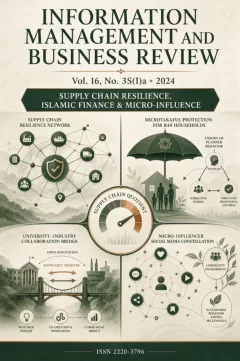 Vol. 16 No. 3S(I)a (2024)
Supply Chain Resilience, Islamic Finance & Micro-Influence
View issue contents
Published
Submissions
Have research to publish? Information Management and Business Review welcomes submissions.
Make a Submission