Abstract
This study explores the key factors influencing customer satisfaction with food delivery services at UiTM Puncak Alam, Selangor. Despite the rising demand for food delivery services, issues surrounding the quality and accuracy of delivered food remain significant challenges. This study seeks to address these concerns by identifying and analyzing the determinants that shape customer satisfaction with food delivery services in Malaysia, specifically in Puncak Alam. We adopted a quantitative research approach to gain comprehensive insights into these issues. We collected data using judgment sampling, a non-probability sampling technique and used the Statistical Package for Social Sciences (SPSS) to analyze the responses through descriptive statistics and correlational analysis. The study involved a structured survey of 357 respondents, investigating the impact of three key variables—food quality, app ease of use, and food packaging—on customer satisfaction. The findings provide important implications for businesses and institutions looking to enhance the quality of food delivery services and elevate customer satisfaction levels. By identifying these critical factors, the research offers valuable insights that can help food service providers, policymakers, and industry stakeholders refine their strategies. These insights will not only improve the customer experience but also encourage broader adoption of food delivery services within the Malaysian population. Ultimately, the study’s conclusions hold significance for enhancing service quality and fostering customer loyalty in the increasingly competitive food delivery industry.
Keywords
- Customer Satisfaction Search this journal for Customer Satisfaction (opens in a new tab)
- Food Delivery Service Search this journal for Food Delivery Service (opens in a new tab)
- Food Quality Search this journal for Food Quality (opens in a new tab)
- Food Packaging Search this journal for Food Packaging (opens in a new tab)
References
- Alamri, M. S., Qasem, A. A., Mohamed, A. A., Hussain, S., Ibraheem, M. A., Shamlan, G., ... & Qasha, A. S. (2021). Food packaging’s materials: A food safety perspective. Saudi Journal of Biological Sciences, 28(8), 4490-4499.
- Alden, S. M., Rosshahpudin, N. S., Tarmazi, S. A. A., Sulaiman, S., & Ali, N. M. (2023). Food Delivery Service: The Effects of Perceived Quality, Perceived Ease of Use and Perceived Value Towards Customer Satisfaction. Journal of Tourism Hospitality and Environment Management, 8(32), 88-98.
- Ahsan Ansari, M. U., & Siddiqui, D. A. (2019). Packaging features and consumer buying behavior towards packaged food items. Ansari, MUA and Siddiqui, DA (2019). Packaging Features and Consumer Buying Behavior Towards Packaged Food Items. Global Scientific Journal, 7(3), 1050-1073.
- Banerjee, S. P., Jain, D., & Nayyar, R. (2019). Measuring service quality of food delivery services: a study of generation Z. African Journal of Hospitality, Tourism and Leisure, 8(2), 1-12.
- Chai, L. T., & Yat, D. N. C. (2019). Online food delivery services: Making food delivery the new normal. Journal of Marketing Advances and Practices, 1(1), 62-77.
- Chowdhury, R. (2023). Impact of perceived convenience, service quality and security on consumers’ behavioral intention towards online food delivery services: the role of attitude as mediator. SN Business & Economics, 3(1), 29.
- Dazmin, D., & Ho, M. Y. (2019). The relationship between consumers’ price-saving orientation and time-saving orientation towards food delivery intermediaries (FDI) services: an exploratory study. Gsj, 7(2).
- Jun, K., Yoon, B., Lee, S., & Lee, D.-S. (2021). Factors influencing customer decisions to use online food delivery service during the COVID-19 pandemic. Foods, 11(1), 64.
- Mehrolia, S., Alagarsamy, S., & Solaikutty, V. M. (2021). Customers' response to online food delivery services during the COVID?19 outbreak using binary logistic regression. International journal of consumer studies, 45(3), 396-408.
- Rombach, M., Kartikasari, A., Dean, D. L., Suhartanto, D., & Chen, B. T. (2023). Determinants of customer loyalty to online food service delivery: evidence from Indonesia, Taiwan, and New Zealand. Journal of Hospitality Marketing & Management, 32(6), 818-842.
- Saad, A. T. (2021). Factors affecting online food delivery service in Bangladesh: an empirical study. British Food Journal, 123(2), 535-550.
- Tan, H., & Kim, V. W. E. (2021). Examining the Factors that Influence Consumer Satisfaction with Online Food Delivery in Klang Valley, Malaysia. The Journal of Management Theory and Practice (JMTP), 88–95.
- Wen, H., Pookulangara, S., & Josiam, B. M. (2022). A comprehensive examination of consumers' intentions to use food delivery apps. British Food Journal, 124(5), 1737-1754.
Downloads
No downloads have been recorded for this article yet. Figures appear here once readers begin downloading the full text.
How to Cite
Share this article
License
Copyright (c) 2024 Ainol Fizy Ruslan, Shamsul Azren Mohd Shukur, Nur Aizureen binti Anwar, Mohd Fahimi bin Ahmad Faculty (Author)

This work is licensed under a Creative Commons Attribution 4.0 International License.
Author (s) should affirm that the material has not been published previously. It has not been submitted and it is not under consideration by any other journal. At the same time author (s) need to execute a publication permission agreement to assume the responsibility of the submitted content and any omissions and errors therein. After submission of revised paper in the light of suggestions of the reviewers, the editorial team edits and formats manuscripts to bring uniformity and standardization in published material.
This work will be licensed under Creative Commons Attribution 4.0 International (CC BY 4.0) and under condition of the license, users are free to read, copy, remix, transform, redistribute, download, print, search or link to the full texts of articles and even build upon their work as long as they credit the author for the original work. Moreover, as per journal policy author (s) hold and retain copyrights without any restrictions.
Keywords
- Customer Satisfaction Search this journal for Customer Satisfaction (opens in a new tab)
- Food Delivery Service Search this journal for Food Delivery Service (opens in a new tab)
- Food Quality Search this journal for Food Quality (opens in a new tab)
- Food Packaging Search this journal for Food Packaging (opens in a new tab)
Section
Published in
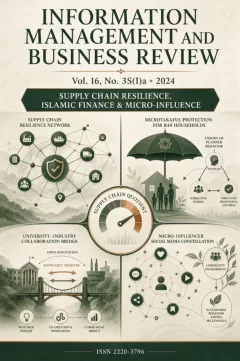 Vol. 16 No. 3S(I)a (2024)
Supply Chain Resilience, Islamic Finance & Micro-Influence
View issue contents
Published
Submissions
Have research to publish? Information Management and Business Review welcomes submissions.
Make a Submission