Abstract
Ethics plays a vital role across all fields. However, significant attention has been directed toward addressing citizen complaints about unethical behavior in public and private institutions. These complaints primarily concern corruption and unethical conduct in the execution of duties and service delivery. This article systematically reviews 11 theoretical and empirical journal articles focusing on ethical work behavior in public and private institutions. The selected studies were evaluated based on the following themes: (1) the impact of ethical leadership on ethical work behavior, (2) the role of Islamic work ethics in shaping ethical work behavior, and (3) the methodological approaches employed in studies of ethical leadership, Islamic work ethics and ethical work behavior. Relevant articles were identified using university electronic databases, such as Scopus and Emerald Insight and meta-analytical techniques were applied to systematically analyze and synthesize the literature. The findings indicate that both ethical leadership and Islamic work ethics have a significant positive effect on ethical work behavior. Furthermore, studies have utilized both quantitative and qualitative methods to explore workplace ethics. Future research directions are discussed in the subsequent section.
Keywords
- Ethical Work Behavior Search this journal for Ethical Work Behavior (opens in a new tab)
- Ethical Leadership Search this journal for Ethical Leadership (opens in a new tab)
- Islamic Work Ethics Search this journal for Islamic Work Ethics (opens in a new tab)
- Meta-Analysis Search this journal for Meta-Analysis (opens in a new tab)
References
- Abeng, T. (1997). Business Ethics in Islamic Context: Perspectives of a Muslim. Business Ethics Quarterly, 7(3).
- Ahmad, M. G., & Syed, J. (2021). Meta-Characteristics of Islamic Ethics and Moral Consistency in Islamic Banking. Business and Society, 60(8), 2026–2059. https://doi.org/10.1177/0007650320928470
- Al Halbusi, H., Tang, T. L. P., Williams, K. A., & Ramayah, T. (2022). Do ethical leaders enhance employee ethical behaviors? Organizational justice and ethical climate as dual mediators and leader moral attentiveness as a moderator--Evidence from Iraq’s emerging market. Asian Journal of Business Ethics, 11(1), 105–135. https://doi.org/10.1007/s13520-022-00143-4
- Ali, A. J. (2009). Levels of existence and motivation in Islam. Journal of Management History, 15(1), 50–65. https://doi.org/10.1108/17511340910921781
- Ali, A. J., & Al-Owaihan, A. (2008). Islamic work ethic: A critical review. In Cross Cultural Management: An International Journal (Vol. 15, Issue 1, pp. 5–19). https://doi.org/10.1108/13527600810848791
- Ali, M. F. M., & Ahmad, M. (2021). Relationship Between Leader Integrity, Religiosity and Islamic Work Ethics: A Conceptual Model. Central Asia and The Caucasus, 22(5), 172–177. Https://Doi.Org/10.37178/Ca-C.21.5.017
- Arslan, M. (2000). A cross-cultural comparison of British and Turkish managers in terms of Protestant work ethic characteristics.
- Arslan, M. (2001). The Work Ethic Values of Protestant British, Catholic Irish and Muslim Turkish Managers the Work Ethic Values of Protestant British, Catholic Irish and Muslim Turkish Managers M. Arslan. In Source: Journal of Business Ethics, 31(4).
- Basnayake, R. & Hassan, Z. (2015). Employees Ethical Behavior and its Effect on Customer Satisfaction and Retention: An Empirical Study on Multinational Fast Food Restaurants in Malaysia. International Journal of Accounting and Business Management. 4. 1-15. 10.24924/ijabm/2015.04/v3.iss1/1.15.
- Boudlaie, H., Boghosian, A., Chandra, T., Al-Hawary, S. I. S., Hussein, R. A., Talib, S. G., Mutlak, D. A., Muda, I., & Iswanto, A. H. (2022). Investigating the effect of the humility of Muslim leaders on the moral behaviors of followers and spirituality at work in Islamic society. HTS Teologiese Studies / Theological Studies, 78(1). https://doi.org/10.4102/hts.v78i1.7833
- Bouichou, S. I., Wang, L., & Zulfiqar, S. (2022). How Corporate Social Responsibility Boosts Corporate Financial and Non-financial Performance: The Moderating Role of Ethical Leadership. Frontiers in Psychology, 13. https://doi.org/10.3389/fpsyg.2022.871334
- Brown, M. E., Treviño, L. K., & Harrison, D. A. (2005). Ethical leadership: A social learning perspective for construct development and testing. Organizational Behavior and Human Decision Processes, 97(2), 117–134. https://doi.org/10.1016/j.obhdp.2005.03.002
- Driscoll, C., McIsaac, E. M., & Wiebe, E. (2019). The material nature of spirituality in the small business workplace: from transcendent ethical values to immanent ethical actions. Journal of Management, Spirituality and Religion, 16(2), 155–177. https://doi.org/10.1080/14766086.2019.1570474
- Eisenbeiß, S. A., & Brodbeck, F. (2014). Ethical and Unethical Leadership: A Cross-Cultural and Cross-Sectoral Analysis. Journal of Business Ethics, 122(2), 343–359. https://doi.org/10.1007/s10551-013-1740-0
- Ford, R. C., & Richardson, W. D. (1994). Ethical Decision Making: A Review of the Empirical Literature.
- Gigol, T. (2021). Leadership, religiousness, state ownership of an enterprise and unethical pro-organizational behavior: The mediating role of organizational identification. PLoS ONE, 16(5 May). https://doi.org/10.1371/journal.pone.0251465
- Hayati, K., & Caniago, I. (2012). Islamic Work Ethic: The Role of Intrinsic Motivation, Job Satisfaction, Organizational Commitment and Job Performance. Procedia - Social and Behavioral Sciences, 65, 1102–1106. https://doi.org/10.1016/j.sbspro.2014.05.148
- Kalshoven, K., den Hartog, D. N., & de Hoogh, A. H. B. (2011). Ethical leadership at work questionnaire (ELW): Development and validation of a multidimensional measure. Leadership Quarterly, 22(1), 51–69. https://doi.org/10.1016/j.leaqua.2010.12.007
- Kashif, M., de Run, E. C., Abdul Rehman, M., & Ting, H. (2015). Bringing Islamic tradition back to management development: A new Islamic Dawah-based framework to foster workplace ethics. Journal of Islamic Marketing, 6(3), 429–446. https://doi.org/10.1108/JIMA-12-2013-0086
- Khadijah, A. M. S., Kamaluddin, N., & Salin, A. S. A. P. (2015). Islamic Work Ethics (IWE) Practice among Employees of Banking Sectors. Middle-East Journal of Scientific Research, 23(5), 924–931. https://doi.org/10.5829/idosi.mejsr.2015.23.05.22173
- Khan, K., Abbas, M., Gul, A., & Raja, U. (2015). Organizational Justice and Job Outcomes: Moderating Role of Islamic Work Ethic. Journal of Business Ethics, 126(2), 235–246. https://doi.org/10.1007/s10551-013-1937-2
- Mayer, D. M., Kuenzi, M., Greenbaum, R., Bardes, M., & Salvador, R. (Bombie). (2009). How low does ethical leadership flow? Test of a trickle-down model. Organizational Behavior and Human Decision Processes, 108(1), 1–13. https://doi.org/10.1016/j.obhdp.2008.04.002
- Mayer, D. M., Nurmohamed, S., Treviño, L. K., Shapiro, D. L., & Schminke, M. (2013). Encouraging employees to report unethical conduct internally: It takes a village. Organizational Behavior and Human Decision Processes, 121(1), 89–103. https://doi.org/10.1016/j.obhdp.2013.01.002
- Murtaza, G., Abbas, M., Raja, U., Roques, O., Khalid, A., & Mushtaq, R. (2016). Impact of Islamic Work Ethics on Organizational Citizenship Behaviors and Knowledge-sharing Behaviors. Journal of Business Ethics, 133(2), 325–333. https://doi.org/10.1007/s10551-014-2396-0
- Nayak, S., & Chandiramani, J. (2022). A crisis that changed the banking scenario in India: exploring the role of ethics in business. Asian Journal of Business Ethics. https://doi.org/10.1007/s13520-022-00151-4
- Oe, H., & Yamaoka, Y. (2022). The Impact of Communicating Sustainability and Ethical Behaviour of the Cosmetic Producers: Evidence from Thailand. Sustainability (Switzerland), 14(2). https://doi.org/10.3390/su14020882
- Beekun, I. R. (2006). Islamic Business Ethics. International Institute of Islamic Thought (IIIT)
- Randeree, K., & Faramawy, A. T. (2011). Islamic perspectives on conflict management within project-managed environments. International Journal of Project Management, 29(1), 26–32. https://doi.org/10.1016/j.ijproman.2010.01.013
- Resick, C. J., Martin, G. S., Keating, M. A., Dickson, M. W., Kwong Kwan, H., & Peng, C. (2011). What Ethical Leadership Means to Me: Asian. Source: Journal of Business Ethics, 101(3), 435–457. https://doi.org/10.1007/sl0551-010-0730-8
- Rokhman, W. (2010). The Effect of Islamic Work Ethics on Work Outcomes. In Electronic Journal of Business Ethics and Organization Studies (Vol. 15, Issue 1). http://ejbo.jyu.fi/
- Rubin, R. S., Dierdorff, E. C., & Brown, M. E. (2010). Do Ethical Leaders Get Ahead? Exploring Ethical Leadership and Promotability. Business Ethics Quarterly, 20(2), 215–236. https://doi.org/10.5840/beq201020216
- Sajari, A., Haron, H., Ganesan, Y., & Khalid, A. A. (2022). Factors influencing the level of ethics and integrity in the Malaysian public sector. Journal of Islamic Accounting and Business Research. https://doi.org/10.1108/JIABR-09-2021-0256
- Sulaiman, R., Toulson, P., Brougham, D., Lempp, F., & Haar, J. (2022). The Role of Religiosity in Ethical Decision-Making: A Study on Islam and the Malaysian Workplace. Journal of Business Ethics, 179(1), 297–313. https://doi.org/10.1007/s10551-021-04836-x
- Treviño, L. K., Brown, M., & Hartman, L. P. (2003). A qualitative investigation of perceived executive ethical leadership: Perceptions from inside and outside the executive suite. Human Relations, 56(1), 5-37.
- Treviño, L. K., Weaver, G. R., & Reynolds, S. J. (2006). Behavioral ethics in organizations: A review. In Journal of Management (Vol. 32, Issue 6, pp. 951–990). https://doi.org/10.1177/0149206306294258
- Usman Khurram Shahzad Khurram Khan, M. (2015). Islamic Work Ethics (IWE): A Review of Literature and Directions for Future Research.
- Wang, G., & Hackett, R. D. (2015). Conceptualization and Measurement of Virtuous Leadership: Doing Well by Doing Good.
- Wright, B. E., Hassan, S., & Park, J. (2016). Does A Public Service Ethic Encourage Ethical Behaviour? Public Service Motivation, Ethical Leadership And The Willingness To Report Ethical Problems. Public Administration, 94(3), 647–663. https://doi.org/10.1111/padm.12248
- Yazdanshenas, M., & Mirzaei, M. (2022). Leadership integrity and employees’ success: role of ethical leadership, psychological capital, and psychological empowerment. International Journal of Ethics and Systems. https://doi.org/10.1108/IJOES-05-2022-0117
- Yousef, D. A. (2001). Personnel Review 30, 2 Islamic work ethic A moderator between organizational commitment and job satisfaction in a cross-cultural context. In Personnel Review, 30(2). # MCB University Press. http://www.emerald-library.com/ft
Downloads
No downloads have been recorded for this article yet. Figures appear here once readers begin downloading the full text.
How to Cite
Share this article
License
Copyright (c) 2025 Norlida Zakirai Zakaria, Masliza Mohd Razali, Nur Faithzah Jamian, Erratul Shela Eshak, Idris Osman (Author)

This work is licensed under a Creative Commons Attribution 4.0 International License.
Author (s) should affirm that the material has not been published previously. It has not been submitted and it is not under consideration by any other journal. At the same time author (s) need to execute a publication permission agreement to assume the responsibility of the submitted content and any omissions and errors therein. After submission of revised paper in the light of suggestions of the reviewers, the editorial team edits and formats manuscripts to bring uniformity and standardization in published material.
This work will be licensed under Creative Commons Attribution 4.0 International (CC BY 4.0) and under condition of the license, users are free to read, copy, remix, transform, redistribute, download, print, search or link to the full texts of articles and even build upon their work as long as they credit the author for the original work. Moreover, as per journal policy author (s) hold and retain copyrights without any restrictions.
Keywords
- Ethical Work Behavior Search this journal for Ethical Work Behavior (opens in a new tab)
- Ethical Leadership Search this journal for Ethical Leadership (opens in a new tab)
- Islamic Work Ethics Search this journal for Islamic Work Ethics (opens in a new tab)
- Meta-Analysis Search this journal for Meta-Analysis (opens in a new tab)
Section
Published in
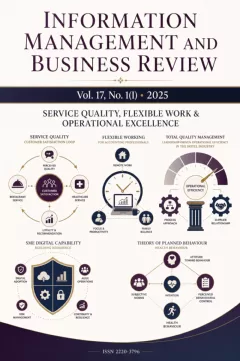 Vol. 17 No. 1(I) (2025)
Service Quality, Flexible Work & Operational Excellence
View issue contents
Published
Submissions
Have research to publish? Information Management and Business Review welcomes submissions.
Make a Submission