Abstract
This study investigates the factors influencing non-Muslim consumers' intention to purchase halal products in Malaysia, focusing on halal awareness, halal certification, halal knowledge, and halal marketing. Using a quantitative approach, data were collected via surveys from 300 respondents at malls in Petaling Jaya and analyzed using SPSS version 29. The results reveal that halal certification and marketing strategies have a significant positive impact on purchase intention, while awareness and knowledge show moderate influences. These findings highlight the critical role of certification and targeted marketing in fostering non-Muslim consumer confidence in halal products. The study contributes to the growing body of knowledge on halal consumer behavior and offers practical insights for marketers and policymakers aiming to expand the halal market beyond the Muslim community.
Keywords
- Halal Products Search this journal for Halal Products (opens in a new tab)
- Non-Muslim Consumers Search this journal for Non-Muslim Consumers (opens in a new tab)
- Purchase Intention Search this journal for Purchase Intention (opens in a new tab)
- Halal Certification Search this journal for Halal Certification (opens in a new tab)
- Halal Marketing Search this journal for Halal Marketing (opens in a new tab)
- Halal Knowledge Search this journal for Halal Knowledge (opens in a new tab)
References
- Adekunle, B., & Filson, G. (2020). Understanding halal food market: Resolving asymmetric information. Food ethics, 5(1), 13. https://doi.org /10.1007/s41055-020-00072-7
- Ambali, A. R., & Bakar, A. N. (2014). People's awareness on halal foods and products: potential issues for policy-makers. Procedia-Social and Behavioral Sciences, 121, 3-25. https://doi.org/10.1016/j.sbspro.2014.01.1104
- Azam, M. S. E., & Abdullah, M. A. (2020). Global halal industry: realities and opportunities. IJIBE (International Journal of Islamic Business Ethics), 5(1), 47-59. http://dx.doi.org/10.30659/ijibe.5.1.47-59
- Azam, M. S. E., & Abdullah, M. A. (2021). Halal standards globally: A comparative study of unities and diversities among the most popular halal standards globally. Halalsphere, 1(1), 11-31. https://doi.org/10.31436/hs.v1i1.20
- Aziz, I. (2023). Where Do We Go From Here?: Halal Food Regulation and Monitoring. UCLA J. Islamic & Near EL, 20, 179. https://doi.org/10.5070/N420160506
- Aziz, Y. A., & Chok, N. V. (2013). The role of Halal awareness, Halal certification, and marketing components in determining Halal purchase intention among non-Muslims in Malaysia: A structural equation modelling approach. Journal of International Food & Agribusiness Marketing, 25(1), 1-23. https://doi.org/10.1080/08974438.2013.723997
- Billah, A., Rahman, M. A., & Hossain, M. T. B. (2020). Factors influencing Muslim and non-Muslim consumers’ consumption behavior: A case study on halal food. Journal of Foodservice Business Research, 23(4), 324-349. https://doi.org/10.1080/15378020.2020.1768040
- Chong, S. C., Yeow, C. C., Low, C. W., Mah, P. Y., & Tung, D. T. (2022). Non-Muslim Malaysians’ purchase intention towards halal products. Journal of Islamic Marketing, 13(8), 1751-1762. https://doi.org/10.1108/JIMA-10-2020-0326
- Dashti, L. A., Jackson, T., West, A., & Jackson, L. (2024). Enhancing halal food traceability: a model for rebuilding trust and integrity in Muslim countries. Journal of Islamic Marketing, 15(12), 3382-3408. https://doi.org/10.1108/JIMA-06-2023-0167
- Elasrag, H. (2016). Halal industry: Key challenges and opportunities.
- Halimi, F. F., Gabarre, S., Rahi, S., Al-Gasawneh, J. A., & Ngah, A. H. (2022). Modelling Muslims’ revisit intention of non-halal certified restaurants in Malaysia. Journal of Islamic Marketing, 13(11), 2437-2461. https://doi.org/10.1108/JIMA-01-2021-0014
- Hashim, N. S., & Mohd Nor, A. R. (2022). The benefit of halal certificate application from small and medium industries perspective. Journal of Islamic Philanthropy & Social Finance (JIPSF), 4(2), 102-112. https://doi.org/10.24191/JIPSF/v4n22022_102-112
- Ismail, W. R. W., Mazlan, N. H., Rahim, N., & Bakar, A. R. A. (2023). Halal Malaysia Brand Image: Analyzing the impact of negative publicities using implicit and explicit measures. Environment-Behaviour Proceedings Journal, 8(SI14), 97-104. https://doi.org/10.21834/e-bpj.v8iSI14.5058
- Juergensmeyer, M., Moore, K., & Sachsenmaier, D. (Eds.). (2022). Religious othering: global dimensions. Taylor & Francis. https://doi.org/10.4324/b22926
- Keskintürk, T., & Er, ?. (2007). A genetic algorithm approach to determine stratum boundaries and sample sizes of each stratum in stratified sampling. Computational Statistics & Data Analysis, 52(1), 53-67. https://doi.org/10.1016/j.csda.2007.03.026
- Lee, S. H., Siong, K. C., Lee, K. S., & Kim, H. S. (2016). Non-Muslim customers' purchase intention on halal food products in Malaysia. Culinary Science & Hospitality Research, 22(1), 108-116. https://doi.org/10.20878/cshr.2016.22.1.012
- Lim, Y. H., Lada, S., Ullah, R., & Abdul Adis, A. A. (2022). Non-Muslim consumers’ intention to purchase halal food products in Malaysia. Journal of Islamic Marketing, 13(3), 586-607. https://doi.org/10.1108/JIMA-06-2020-0172
- Rafiki, A., Pananjung, A. G., & Nasution, M. D. T. P. (Eds.). (2023). Strategies and applications of Islamic entrepreneurship. IGI Global. . https://doi.org /10.4018/978-1-6684-7519-5
- Ramli, M. A., Abd Razak, M. A., & Jaafar, M. H. (2023). Understanding non-Muslims’ reluctance to halal food: a systematic review. Journal of Islamic Marketing, 14(2), 544-561. https://doi.org/10.1108/JIMA-05-2021-0134
- Ramli, R. Z., Wan Husin, W. Z., Elaklouk, A. M., & Sahari@ Ashaari, N. (2024). Augmented reality: a systematic review between usability and learning experience. Interactive Learning Environments, 32(10), 6250-6266. https://doi.org/10.1080/10494820.2023.2255230
- Saleh, H., & Wahab, N. A. A. (2024, December). Employers’ Perspectives on Skills Falling Short, HEIs’ Education System, and Graduates’ Attributes. In 2024 International Conference on TVET Excellence & Development (ICTeD) (pp. 54-58). IEEE. http://dx.doi.org/10.6007/IJARBSS/v14-i8/22119
- Supian, K. (2016). Enhancing halal practices integrity in the Malaysian halal food industry. Australian Journal of Basic and Applied Sciences, 10(11), 221-227.
- Supriyadi, S., Aulia, R., Nubahai, L., Ab Rahman, R., & Mohamed, R. (2024). Legal Effectiveness of Halal Product Certification in Improving Business Economics in Indonesia and Malaysia. Al-Ahkam, 34(1), 193-220. https://doi.org/10.21580/ahkam.2024.34.1.20546
- Tarofder, A. K., Sultana, U. S., Ismail, R., Salem, S. F., & Musah, A. A. (2022). The anatomy of non-Muslim consumers’ halal fashion buying behavior: a quantitative approach. Journal of Islamic Marketing, 13(8), 1763-1785. https://doi.org/10.1108/JIMA-05-2020-0156
- Wilkins, S., Butt, M. M., Shams, F., & Pérez, A. (2019). The acceptance of halal food in non-Muslim countries: Effects of religious identity, national identification, consumer ethnocentrism and consumer cosmopolitanism. Journal of Islamic Marketing, 10(4), 1308-1331. https://doi.org/10.1108/JIMA-11-2017-0132
- Won, J., Lee, S., Park, M., Kim, T. Y., Park, M. G., Choi, B. Y., ... & Lee, C. J. (2020). Development of a Laboratory-safe and Low-cost Detection Protocol for SARS-CoV-2 of the Coronavirus Disease 2019 (COVID-19). Experimental neurobiology, 29(2), 107. https://doi.org/10.5607/en20009
Downloads
No downloads have been recorded for this article yet. Figures appear here once readers begin downloading the full text.
How to Cite
Share this article
License
Copyright (c) 2025 Hasan Saleh, Thurga Rajandran (Author)

This work is licensed under a Creative Commons Attribution 4.0 International License.
Author (s) should affirm that the material has not been published previously. It has not been submitted and it is not under consideration by any other journal. At the same time author (s) need to execute a publication permission agreement to assume the responsibility of the submitted content and any omissions and errors therein. After submission of revised paper in the light of suggestions of the reviewers, the editorial team edits and formats manuscripts to bring uniformity and standardization in published material.
This work will be licensed under Creative Commons Attribution 4.0 International (CC BY 4.0) and under condition of the license, users are free to read, copy, remix, transform, redistribute, download, print, search or link to the full texts of articles and even build upon their work as long as they credit the author for the original work. Moreover, as per journal policy author (s) hold and retain copyrights without any restrictions.
Keywords
- Halal Products Search this journal for Halal Products (opens in a new tab)
- Non-Muslim Consumers Search this journal for Non-Muslim Consumers (opens in a new tab)
- Purchase Intention Search this journal for Purchase Intention (opens in a new tab)
- Halal Certification Search this journal for Halal Certification (opens in a new tab)
- Halal Marketing Search this journal for Halal Marketing (opens in a new tab)
- Halal Knowledge Search this journal for Halal Knowledge (opens in a new tab)
Section
Published in
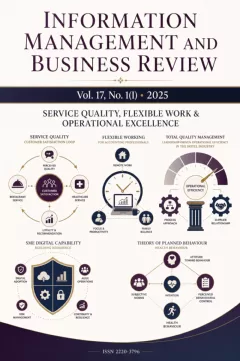 Vol. 17 No. 1(I) (2025)
Service Quality, Flexible Work & Operational Excellence
View issue contents
Published
Submissions
Have research to publish? Information Management and Business Review welcomes submissions.
Make a Submission