Abstract
The rapid advancement of technology has significantly transformed accounting education, necessitating a deeper understanding of its impact on teaching practices and research trends. This study aims to explore the evolution of technology in accounting education through a bibliometric analysis, focusing on identifying key research trends, innovative teaching methods, and their implications for curriculum development. The significance of this study lies in its ability to provide actionable insights for educators, policymakers, and researchers to enhance pedagogy, align academic standards with industry needs, and prepare students for a technology-driven professional landscape. The methodology involves a comprehensive bibliometric analysis of peer-reviewed literature on technology in accounting education. Using data visualization and trend analysis tools, the study examines publication patterns, influential works, emerging themes, and key research gaps. The applied approach ensures a robust synthesis of existing knowledge while uncovering future opportunities for academic and practical advancements. The findings reveal significant trends in the adoption of digital tools, such as artificial intelligence, data analytics, and cloud computing, as well as their integration into accounting education. These outcomes demonstrate the growing emphasis on equipping students with competencies aligned with modern industry requirements. The study also identifies innovative teaching practices and potential areas for further research, offering valuable contributions to the academic community and professional organizations. Overall, this study contributes to the field by providing a roadmap for enhancing accounting education through technology integration, fostering better alignment between academia and industry, and encouraging future research on emerging technological trends.
Keywords
- Accounting Education Search this journal for Accounting Education (opens in a new tab)
- Technology Search this journal for Technology (opens in a new tab)
- Teaching Innovations Search this journal for Teaching Innovations (opens in a new tab)
- Accounting Students Search this journal for Accounting Students (opens in a new tab)
- E-learning Search this journal for E-learning (opens in a new tab)
- Digital Search this journal for Digital (opens in a new tab)
- Bibliometric Analysis Search this journal for Bibliometric Analysis (opens in a new tab)
- VOSviewer Search this journal for VOSviewer (opens in a new tab)
References
- Ahmi, A., & Mohd Nasir, M. H. (2019). Examining the trend of the research on extensible business reporting language (XBRL): A bibliometric review. International journal of innovation, creativity and change, 5(2), 1145-1167.
- Al-Htaybat, K., von Alberti-Alhtaybat, L., & Alhatabat, Z. (2018). Artificial intelligence in accounting education: Effects on learning outcomes and career readiness. Journal of Accounting Education, 44, 56–69. https://doi.org/10.1016/j.jaccedu.2018.05.001
- Apostolou, B., Dorminey, J. W., Hassell, J. M., & Rebele, J. E. (2013). Accounting education literature review (2010–2012). Journal of Accounting Education, 31(2), 107–161. https://doi.org/10.1016/j.jaccedu.2013.03.001
- Boyce, G., Williams, S., Kelly, A., & Yee, H. (2001). Fostering deep and elaborative learning and generic (soft) skill development: The strategic use of case studies in accounting education. Accounting Education, 10(1), 37–60. https://doi.org/10.1080/09639280121878
- Coyne, J. G., & McMickle, P. L. (2017). Can blockchains serve an accounting purpose? Journal of Emerging Technologies in Accounting, 14(2), 101–111. https://doi.org/10.2308/jeta-51910
- Damerji, H., & Salimi, A. (2023). Generative AI in accounting education: Transformative potential and challenges. Accounting Education. Advanced online publication. https://doi.org/10.1016/j.jaccedu.2023
- Domínguez, A., Saenz-de-Navarrete, J., de-Marcos, L., Fernández-Sanz, L., Pagés, C., & Martínez-Herráiz, J. J. (2013). Gamifying learning experiences: Practical implications and outcomes. Computers & Education, 63, 380–392. https://doi.org/10.1016/j.compedu.2012.12.020
- Ho, Y. S. (2007). Bibliometric analysis of adsorption technology in environmental science. Journal of Environmental Protection Science, 1(1), 1-11.
- Howieson, B., Hancock, P., Segal, N., Kavanagh, M., Tempone, I., & Kent, J. (2014). Who should teach what? Australian perceptions of the role of the accounting profession and the academy in developing the capabilities of accounting graduates. Journal of Accounting Education, 32(3), 259–275. https://doi.org/10.1016/j.jaccedu.2014.05.001
- Johnson, H., Ruppel, C., & Crain, J. L. (2019). Overcoming the digital divide: Enhancing educational equity through technology. International Journal of Educational Research, 93, 107–120. https://doi.org/10.1016/j.ijer.2018.11.014
- McCarthy, W. E. (2003). The REA accounting model: Intellectual heritage and prospects for progress. Journal of Information Systems, 17(1), 31–51. https://doi.org/10.2308/jis.2003.17.1.31
- Nasir, N. E. M., Yaacob, N. M., Rashid, N., & Kamarudin, S. N. (2023). Visualizing and mapping two decades of literature on corporate tax: A bibliometric analysis. Indonesian Journal of Sustainability Accounting and Management, 7(1), 88–103. https://doi.org/10.28992/ijsam.v7i1.749
- Öztürk, O., Kocaman, R., & Kanbach, D. K. (2024). How to design bibliometric research: an overview and a framework proposal. Library Technology Reports, 58(8).
- Pritchard, A. 1969. Statistical Bibliography or Bibliometrics? Journal of Documentation, 25(4), 348–49.
- Qasim, A., & Kharbat, F. (2020). Blockchain technology, business data analytics, and artificial intelligence: Use in the accounting profession and ideas for inclusion into the accounting curriculum. Journal of Emerging Technologies in Accounting, 17(1), 77–91. https://doi.org/10.2308/jeta-52604
- Richins, G., Stapleton, A., Stratopoulos, T., & Wong, C. (2017). Big data analytics: Opportunity or threat for the accounting profession? Journal of Information Systems, 31(3), 63–79. https://doi.org/10.2308/isys-51805
- Rusly, F. H., Ahmi, A., Yakimin, Y., Talib, A., & Rosli, K. (2019).A global perspective on payroll system patent and research: A bibliometric performance. International Journal of Recent Technology and Engineering, 8(2S2), 148–157.
- Sangster, A., Stoner, G., & McCarthy, P. (2020). The genesis of double-entry bookkeeping. The British Accounting Review, 52(4), 100863. https://doi.org/10.1016/j.bar.2020.100863
- Smith, G., & Brown, R. (2020). Educator perceptions of barriers to integrating technology in accounting education. Accounting Education, 29(5), 423–441. https://doi.org/10.1080/09639284.2020.1786353
- Smith, L. M., Summers, S. L., & Wood, D. A. (2015). Accounting education research: A status report. Journal of Accounting Education, 33(1), 1–15. https://doi.org/10.1016/j.jaccedu.2014.09.003
- Sweileh, W. M., Al-Jabi, S. W., AbuTaha, A. S., Zyoud, S. H., Anayah, F. M. A., & Sawalha, A. F. (2017). Bibliometric analysis of worldwide scientific literature in mobile health: 2006–2016. BMC Medical Informatics and Decision Making, 17(1), 1–12. https://doi.org/10.1186/s12911-017-0476-7
- Tingey-Holyoak, J., & Burritt, R. L. (2012). The impact of education and training on financial literacy: A review of evidence and future directions. Accounting Education, 21(6), 583–598. https://doi.org/10.1080/09639284.2012.725636
- Watty, K., Jackling, B., & Wilson, K. (2010). The impact of technology on accounting curricula: A literature review. Australian Accounting Review, 20(4), 302–309. https://doi.org/10.1111/j.1835-2561.2010.00105.x
Downloads
No downloads have been recorded for this article yet. Figures appear here once readers begin downloading the full text.
How to Cite
Share this article
License
Copyright (c) 2025 Emiza Tahar, Yusliena Yusoff, Inayah Abdul Aziz, Rohayati Jusoh (Author)

This work is licensed under a Creative Commons Attribution 4.0 International License.
Author (s) should affirm that the material has not been published previously. It has not been submitted and it is not under consideration by any other journal. At the same time author (s) need to execute a publication permission agreement to assume the responsibility of the submitted content and any omissions and errors therein. After submission of revised paper in the light of suggestions of the reviewers, the editorial team edits and formats manuscripts to bring uniformity and standardization in published material.
This work will be licensed under Creative Commons Attribution 4.0 International (CC BY 4.0) and under condition of the license, users are free to read, copy, remix, transform, redistribute, download, print, search or link to the full texts of articles and even build upon their work as long as they credit the author for the original work. Moreover, as per journal policy author (s) hold and retain copyrights without any restrictions.
Keywords
- Accounting Education Search this journal for Accounting Education (opens in a new tab)
- Technology Search this journal for Technology (opens in a new tab)
- Teaching Innovations Search this journal for Teaching Innovations (opens in a new tab)
- Accounting Students Search this journal for Accounting Students (opens in a new tab)
- E-learning Search this journal for E-learning (opens in a new tab)
- Digital Search this journal for Digital (opens in a new tab)
- Bibliometric Analysis Search this journal for Bibliometric Analysis (opens in a new tab)
- VOSviewer Search this journal for VOSviewer (opens in a new tab)
Section
Published in
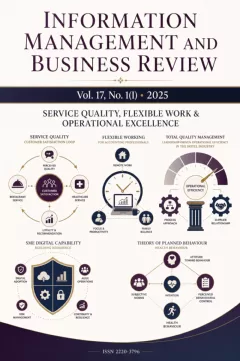 Vol. 17 No. 1(I) (2025)
Service Quality, Flexible Work & Operational Excellence
View issue contents
Published
Submissions
Have research to publish? Information Management and Business Review welcomes submissions.
Make a Submission