Abstract
For people with disabilities (PWDs) to have the best possible dining experiences in restaurants, they require specialized accessibility. Nevertheless, some restaurant owners sometimes overlook this issue when offering suitable amenities for this particular group of patrons. Therefore, this study aims to identify physical key factors influencing individuals with physical disabilities at family-style restaurants in Kuala Terengganu, Malaysia. The physical key variables in this study include the respective space for parking facilities, the building's design, the design of the dining area, and the family-style restaurant restroom specifications. 400 valid replies were analyzed using the Statistical Package for the Social Sciences (SPSS), and the analysis's findings demonstrate the importance of each suggested variable. The data was gathered in Kuala Terengganu using an online questionnaire and some paper surveys ~~,~~ in compliance with the restriction on physical distances. According to this study, the design of buildings, the design of the dining area, and restroom specifications are the three independent factors that impact customer satisfaction. Future academicians and other interested parties can learn more about the topic of this study. Government agencies and food service providers will also benefit from the insights as they plan and operationalize better in the future to increase consumer satisfaction.
Keywords
- Persons with Physical Disabilities Search this journal for Persons with Physical Disabilities (opens in a new tab)
- PWD Satisfaction Search this journal for PWD Satisfaction (opens in a new tab)
- Restaurant Facilities Search this journal for Restaurant Facilities (opens in a new tab)
- Accessibility Search this journal for Accessibility (opens in a new tab)
- Family-Style Restaurants Search this journal for Family-Style Restaurants (opens in a new tab)
References
- Ahmed, S., Asheq, A. A., Ahmed, E., Chowdhury, U. Y., Sufi, T., & Mostafa, M. G. (2022). The intricate relationships of consumers’ loyalty and their perceptions of service quality, price and satisfaction in restaurant service. The TQM Journal, 35(2), 519–539. https://doi.org/10.1108/tqm-06-2021-0158
- Aini, Q., Marlina, H., & Nikmatullah, A. (2019). Evaluation of Accessibility for People with Disability in Public Open Space. IOP Conference Series: Materials Science and Engineering, 506, 012018. https://doi.org/10.1088/1757-899x/506/1/012018
- Asenahabi, B. M. (2019). Basics of Research Design: A Guide to selecting appropriate research design. International Journal of Contemporary Applied Researches, 6(5), 76–89.
- Ata, K. M., Soh, A. C., Ishak, A., Jaafar, H. I., & Khairuddin, N. A. (2019). Smart Indoor Parking System Based on Dijkstra’s Algorithm. International Journal of Electrical Engineering and Applied Sciences (IJEEAS), 2(1), 13–20. https://core.ac.uk/download/pdf/229280683.pdf
- Aureliano-Silva, L., Xi, L., & Spers, E. E. (2021). The effect of online reviews on restaurant visit intentions: applying signalling and involvement theories. Journal of Hospitality and Tourism Technology, 12(4), 672–688. https://doi.org/10.1108/jhtt-06-2020-0143
- Awang, N. A., Chua, S. J. L., Ali, A. S., Au-Yong, C. P., Naicker, A. S., & Yuliawiratman, B. S. (2021). Persons with disability perception of facilities management service quality: hospital buildings in Malaysia. International Journal of Health Care Quality Assurance, 34(3/4), 125–139.
- Badia, M., Orgaz, B. M., Verdugo, M. A., Ullán, A. M., & Martinez, M. M. (2011). Personal factors and perceived barriers to participation in leisure activities for young and adults with developmental disabilities. Research in Developmental Disabilities, 32(6), 2055 -2063. https://doi.org/10.1016/j.ridd.2011.08.007
- Bae, S., Slevitch, L., & Tomas, S. (2018). The effects of restaurant attributes on satisfaction and return patronage intentions: Evidence from solo diners’ experiences in the United States. Cogent Business & Management, 5(1), 1–16. https://doi.org/10.1080/23311975.2018.1493903
- Bakar, A. Z. A., Ganesan, L., Othman, M., Haron, S. A., and Ishak, F. A. C. (2020). Where to eat: exploring silver consumer restaurant dining choice in Malaysia. JSSH 28, 3297–3317. doi: 10.47836/pjssh.28.4.44
- Bashiti, A., & Asiah Abdul Rahim. (2016). Physical Barriers Faced by People with Disabilities (PwDs) in Shopping Malls. Procedia - Social and Behavioral Sciences, 222, 414–422. https://doi.org/10.1016/j.sbspro.2016.05.199
- Berezina, K., Cobanoglu, C., Miller, B. L., &Kwansa, F. A. (2012). The impact of information security breach on hotel guest perception of service quality, satisfaction, revisit intentions and word-of-mouth. International Journal of Contemporary Hospitality Management, 24(7), 991–1010. https://doi.org/10.1108/09596111211258883
- Castro, C. F. T., Gay, D. L., Joaquin, M. L. A., Landicho, J. M., Lazaro, K. M., Sorrosa, V. M. V., & Villanueva, F. C. C. (2022). Accessible Tourism Experience in Restaurants: The Case of Persons with Disabilities Residing in Bulacan. Cosmos An International Journal of Art & Higher Education, 11(1), 53–71. http://doi.org/10.46360/cosmos.ahe.520221007
- Cheng, C.-H. (2020). The Satisfaction Study of People with Disabilities Regarding the Restaurant with Barrier-Free Environment in Taiwan Tourism Area. International Business Research, 13(4), 1–13. https://doi.org/10.5539/ibr.v13n4p1
- Choibamroong, T., & Angkananon, K. (2022). Accessibility Barriers in the Second-Tier Tourism Cities of Thailand for People with Visual Impairments. GeoJournal of Tourism and Geosites, 45(4, Suppl.), 1683–1692. https://doi.org/10.30892/gtg.454spl18-989
- De Faria, M. D., Da Silva, J. F., & Ferreira, J. B. (2012). The visually impaired and consumption in restaurants. International Journal of Contemporary Hospitality Management, 24(5), 721–734. https://doi.org/10.1108/09596111211237264
- Daniel, D., Nastiti, A., Surbakti, H. Y., & Dwipayanti, N. M. (2023). Access to inclusive sanitation and participation in sanitation programs for people with disabilities in Indonesia. Scientific Reports, 13(4310), 1–12. https://doi.org/10.1038/s41598-023-30586-z
- Department of Social Welfare Malaysia. (2023). https://www.jkm.gov.my/jkm/index.php?r=portal/index
- D’Souza, O. N., & Kuntz, J. R. C. (2021). Examining the impact of reasonable accommodation appraisals on New Zealand managers’ attitudes toward hiring people with disability. Equality, Diversity and Inclusion: An International Journal, 42(6), 754–771. https://doi.org/10.1108/edi-08-2021-0207
- Ghasemi, V., Oliveira, M.G. & Kuhzady, S., (2022). “Marketing Mix Analysis for Dote Restaurants in Portugal”. International Case Studies in Tourism Marketing, 218.
- Gillovic, B., & McIntosh, A. (2020). Accessibility and Inclusive Tourism Development: Current State and Future Agenda. Sustainability, 12(22), 9722. https://doi.org/10.3390/su12229722
- Gordon, J.-S., & Tavera-Salyutov, F. (2018). Remarks on disability rights legislation. Equality, Diversity and Inclusion: An International Journal, 37(5), 506–526. https://doi.org/10.1108/edi-12-2016-0114
- Hwang, J. (2022). A factor analysis for identifying people with disabilities’ mobility issues in built environments. Transportation Research Part F: Traffic Psychology and Behavior, 88, 122–131. https://doi.org/10.1016/j.trf.2022.05.016
- Ishak, F. A. C., Mazlan, N., Lokman, N. A., Karim, M. S. A., & Mohamad, S. F. (2021). Exploring the Issues and Challenges in Managing Themed Restaurants in Klang Valley, Malaysia. International Journal of Academic Research in Business and Social Sciences, 11(10), 1121–1135. http://dx.doi.org/10.6007/IJARBSS/v11-i10/11490
- Jani, D. and Han, H. (2011). Investigating the key factors affecting behavioral intentions: Evidence from a full?service restaurant setting. International Journal of Contemporary Hospitality Management, 23(7), 100?18.
- Joo, N., & Cho, K. (2012). Study on the Utilization of Restaurant Services by the Disabled and their Demand for Better Access in Korea. Asia Pacific Journal of Tourism Research, 17(3), 338–353. https://doi.org/10.1080/10941665.2011.628327
- Kamarudin, H., Ariff, N. R. M., Ismail, W. Z. W., Bakri, A. F., & Ithnin, Z. (2014). Malaysian Scenario on Access and Facilities for Persons with Disabilities: A literature review. MATEC Web of Conferences, 15, 1–7. https://doi.org/10.1051/matecconf/20141501019
- Khan, S., Hussain, S. and Yaqoob, F. (2013). Determinants of customer satisfaction in fast food industry a study of fast-food restaurants Peshawar Pakistan. Studia commercialia Bratislavensia, 6(21), 56-65.
- Maemunah, I. (2021). Implementation of Cleanliness, Health and Environmental Sustainability Guidelines in Restaurants around the Southern Java Crossing Route in Ciamis Regency. Budapest International Research and Critics Institute-Journal (BIRCI-Journal), 4(2), 2635–2642. https://doi.org/10.33258/birci.v4i2.1970
- Mamee, W., & Sahachaisaeree, N. (2010). Public toilet design criteria for users with walking disability in conjunction with universal design paradigm. Procedia - Social and Behavioral Sciences, 5, 1246–1250. https://doi.org/10.1016/j.sbspro.2010.07.269
- Mu, J., & Kang, J. (2023). Dining comfort in elderly care facility dining rooms and influencing factors before and after the outbreak of the COVID-19 pandemic. Frontiers in Psychology, 14. https://doi.org/10.3389/fpsyg.2023.1106741
- Nguyen, Q., Nisar, T. M., Knox, D., & Prabhakar, G. P. (2018). Understanding customer satisfaction in the UK quick service restaurant industry: The influence of the tangible attributes of perceived service quality. British Food Journal, 120(6), 1207–1222. https://doi.org/10.1108/bfj-08-2017-0449
- Najhan, N. F. S. M., Shahril, A. M., Chik, C. T., & Abdullah, F. C. (2022). The relationship between restaurant atmosphere and customer satisfaction: Malaysian restaurant contexts. Advances in Business Research International Journal, 8(1), 46-59.
- Osman, M. M., Radzi, F. H. M., Bakri, N. I. M., & Ibrahim, M. (2015). Barrier-Free Campus: University Malaya, Kuala Lumpur. Procedia - Social and Behavioral Sciences, 168, 134–144.
- Perdana, F. R. (2020). Aksebilitas Difabel Pada Objek Wisata Malioboro. JPI (Jurnal Pendidikan Inklusi), 4(1), 66–84. https://doi.org/10.26740/inklusi.v4n1.p66-84
- Piramanayagam, S., Pratim, P., & More, B. (2019). Inclusive hotel design in India: A User Perspective. Journal of Accessibility and Design for All, 9(1), 41–65. https://doi.org/10.17411/jacces.v9i1.185
- Rahate, P., Gujwar, N., Khorgade, M., Moundekar, V., Gupta, Y., & Mirza, A. (2022). Design and Development of Staircase Ramp for Disabled Person. International Journal of Multidisciplinary Research in Science, Engineering and Technology (IJMRSET), 5(6), 1067–1071. https://doi.org/10.15680/IJMRSET.2022.0506010
- Rashid, M. H. A., Hamzah, M. I., Shobri, N. D. M., & Hashin, N. (2019). A Review on Full-Service Restaurants in Malaysia. International Tourism and Hospitality Journal, 2(1), 1–6.
- Razak, A., Sabri, A., & Mohammad, T. (2023). The Restaurateurs’ Perspective on The Impact of Social Media Advertisements on Family Restaurants in Dungun, Terengganu. International Journal of Business and Technology Management, 5(S1), 292–304. https://doi.org/10.55057/ijbtm.2023.5.S1.28
- Reindrawati, D.Y., Noviyanti, U.D.E., & Young, T. (2022). Tourism Experiences of People with Disabilities: Voices from Indonesia. Sustainability, 14, 1–21. https://doi.org/10.3390/su142013310
- Safri, S. N. W., & Mohi, Z. (2022). The Quality of Kopitiam Physical Environment: Are Patrons Satisfied? Journal of Tourism, Hospitality & Culinary Arts (JTHCA), 14(3), 1–22. https://ir.uitm.edu.my/id/eprint/72334/1/72334.pdf
- Sawangsuk, N. (2017). Cultural Tourism Management for groups of people with disabilities. International Thai Tourism Journal, 13(1), 57-82
- The ASEAN Secretariat. (2016, January). ASEAN Public Toilet Standard (338.4791). Association of Southeast Asian Nations (ASEAN). https://www.asean.org/wp-content/uploads/2012/05/ASEAN-Public-Toilet-Standard.pdf
- Uslu, A., & Eren, R. (2020). Critical Review of Service Quality Scales with a Focus on Customer Satisfaction and Loyalty in Restaurants. DETUROPE – The Central European Journal of Regional Development and Tourism, 12(1), 64–84. https://doi.org/10.32725/det.2020.004
- Van Naarden Braun, K., Yeargin-Allsopp, M., & Lollar, D. (2006). Factors associated with leisure activity among young adults with developmental disabilities. Research in Developmental Disabilities, 27, 567-583. https://doi.org/10.1016/j.ridd.2005.05.008
- Walker, J. R. (2022). The Restaurant: From Concept to Operation (Ninth ed.). John Wiley & Sons.
- Walter, U., Edverdson, B. and Ostromos, A. (2010). Drivers of customers’ service experiences: a study in the restaurant industry. Managing Service Quality, 20(3), 236?58.
- World Health Organization (2023, March 7). Disability. https://www.who.int/news-room/fact-sheets/detail/disability-and-health
- Zakaria, H., Kamarudin, D., & Manan, W. K. A. W. A. (2019). Service Quality, Satisfaction, and Customer Loyalty in Peer-to-Peer Lodging in Malaysia. TEST Engineering and Management, 81, 812–818. https://www.researchgate.net/publication/352438327
Downloads
No downloads have been recorded for this article yet. Figures appear here once readers begin downloading the full text.
How to Cite
Share this article
License
Copyright (c) 2025 Nur Anis Fatihah Abu Bakar Hamzah, Nur Amira Syazani Anuar, Fatimah Abd Ghani, Noorazlin Ramli (Author)

This work is licensed under a Creative Commons Attribution 4.0 International License.
Author (s) should affirm that the material has not been published previously. It has not been submitted and it is not under consideration by any other journal. At the same time author (s) need to execute a publication permission agreement to assume the responsibility of the submitted content and any omissions and errors therein. After submission of revised paper in the light of suggestions of the reviewers, the editorial team edits and formats manuscripts to bring uniformity and standardization in published material.
This work will be licensed under Creative Commons Attribution 4.0 International (CC BY 4.0) and under condition of the license, users are free to read, copy, remix, transform, redistribute, download, print, search or link to the full texts of articles and even build upon their work as long as they credit the author for the original work. Moreover, as per journal policy author (s) hold and retain copyrights without any restrictions.
Keywords
- Persons with Physical Disabilities Search this journal for Persons with Physical Disabilities (opens in a new tab)
- PWD Satisfaction Search this journal for PWD Satisfaction (opens in a new tab)
- Restaurant Facilities Search this journal for Restaurant Facilities (opens in a new tab)
- Accessibility Search this journal for Accessibility (opens in a new tab)
- Family-Style Restaurants Search this journal for Family-Style Restaurants (opens in a new tab)
Section
Published in
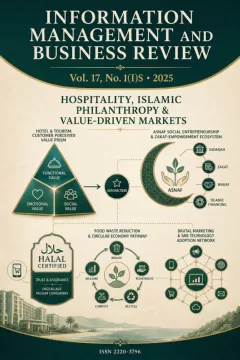 Vol. 17 No. 1(I)S (2025)
Hospitality, Islamic Philanthropy & Value-Driven Markets
View issue contents
Published
Submissions
Have research to publish? Information Management and Business Review welcomes submissions.
Make a Submission