Abstract
Green restaurants are establishments that prioritize environmental sustainability by implementing practices such as reducing energy consumption, minimizing disposable product use, and curbing food waste. This study aims to investigate the factors within a modified Theory of Planned Behavior (TPB) framework that influence repurchase intentions toward green restaurants in the Klang Valley. Specifically, it examines how sustainable attitudes, price perceptions, and subjective norms affect consumer decisions while fostering greater awareness and understanding of green dining practices to promote environmental sustainability. A quantitative approach was adopted, surveying 390 Klang Valley residents with prior experiences at green restaurants. Purposive sampling was used to select participants, and data were collected through a structured questionnaire. The responses were analyzed using descriptive statistics, reliability testing, and multiple regression analysis via the Statistical Package for Social Science (SPSS). The findings revealed that all TPB variables, sustainable attitudes, price, and subjective norms, positively influence repurchase intentions, with sustainable attitude emerging as the most significant predictor. These results underscore the importance of fostering pro-environmental attitudes to drive consumer loyalty toward green restaurants. This study contributes to the limited body of research on green restaurants in Malaysia, offering practical insights for restaurant owners, policymakers, and community groups to integrate eco-friendly practices such as reducing paper waste, optimizing energy consumption, and adopting biodegradable disposables. Academically, the study serves as a foundation for future research, encouraging scholars and practitioners to further investigate the potential of green restaurants in advancing environmental sustainability.
Keywords
- Green Restaurant Search this journal for Green Restaurant (opens in a new tab)
- Repurchase Intention Search this journal for Repurchase Intention (opens in a new tab)
- Theory of Planned Behavior Search this journal for Theory of Planned Behavior (opens in a new tab)
- Sustainability Search this journal for Sustainability (opens in a new tab)
- Klang Valley Search this journal for Klang Valley (opens in a new tab)
References
- Al-Swidi, A., Mohammed Rafiul Huque, S., Haroon Hafeez, M., & Noor Mohd Shariff, M. (2014). The role of subjective norms in theory of planned behavior in the context of organic food consumption. British food journal, 116(10), 1561-1580.
- Asare, M. (2015). Using the theory of planned behavior to determine the condom use behavior among college students. American journal of health studies, 30(1), 43.
- Baloglu, S., Raab, C., & Malek, K. (2020). Organizational Motivations for Green Practices in Casual Restaurants. International Journal of Hospitality & Tourism Administration, 23(2), 269–288. https://doi.org/10.1080/15256480.2020.1746216
- Bedua-Taylor, N., Amissah, E., & Mensah, N. (2022). Motivation, satisfaction and repurchase intentions of Chinese restaurant customers: evidence from the Accra Metropolis, Ghana. Journal of Hospitality and Tourism, 2(2), 24-42. https://doi.org/10.47672/jht.1183
- Cai, S., Long, X., Li, L., Liang, H., Wang, Q., & Ding, X. (2019). Determinants of intention and behavior of low carbon commuting through bicycle-sharing in China. Journal of cleaner production, 212, 602-609.
- Cambridge Dictionary (2022). https://dictionary.cambridge.org/dictionary/english/handicap
- Chen, M. F., & Tung, P. J. (2014). Developing an extended theory of planned behavior model to predict consumers’ intention to visit green hotels. International Journal of Hospitality Management, 36(1), 221-230.
- Chia, C. H., Lai, M. Z., Lau, H. Y., Liong, S. H., & Samantha, S. (2018). A study on green restaurant patronage intention in Malaysia: an integrated model approach (Doctoral dissertation, UTAR).
- Christ, K. L., & Burritt, R. (2017). Material flow cost accounting for food waste in the restaurant industry. British Food Journal, 119(3), 600-612.
- Damit, D. H. D. A., Harun, A., Martin, D., Othman, B., & Ahmad, H. (2019). What makes a non-Muslim purchase halal food in a Muslim country? An application of theory of planned behavior. Management Science Letters, 9(12), 2029-2038.
- Doeim, A., Hassan, T., Helal, M., Saleh, M., Salem, A., & Elsayed, M. (2022). Service value and repurchase intention in the Egyptian fast-food restaurants: toward a new measurement model. International Journal of Environmental Research and Public Health, 19(23), 15779. https://doi.org/10.3390/ijerph192315779
- Franzidis, A., Zinder, S., & Backston, O. (2023). An analysis of students’ attitudes and behaviors toward on-campus sustainable dining initiatives. International Journal of Sustainability in Higher Education, 24(7), 1524-1539. https://doi.org/10.1108/ijshe-02-2022-0034
- George, D., & Mallery, P. (2019). IBM SPSS statistics 26 step by step: A simple guide and reference. Routledge.
- Han, H. (2021). Consumer behavior and environmental sustainability in tourism and hospitality: a review of theories, concepts, and latest research. Journal of Sustainable Tourism, 29(7), 1021–1042. https://doi.org/10.1080/09669582.2021.1903019
- Hansen, R., Olafsson, A. S., Van Der Jagt, A. P., Rall, E., & Pauleit, S. (2019). Planning multifunctional green infrastructure for compact cities: What is the state of practice?. Ecological indicators, 96, 99-110.
- Hidayat, D., Bismo, A., & Basri, A. R. (2020). The effect of food quality and service quality towards customer satisfaction and repurchase intention (case study of hot plate restaurants). Jurnal Manajemen Bisnis, 10(01), 01-09.
- Higgins-Desbiolles, F., Moskwa, E., & Wijesinghe, G. (2017). How sustainable is sustainable hospitality research? A review of sustainable restaurant literature from 1991 to 2015. Current Issues in Tourism, 22(13), 1551–1580. https://doi.org/10.1080/13683500.2017.1383368
- Higgins-Desbiolles, F., Moskwa, E., & Wijesinghe, G. (2019). How sustainable is sustainable hospitality research? A review of sustainable restaurant literature from 1991 to 2015. Current Issues in Tourism, 22(13), 1551-1580.
- Hui, C. C., Zhen, L. M., Yeng, L. H., Hui, L. S., & Sukaraman, S. S. (2018). A study on green restaurant patronage intention in Malaysia: an integrated model approach (Doctoral dissertation, UTAR).
- Langgat, J. (2020). Route to Green Restaurant: Malaysian Perceptions and Attitudes. International Journal of Business and Social Science, 11(5) 10-17. https://doi.org/10.30845/ijbss.v11n5a2
- Lee, H. (2024). Exploring the attitudes, perceived value, and repurchase intention of the elderly towards green restaurants. Technium Social Sciences Journal, 53, 365-374. https://doi.org/10.47577/tssj.v53i1.10324
- Li, J., Chiu, D. K., Ho, K. K., & So, S. (2024). The Use of Social Media in Sustainable Green Lifestyle Adoption: Social Media Influencers and Value Co-Creation. Sustainability, 16(3), 1133.
- Loh, Z. and Hassan, S. (2021). Consumers’ attitudes, perceived risks and perceived benefits towards repurchase intention of food truck products. British Food Journal, 124(4), 1314-1332. https://doi.org/10.1108/bfj-03-2021-0216
- Lu, L. and Christina, G. (2018). An examination of the perceived value of organic dining. International Journal of Contemporary Hospitality Management, 30(8), 2826-2844. https://doi.org/10.1108/ijchm-05-2017-0267
- Madanaguli, A., Dhir, A., Kaur, P., Srivastava, S., & Singh, G. (2022). Environmental sustainability in restaurants. A systematic review and future research agenda on restaurant adoption of green practices. Scandinavian Journal of Hospitality and Tourism, 22(4-5), 303-330.
- Mahmoud, M. (2024). Green marketing mix and repurchase intention: the role of green knowledge. African Journal of Economic and Management Studies, 15(3), 501-518. https://doi.org/10.1108/ajems-04-2023-0137
- Nilsen?Nygaard, J., Fernández, E. N., Radusin, T., Rotabakk, B. T., Sarfraz, J., Sharmin, N., ... & Pettersen, M. K. (2021). Current status of biobased and biodegradable food packaging materials: Impact on food quality and effect of innovative processing technologies. Comprehensive reviews in food science and food safety, 20(2), 1333-1380.
- Obrist, M., Bertran, F. A., Makam, N., Kim, S., Dawes, C., Marti, P., & Wang, Y. (2024). Grand challenges in human-food interaction. International Journal of Human-Computer Studies, 183, 103197.
- Paul, J., Modi, A., & Patel, J. (2016). Predicting green product consumption using theory of planned behavior and reasoned action. Journal of Retailing and Consumer Services, 29(7), 123-134.
- Policarpo, M. C., & Aguiar, E. C. (2020). How self-expressive benefits relate to buying a hybrid car as a green product. Journal of Cleaner Production, 252, 119859.
- Poulain, J. P., Laporte, C., Tibère, L., Mognard, E., Ragavan, N. A., Zadeh, A. A., & Noor, I. M. (2020). Malaysian Food Barometer (MFB): A study of the impact of compressed modernization on food habits. Malaysian Journal of Nutrition, 26(1) 001-017. https://doi.org/10.31246/MJN-2019-0042
- Riva, F., ????????, ?., Rubel, M., & Rizomyliotis, I. (2022). Green consumerism, green perceived value, and restaurant revisit intention: millennials' sustainable consumption with moderating effect of green perceived quality. Business Strategy and the Environment, 31(7), 2807-2819. https://doi.org/10.1002/bse.3048
- Shishan, F., Mahshi, R., Kurdi, B., Al-otoum, F., & Alshurideh, M. (2021). Does the past affect the future? An analysis of consumers’ dining intentions towards green restaurants in the UK. Sustainability, 14(1), 276. https://doi.org/10.3390/su14010276
- Subramaniam, S., Chan, C. Y., Soelaiman, I. N., Mohamed, N., Muhammad, N., Ahmad, F., Ng, P. Y., Aini Jamil, N., Abd Aziz, N., & Chin, K. Y. (2020). Development of osteoporosis screening algorithm for population aged 50 years and above in Klang Valley, Malaysia. International Journal of Environmental Research and Public Health, 17(7). https://doi.org/10.3390/ijerph17072526
- Suki, N. M. (2013). Green awareness effects on consumers' purchasing decision: Some insights from Malaysia. International Journal of Asia Pacific Studies, 9(2), 50-63.
- Tan, B. C., Khan, N., & Lau, T. C. (2016). Investigating the determinants of green restaurant patronage intention. Social Responsibility Journal, 14(3), 469-484. https://doi.org/10.1108/SRJ-04-2017-0070
- Tan, B. C., Lau, T. C., Yong, G. F., Khan, N., & Nguyen, T. P. L. (2019). A qualitative study of green practices adoption for restaurants in Malaysia. Social Responsibility Journal, 15(8), 1087-1099.
- Tan, Z., Sadiq, B., Bashir, T., Mahmood, H., & Rasool, Y. (2022). Investigating the impact of green marketing components on purchase intention: the mediating role of brand image and brand trust. Sustainability, 14(10), 5939. https://doi.org/10.3390/su14105939
- Testa, R., Rizzo, G., Schifani, G., Tóth, J., & Migliore, G. (2024). Critical determinants influencing consumers’ decision-making process to buy green cosmetics. A systematic literature review. Journal of Global Fashion Marketing, 15(3), 357-381.
- Wang, J. (2023). Research on the impact of consumer experience satisfaction on green food repurchase intention. Foods, 12(24), 4510. https://doi.org/10.3390/foods12244510
- Wongsaichia, S., Naruetharadhol, P., Schrank, J., Phoomsom, P., Sirisoonthonkul, K., Paiyasen, V., & Ketkaew, C. (2022). Influences of green eating behaviors underlying the extended theory of planned behavior: a study of market segmentation and purchase intention. Sustainability, 14(13), 8050. https://doi.org/10.3390/su14138050
- Xu, Y., Du, J., Khan, M. A. S., Jin, S., Altaf, M., Anwar, F., & Sharif, I. (2022). Effects of subjective norms and environmental mechanism on green purchase behavior: An extended model of theory of planned behavior. Frontiers in Environmental Science, 10, 779629.
- Yasri, Y., Susanto, P., Hoque, M., & Gusti, M. (2020). Price perception and price appearance on repurchase intention of Gen Y: do brand experience and brand preference mediate?. Heliyon, 6(11), e05532. https://doi.org/10.1016/j.heliyon.2020.e05532
- Zahra, A. (2020). Consumer’s behavioral intention toward “green” restaurant: empirical evidence from Indonesia. Journal of Business and Behavioral Entrepreneurship, 4(2), 1-12. https://doi.org/10.21009/jobbe.004.2.01
- Zou, H., & Zhong, M. R. (2022). Does environmental regulation enhance a firm's position in a dual value chain? An analysis based on environmental information disclosure. Journal of Environmental Management, 321, 115918.
Downloads
No downloads have been recorded for this article yet. Figures appear here once readers begin downloading the full text.
How to Cite
Share this article
License
Copyright (c) 2025 Nur Syaza Aliah Salehuddin, Nurnasrin Awatief Ibrahim, Norhaya Hanum Mohamad, Nur Amanina Idris, Antonius Rizki Krisnadi (Author)

This work is licensed under a Creative Commons Attribution 4.0 International License.
Author (s) should affirm that the material has not been published previously. It has not been submitted and it is not under consideration by any other journal. At the same time author (s) need to execute a publication permission agreement to assume the responsibility of the submitted content and any omissions and errors therein. After submission of revised paper in the light of suggestions of the reviewers, the editorial team edits and formats manuscripts to bring uniformity and standardization in published material.
This work will be licensed under Creative Commons Attribution 4.0 International (CC BY 4.0) and under condition of the license, users are free to read, copy, remix, transform, redistribute, download, print, search or link to the full texts of articles and even build upon their work as long as they credit the author for the original work. Moreover, as per journal policy author (s) hold and retain copyrights without any restrictions.
Keywords
- Green Restaurant Search this journal for Green Restaurant (opens in a new tab)
- Repurchase Intention Search this journal for Repurchase Intention (opens in a new tab)
- Theory of Planned Behavior Search this journal for Theory of Planned Behavior (opens in a new tab)
- Sustainability Search this journal for Sustainability (opens in a new tab)
- Klang Valley Search this journal for Klang Valley (opens in a new tab)
Section
Published in
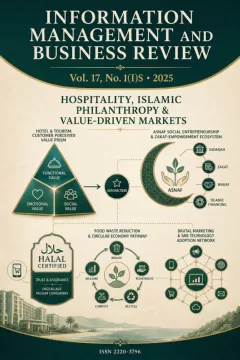 Vol. 17 No. 1(I)S (2025)
Hospitality, Islamic Philanthropy & Value-Driven Markets
View issue contents
Published
Submissions
Have research to publish? Information Management and Business Review welcomes submissions.
Make a Submission