Abstract
In the past 25 years, many tourism researchers have studied how local food, tourists, and travel locations are interrelated. While many studies have examined the impact of local food and dining experiences on tourists' travel decisions and length of stay, less attention has been given to how local food heritage is strategically incorporated into tourism destination marketing. Understanding this aspect is crucial, as it highlights the distinctive appeal of a destination and its contribution to community development. This article examines how the Malaysian government incorporates local food heritage into its country’s marketing strategies. In this study, relevant archival documents, including tourism-related policies and marketing collaterals, were collected and analysed using thematic analysis. The results show that tourism and foodrelated policies play critical roles in the effort to strategize on ‘what and how’ to promote local food heritage as a key part of Malaysia’s unique experience. The marketing collaterals, on the other hand, act as a ‘middle person’ which informs potential tourists about the local food heritage experiences, including the food's historical background and dining places either in descriptive (textual) or image (visual through specific food photographs). Although the results reveal both the specific and interrelated functions of tourism-related policies and marketing strategies, a few archival documents were excluded due to confidentiality issues and limited access. Therefore, future research might empirically delve deeper into the various tourism stakeholders’ collaboration on the complexities of incorporating local food heritage into destination marketing strategies to provide comprehensive theoretical and practical knowledge.
Keywords
- Culinary Heritage Search this journal for Culinary Heritage (opens in a new tab)
- Government Search this journal for Government (opens in a new tab)
- Tourism Marketing Search this journal for Tourism Marketing (opens in a new tab)
- Local Food Search this journal for Local Food (opens in a new tab)
- Destination Search this journal for Destination (opens in a new tab)
References
- Bessiere, J., & Tibere, L. (2013). Traditional food and tourism: French tourist experience and food heritage in rural spaces. Journal of the Science of Food and Agriculture, 93(14), 3420–3425. https://doi.org/10.1002/jsfa.6284
- Boyne, S., & Hall, D. (2004). Place promotion through food and tourism: Rural branding and the role of websites. Place Branding, 1(1), 80–92. https://doi.org/10.1057/palgrave.pb.5990007
- Boyne, S., Hall, D., & Williams, F. (2003). Policy, support and promotion for food-related tourism initiatives: A marketing approach to regional development. Journal of Travel & Tourism Marketing, 14(3–4), 131–154. https://doi.org/10.1300/J073v14n03_08
- Braun, V., & Clarke, V. (2006). Using thematic analysis in psychology. Qualitative Research in Psychology, 3(2), 77–101. https://doi.org/10.1191/1478088706qp063oa
- Dixit, S. K., & Prayag, G. (2022). Gastronomic tourism experiences and experiential marketing. Tourism Recreation Research, 47(3), 217–220. https://doi.org/10.1080/02508281.2022.2065089
- Economic Planning Unit. (2022a). Sixth Malaysia Plan 1991-1995. http://www.epu.gov.my/documents/10124/46da7926-51ec-4797-86b0-33a1720d062c
- Economic Planning Unit. (2022b). Seventh Malaysia Plan 1996-2000. http://www.epu.gov.my/epu-theme/RMK7/Chapter%2016%20-%20Tourism%20and%20Distributive%20Trade.pdf
- Elis, S. (2009, May 11). Foreign tourists are not so into Nasi Lemak. New Straits Times Press. http://malaysiahotelnews.blogspot.com.au/2009/05/foreign-tourists-not-so-into-nasi-lemak.html
- Everett, S. (2015). Iconic cuisines, marketing, and place promotion. In D. Timothy (Ed.), Heritage cuisines: Traditions, identities, and tourism (pp. 119–131). Taylor & Francis.
- FTM Reports. (2014, August 11). Popiah war: Nazri fires back, lays claim to Bahasa Indonesia. Free Malaysia Today. http://www.freemalaysiatoday.com/category/nation/2015/02/22/popiah-war-nazri-fires-back-lays-claim-to-bahasa-indonesia/
- Hall, C. M., & Gössling, S. (2016). From food tourism and regional development to food, tourism and regional development: Themes and issues in contemporary foodscapes. In C. M. Hall & S. Gössling (Eds.), Food tourism and regional development: Networks, products and trajectories (pp. 20–76). Routledge.
- Hashimoto, A., & Telfer, D. J. (2006). Selling Canadian culinary tourism: Branding the global and the regional product. Tourism Geographies, 8(1), 31–55. https://doi.org/10.1080/14616680500392465
- Henderson, J. C. (2016). Local and traditional or global and modern? Food and tourism in Singapore. Journal of Gastronomy and Tourism, 2(1), 55–68. https://doi.org/10.3727/216929716X14546365943494
- Hsu, F. C., & Scott, N. (2020). Food Experience, Place Attachment, Destination Image and the Role of Food-Related Personality Traits. Journal of Hospitality and Tourism Management, 44, 79-87. https://doi.org/10.1016/j.jhtm.2020.05.010
- Jalis, M. H. (2016). An analysis of the integration of local cuisine in international destination marketing strategies for Malaysia [Doctoral dissertation, Southern Cross University].
- Jalis, M. H. (2024, April 4). Tap food heritage potential to boost tourism. New Straits Times. https://www.nst.com.my/opinion/letters/2024/04/1039795/tap-food-heritage-potential-boost-tourism
- Jalis, M. H., Che, D., & Markwell, K. (2014). Utilising local cuisine to market Malaysia as a tourist destination. Procedia - Social and Behavioral Sciences, 144, 102–110. https://doi.org/10.1016/j.sbspro.2014.07.278
- Kim, J. J. & Lee, C. J. (2022). A tourist’s gaze on local tourism governance: The relationship between local tourism governance and brand equity, tourism attachment for sustainable tourism. Sustainability, 14(24), 16477. https://doi.org/10.3390/su142416477
- Lin, Y.-C., Pearson, T. E., & Cai, L. A. (2011). Food as a form of destination identity: A tourism destination brand perspective. Tourism and Hospitality Research, 11(1), 30–48. https://doi.org/10.1057/thr.2010.22
- Okumus, B., Xiang, Y., & Hutchinson, J. (2018). Local cuisines and destination marketing: Cases of three cities in Shandong, China. Asia Pacific Journal of Tourism Research, 23(6), 584–599. https://doi.org/10.1080/10941665.2018.1469521
- Richards, G. (2015). Evolving gastronomic experiences: From food to foodies to foodscapes. Journal of Gastronomy and Tourism, 1(1), 5–17. https://doi.org/https://doi.org/10.3727/216929715X14298190828796
- Timothy, D. J. (2016). Introduction: Heritage cuisines, foodways, and culinary traditions. In D. J. Timothy (Ed.), Heritage cuisines: Traditions, identities, and tourism (pp. 1–24). Routledge.
- UNWTO. (2012). Affiliate members global report, Volume 4 - Global report on food tourism. https://doi.org/10.18111/9789284414819
- White, L., & Frew, E. (2011). Tourism and national identities: Connections and conceptualisations. In L. White & E. Frew (Eds.), Tourism and national identities: An international perspective (pp. 1–10). Routledge.
- Yoshino, K. (2010). Malaysian cuisine: A case of neglected culinary globalisation. In Globalisation, food, and social identities in the Asia Pacific region. Sophia University Institute of Comparative Culture.
Downloads
No downloads have been recorded for this article yet. Figures appear here once readers begin downloading the full text.
How to Cite
Share this article
License
Copyright (c) 2025 Siti Nor Fadillah Ahmad Shariff, Mohd Hairi Jalis, Massyittah Omar, Zuratulraha Jaafar, Hawaliana Selamat (Author)

This work is licensed under a Creative Commons Attribution 4.0 International License.
Author (s) should affirm that the material has not been published previously. It has not been submitted and it is not under consideration by any other journal. At the same time author (s) need to execute a publication permission agreement to assume the responsibility of the submitted content and any omissions and errors therein. After submission of revised paper in the light of suggestions of the reviewers, the editorial team edits and formats manuscripts to bring uniformity and standardization in published material.
This work will be licensed under Creative Commons Attribution 4.0 International (CC BY 4.0) and under condition of the license, users are free to read, copy, remix, transform, redistribute, download, print, search or link to the full texts of articles and even build upon their work as long as they credit the author for the original work. Moreover, as per journal policy author (s) hold and retain copyrights without any restrictions.
Keywords
- Culinary Heritage Search this journal for Culinary Heritage (opens in a new tab)
- Government Search this journal for Government (opens in a new tab)
- Tourism Marketing Search this journal for Tourism Marketing (opens in a new tab)
- Local Food Search this journal for Local Food (opens in a new tab)
- Destination Search this journal for Destination (opens in a new tab)
Section
Published in
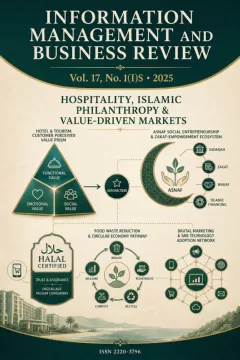 Vol. 17 No. 1(I)S (2025)
Hospitality, Islamic Philanthropy & Value-Driven Markets
View issue contents
Published
Submissions
Have research to publish? Information Management and Business Review welcomes submissions.
Make a Submission